
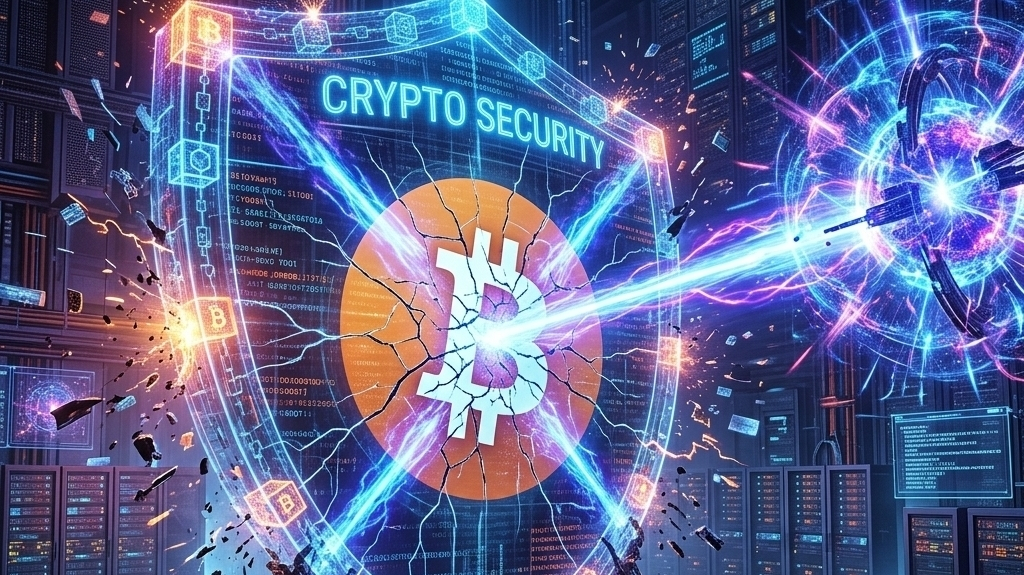
Crypto systems like Bitcoin are built on highly complex cryptography, such as RSA and Elliptic Curve Cryptography (ECC). These systems have been proven secure for decades… but that's assuming we're only dealing with ordinary computers.
Now, how does this threat work? To simplify, the process is quite clear, but the impact is significant.
First, hackers steal data that's still encrypted. This data could be transactions, crypto wallets, or even financial and government data.
Second, they don't use the data immediately, but store it first.
Third, they wait until quantum computing technology is powerful enough to break the currently secure encryption.
And fourth, when the time comes, they unlock and use the data.
This concept is often referred to as "store now, decrypt later." So, even though the attack isn't felt now, the process can actually begin today. This makes the threat feel closer than we think.
The targets are no small feat either. Everything from crypto wallets and transaction histories to financial and even government data could be targeted. Because, fundamentally, all of these are protected by the same cryptographic system.
So what about cryptocurrencies like Bitcoin and others?
Cryptocurrencies like Bitcoin rely heavily on cryptography, specifically Elliptic Curve Cryptography (ECC). This system maintains wallet security, ensuring that only the owner of the private key can access their assets. But if ECC were ever breached by a quantum computer, the consequences could be serious.
Wallets could be hacked, private keys could be reconstructed, and digital signatures could be forged. This means the trust system on which crypto is based could be compromised.
But there's one important thing to understand: quantum computers are currently too weak to do all of this. The technology is developing, but it hasn't reached the point where it could immediately destroy the global crypto system anytime soon.
So, this isn't an immediate crash scenario. It's not something that will cause the market to collapse tomorrow morning. Rather, it's a long-term threat that's slowly approaching.
So, what's the solution?
The solution the industry is currently pursuing is Post-Quantum Cryptography (PQC). This is a new type of algorithm specifically designed to remain secure even in the age of quantum computers.
Why is this important? Because we can't simply rely on legacy systems to deal with fundamentally different new technologies. PQC is like a major upgrade to the security system.
Currently, PQC development is being carried out by various major parties, including Google, NIST, and Microsoft. They are racing to create new standards that can be widely adopted, including by the crypto world.
The bottom line is simple: crypto must upgrade immediately before the attack actually occurs.
Because if we wait until quantum computers are powerful enough, it will be too late.
In my opinion, this is not the end of crypto, but rather a crucial phase in its evolution. Like any technology, those who can adapt will survive.
And here, we, as users or even traders, must at least understand the direction of change. Because even though the impact isn't felt now, the movement is already starting today.
Like and follow if you like this article