

One thought has been unsettling me lately.When crypto talks about governance, it usually starts with participation. Who gets to vote, who gets to represent, who can prove their presence inside the system. On the surface, that feels like the heart of governance. As if letting people in, letting them speak, and letting them prove their identity is enough for legitimacy to form on its own.@SignOfficial $SIGN #SignDigitalSovereignInfra
But I am not convinced that it is that simple.Because the real test of governance does not happen at the moment participation appears. The real test comes later. When someone asks: who approved this decision? On what basis? What were the steps in between? Where did the process change direction? And if something went wrong, can we look back and see a clear, attributable history of what happened?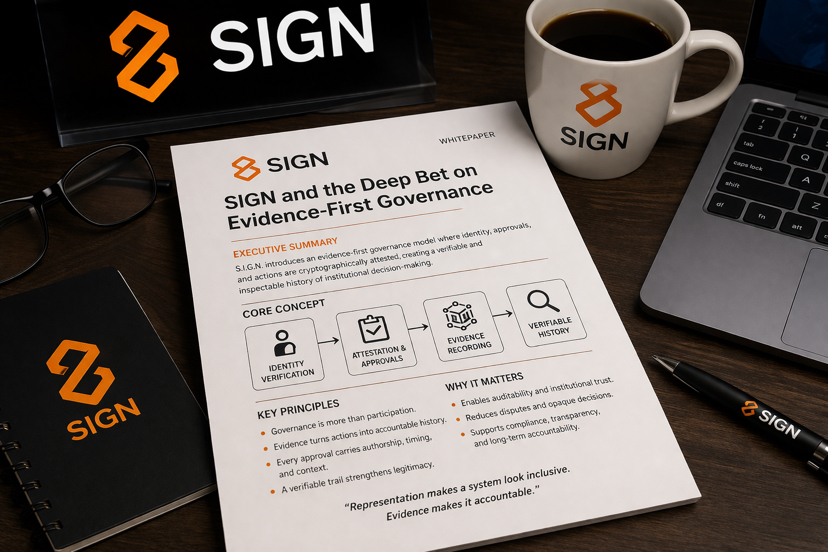
That question is what pushed me to look at S.I.G.N. more closely.Many systems treat participation itself as the foundation of legitimacy. Give someone a credential. Let them sign. Let them vote. Let them prove that they are a valid part of the system. That does one important thing: it tells the system who is allowed to act.
But it does not solve the harder question.How was power actually used?I think this may be where S.I.G.N.’s deeper thesis is hiding. Its real bet may not be identity alone, but evidence. Representation can make a system look inclusive. Only evidence can make it accountable.
Identity can say, “This person is a valid participant here.”But only evidence can say, “This decision came through this process, these people approved it, this was the sequence, this was the context, and the trail can still be verified later.”That difference is not small. It is the difference between governance that is symbolic and governance that becomes real.Because in the real world, institutions are not judged only by outcomes. They are judged by whether they can explain the process behind those outcomes. Especially when money, approvals, compliance, public access, grants, benefits, or institutional power are involved, it is not enough to say, “It worked.” The real questions are: how did it happen? Why did it happen? Who authorized it? And was the proper process actually followed?@SignOfficial $SIGN #SignDigitalSovereignInfra
If a system cannot show a clear history of that, legitimacy can still be weak even if participation is broad.That is why I think S.I.G.N. is touching something deeper.The interesting part is not simply that records can be verified. Many systems can say that. The more meaningful point is treating evidence as an operating layer of governance itself. In other words, governance is not reduced to one final action. It is tied to the approvals before it, the attestations, the sequence, the authorship, and a retrievable history that can still be inspected later.
That approach feels much more practical to me.Imagine a public grant program. An applicant proves eligibility. A reviewer confirms that the application satisfies the rules. Another authority approves the budget release. Later, a compliance team audits the process. From the outside, it may look as if every step happened properly.
But this is often where weak systems begin to fail.Identity lives in one system. Approval sits in another database. Payment records are stored somewhere else. Internal notes sit separately again. As long as everything is running smoothly, this fragmentation does not always show itself. But what happens when a dispute appears? When someone asks, “Why was this approved?” When a wrong payout goes through? When an auditor wants to reconstruct the full sequence afterward?
At that point, everyone has some record, but no one has the whole story.
That is one of the weakest forms of governance. A decision exists, but there is no defensible history behind it.
Now imagine that same flow designed around evidence-first governance.Eligibility is not just claimed; it exists as a structured attestation. Approval is not just a click; it carries authorship and timing. Budget release is not an isolated event; it is tied back to the approval chain before it. Later, when someone audits the process, they do not need a verbal assurance that things were handled properly. They can inspect the history. They can trace the sequence. They can test whether the decision actually followed the claimed process.At that point, governance is not just visible. It becomes inspectable.And inspectable governance has a much better chance of becoming accountable governance.
That is the part of S.I.G.N. that I find most interesting.Crypto has spent a long time assuming that legitimacy naturally emerges from participation and transparency. I am more cautious about that thesis now. Participation matters, but participation alone does not make an institution defensible. Transparency matters too, but raw transparency does not guarantee accountability. Sometimes seeing more data and understanding the right history are two very different things.
Institutional legitimacy often forms when actions leave behind a traceable, attributable, verifiable memory. Not social memory. Operational memory.
That is why I think the idea of evidence infrastructure becoming a core governance layer is not a light thesis. It is a serious one.
But that does not mean there is no tradeoff.Evidence-first systems are not easy to build. They require schema design, attribution logic, approval lineage, access control, and retrieval discipline. They make governance more structured. Sometimes heavier too. A good evidence layer can strengthen accountability. A bad one can trap the system in cryptographic paperwork, where the form exists but the clarity does not.
So I do not see this as an automatic win. I see it as a large but difficult bet.
If S.I.G.N. is right, the future of governance will not stay limited to the question of who participated. The bigger question will be whether a system can later show a verifiable history of institutional action.
That, to me, is the real testing point.What I want to see next is how the evidence layer performs under real pressure. What happens when approvals are disputed? How clear does the chain remain during exception handling? How usable is the history during cross-institution review? And how are older approvals interpreted when policy changes over time?
The model makes sense on paper. But the final test comes under scale and pressure.In crypto infrastructure, what creates legitimacy first: participation, or verifiable history?@SignOfficial $SIGN #SignDigitalSovereignInfra