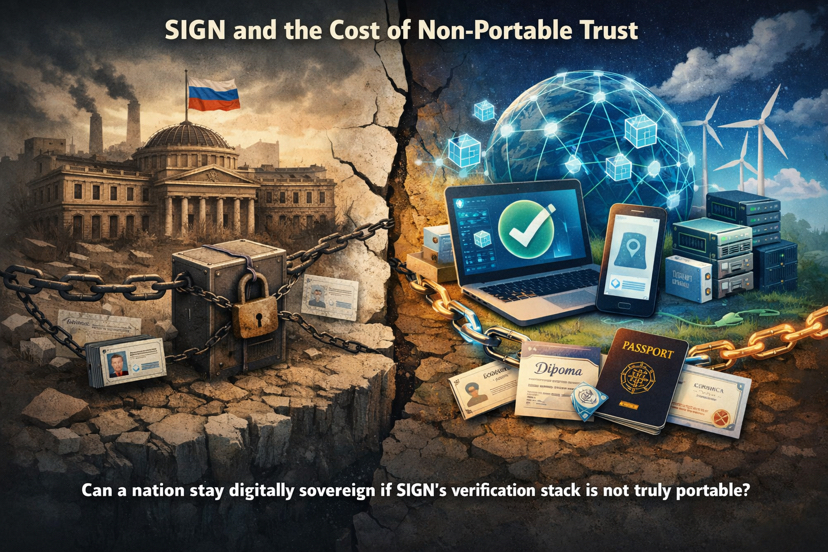
What happens to a national digital system when the vendor changes, the policy changes, or the political priorities change, but the verification stack does not move with them?Crypto often treats standards as a nice architectural virtue. Something clean. Something mature. Something engineers praise in whitepapers and then ignore when real deployment pressure begins. I am not sure that is good enough here.@SignOfficial $SIGN #SignDigitalSovereignInfra
When infrastructure starts touching public records, entitlements, compliance flows, and institutional coordination, portability stops being a design preference. It starts looking like a governance safeguard.
That is one reason SIGN seems worth watching.
Not because “open standards” sounds morally superior. And not because interoperability is a fashionable talking point. The more practical reason is simpler: systems that need to outlive vendors cannot afford to trap trust inside one implementation.
I think that point gets underestimated in crypto.A lot of blockchain discussion still assumes the hard part is getting verification on-chain. Maybe for small internet-native systems, that is enough. But for sovereign-scale or institution-facing infrastructure, the harder question may be different: can another operator, another agency, or even a future administration still read, verify, and use the same records without depending on the original builder forever? That is where standards start to matter.If verification formats are proprietary, if schemas are tightly coupled to one vendor’s tooling, or if attestations are only practical inside one closed workflow, then the system may look decentralized in theory while remaining operationally dependent in practice. That is not real resilience. It is outsourced continuity risk.
What makes this issue interesting in a project like SIGN is that the value is not only in proving something happened. The value is in keeping that proof reusable across changing institutions, changing software stacks, and changing policy needs.That sounds abstract until you make it operational.Imagine a government-backed credential or benefits system. In the first year, one vendor sets up how records get issued and checked. A couple of years later, regulators push for tighter privacy rules.In year five, a new contractor takes over part of the stack. In year seven, a neighboring institution wants to validate the same records for a different purpose under a revised policy framework.
If the trust layer was built on portable standards, the system has a chance to evolve without losing continuity.If not, every transition becomes dangerous.Records may still exist, but their meaning can become trapped. Verification logic may still run, but only in the environment that first defined it. Migration becomes expensive. Audits become harder. Policy updates begin to look like rewrite events instead of manageable changes. That is exactly the kind of hidden fragility public infrastructure should avoid.
This is why I think “future-proofing” is often misunderstood.People hear that phrase and imagine technical flexibility. New vendors. New APIs. Easier upgrades. That is part of it, but I think the deeper issue is institutional sovereignty. A state or public system should be able to change operators without losing the ability to verify its own records. It should be able to revise policy without invalidating the evidence layer underneath it. It should be able to integrate with outside systems without begging one incumbent vendor for translation rights.
That is not idealism. That is basic governance hygiene.And crypto, at its best, should actually be good at this.Open networks are supposed to reduce dependency on single gatekeepers. Shared standards are supposed to let independent actors verify the same state without asking permission. Portable attestations are supposed to make trust more durable than the companies building on top of them.
But there is always a gap between that theory and real deployment.A project can use blockchain language while still creating lock-in through tooling, formats, data models, or verification pathways that are difficult for others to reproduce. That is why I do not think “on-chain” alone solves the problem. A record anchored publicly is useful, yes. But if the surrounding verification structure is not portable, then part of the dependency just moves to another layer.
That is what I would watch with SIGN.Not only whether it can issue and verify records. Not only whether the architecture looks elegant in demo form. But whether the trust model remains legible and usable when institutions change hands, vendors rotate out, and rules evolve.
Because that is when standards stop being decorative.A small concrete example makes the point clearer. Say an education credential is issued under one administrative framework and later needs to be checked by a labor office, a scholarship board, and a foreign institution using different software stacks. If each verifier needs custom integration with the original operator, the system is not truly interoperable. It is merely centralized coordination wearing a decentralized label. But if the credential structure, attestation method, and validation rules are portable enough for independent verification across contexts, then the infrastructure starts to look more durable.
That difference matters more than crypto people sometimes admit.The strongest systems are not the ones that look permanent because one vendor stays dominant. They are the ones that survive replacement. They allow policy to evolve, operators to change, and institutions to adapt without breaking the continuity of trust.
That is also where the tradeoff appears.Open standards can slow teams down. They force design discipline earlier. They reduce freedom to invent purely bespoke flows. They may limit how much a single operator can optimize for its own stack. In the short run, tighter standardization can feel less efficient than building something custom and fast.
But for public or sovereign-facing infrastructure, that constraint may be the point.A system that becomes harder to exit is not automatically a stronger system. Sometimes it is just a more dangerous dependency.
So when I look at SIGN through this lens, the question is not whether it can help verify records today. The more serious question is whether it helps preserve institutional choice tomorrow.
Can records stay valid across operator turnover?
Can policy evolve without destroying interoperability?Can verification survive beyond the company that first shipped the stack?That, to me, is where open standards become politically real, not just technically elegant.And it is probably where digital sovereignty becomes harder than most vendor pitches suggest.So the question I keep landing on is this:
Can a nation stay digitally sovereign if SIGN’s verification stack is not truly portable?@SignOfficial $SIGN #SignDigitalSovereignInfra