
I’ve been trying to think through what the world actually looks like if Sign’s architecture succeeds.
Not the pitch version. The real version. Because I think most discussions about Sign stay at the level of “interesting infrastructure play” without pushing through to what happens downstream if the three national systems actually get deployed at sovereign scale across multiple countries.
I want to try to map that out. With the caveat that I’m speculating from architecture documentation, not from live deployment data.
Start with the New Money System. If a significant number of countries deploy CBDC and regulated stablecoin infrastructure on Sign’s national rail, with Sign Protocol as the shared evidence layer, something interesting happens to interoperability. Right now, cross-border digital payments are slow and expensive because every pair of countries needs bilateral agreements, correspondent banking relationships, and reconciliation processes between incompatible data formats. ISO 20022 is helping with the data format problem. But the trust layer, the ability to verify that a payment on the other side of the border was authorized, compliant, and executed correctly, still requires institutional relationships.
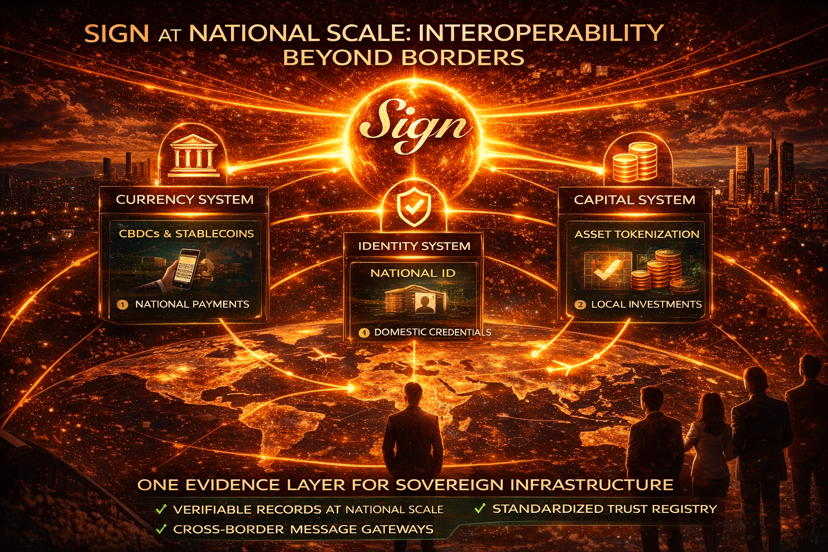
If two countries both run Sign Protocol as their evidence layer, that trust question gets a different answer. The attestation that proves a payment was executed under approved policy parameters is readable by any party with access to the evidence layer, regardless of which country issued it. I kept coming back to this when reading Sign’s documentation on interoperability via bridging and messaging gateways. The architecture assumes interoperability needs to be handled explicitly. But the open standards underneath, ISO 20022, W3C credentials, Sign Protocol schemas, create the conditions for something more organic.
Actually, I want to be careful not to overstate this. Two countries running Sign infrastructure doesn’t automatically produce cross-border interoperability. It produces compatible infrastructure that could enable cross-border interoperability if the governance agreements follow. The technology is a necessary condition, not a sufficient one.
But it’s still meaningfully different from what exists today.
The New ID System implication is the one I find hardest to fully think through. National identity is deeply political. Countries don’t share identity infrastructure. They barely share identity data under bilateral agreements that take years to negotiate. The idea that a verifiable credential issued by Country A’s identity authority could be presented and verified in Country B without a bilateral agreement sounds implausible at first.
Then I think about what actually makes it implausible today. It’s not the cryptography. The cryptography for cross-border credential verification has been solved. It’s the trust layer. Country B has no way to verify that Country A’s issuing authority is credible, that the credential was issued under appropriate standards, that the underlying identity data was accurately verified.
Sign’s trust registry model doesn’t solve the political problem. But it does create a framework where Country B could, if it chose to, inspect Country A’s issuer registration, their key material, their schema definitions, and their attestation history. The information needed to make a trust decision is available in a way it isn’t today. Whether countries make that trust decision is a political question. Sign’s architecture at least makes it technically possible.
I’ve been thinking about the New Capital System implications for longest. Regulated real-world asset tokenization with cross-border verifiable identity is a combination that doesn’t fully exist anywhere today. A tokenized government bond that can be purchased by a verified foreign investor whose identity credentials are readable by the issuing country’s compliance infrastructure. A cross-border grant program where eligibility credentials issued in the recipient country are verifiable by the donor country’s distribution system.
These are not scenarios Sign’s documentation describes explicitly. But they are architectural consequences of what Sign is building.
The $SIGN token sits inside all of this in a way that I think deserves more attention than it usually gets. If Sign Protocol becomes the evidence layer for national systems across multiple countries, the token’s utility is embedded in infrastructure that is genuinely difficult to replace. Governments don’t rotate their foundational infrastructure the way users rotate apps. The switching costs are enormous. The attestation records produced under Sign Protocol schemas are tied to the protocol’s data structures. Migrating them to a different evidence layer would require re-issuing every credential and re-producing every attestation in a new format.
That stickiness is not something most infrastructure tokens can claim honestly.
Binance’s ecosystem is relevant here in a specific way. Binance Square has become the most active global community tracking sovereign digital infrastructure developments. YZI Labs, formerly Binance Labs, is positioned in exactly the emerging markets where Sign’s first sovereign deployments are most likely. If Sign becomes the evidence layer for even two or three significant national programs facilitated through YZI’s network, the proof of concept changes the conversation for every other sovereign deployer evaluating the architecture.
Personally, I think the most underappreciated implication is the audit one. Right now, international financial institutions, the IMF, the World Bank, development finance institutions, spend enormous resources trying to verify that funds disbursed to sovereign programs were used correctly. The evidence is always incomplete. Audit trails are reconstructed from paper records and vendor reports that were never designed for external inspection.
A sovereign capital program running on Sign’s New Capital System produces evidence manifests that are structured, on-chain anchored, and queryable through SignScan in real time. An international auditor doesn’t need to wait for a country’s annual report. They query the attestation layer directly.
Of course, that only works if the country actually deploys Sign’s architecture and maintains the evidence layer with integrity. And that’s a governance problem that no protocol can solve alone.
I don’t have a neat conclusion here. The implications of Sign working at national scale are genuinely hard to map fully. Some of them are obvious and valuable. Some of them, the cross-border identity and capital implications, are almost too consequential to think through cleanly from documentation alone.
That’s probably the most honest thing I can say about where this goes if it works.