
Random thought today what if trust actually had a visible cost like gas fees 🤔 because right now everyone is paying for it, just not in a way you can measure clearly. Time delays, repeated verification, legal back and forth, all of that is cost, but since it is invisible, people ignore it.
Take a simple case 👇 a company expands into the Middle East, they already passed KYC and verified documents before, but a new partner means a new process, a new jurisdiction means new validation, and a new deal means repeating everything again. It is basically paying gas, but with time instead of money and nobody really questions why this loop exists.
Another angle 📊 in Web3 we always talk about trustless systems, but the moment you step outside pure onchain activity, everything becomes fragmented again. Documents, signatures, authority, all disconnected and constantly rechecked. So the system is not fully trustless, it is half efficient, half repetitive.
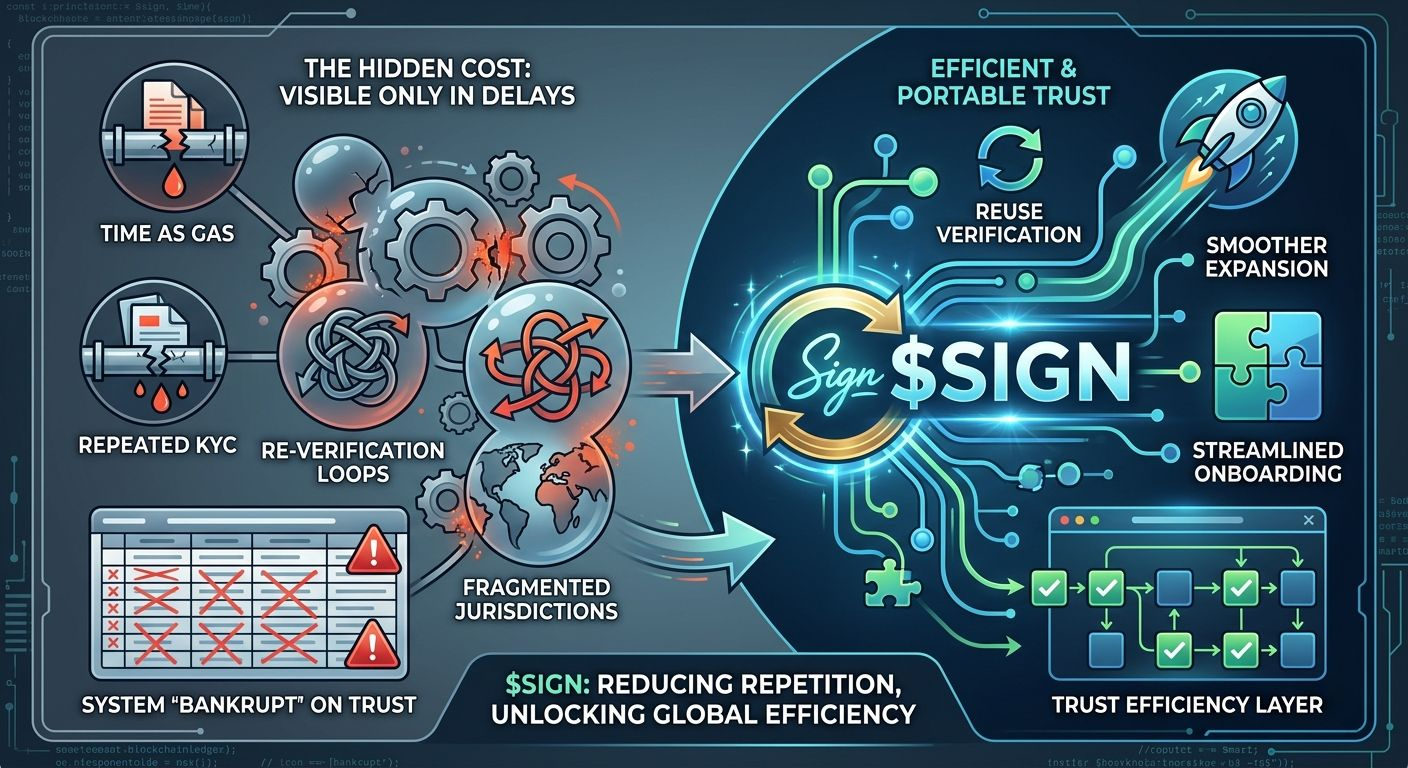
This is where $SIGN started to make more sense to me, not as something flashy, but as something practical 🧩 instead of making things faster, it focuses on removing repetition by allowing verification to be reused across different contexts rather than restarted every time.
If this actually works at scale cross border expansion becomes smoother, onboarding becomes faster, and partnerships do not get stuck in endless verification loops. It does not sound exciting, but neither did most infrastructure before it became standard 😅 and that is usually how these layers win over time.
Maybe I am overthinking it, or maybe the market is too focused on visible metrics and ignoring invisible inefficiencies. Which side are you on?