
Altcoins have encountered their bleakest moment since the FTX collapse, but this also represents an undervalued investment opportunity.
DeFiance Capital CEO Arthur Cheong stated on X that this may be the bleakest period for altcoins since the FTX collapse in November 2022. More than half of the trading varieties are at historic lows, and even though Bitcoin has seen a rebound, they show no signs of stopping their decline. However, for investors with a horizon of over a year, the current market is nurturing severely undervalued investment opportunities.
NYDIG: Factors driving Bitcoin demand have reversed, but the long-term trend remains unchanged.
NYDIG research director Greg Cipolaro pointed out in the latest report that inflows into cryptocurrency ETFs and DAT demand previously drove Bitcoin prices to historic highs, but currently, these factors have led to price declines. He mentioned that the liquidation event in early October triggered outflows from ETFs, a significant drop in DAT premiums, and a reduction in stablecoin supply, indicating that funds are withdrawing from the market. Spot Bitcoin ETFs were once the highlight of this cycle but have now become a hindrance to Bitcoin's development. Nevertheless, global liquidity and macroeconomic dynamics still affect Bitcoin. Bitcoin's dominance typically rises during cyclical corrections but has now fallen from over 60% in early November to about 58%. Cipolaro emphasized that despite the market correction, there is still some cushion in the DAT space, and no signs of financial distress have appeared. He believes the long-term outlook for Bitcoin remains optimistic, but warns investors to prepare for potential risks.
The U.S. economic data is showing significant deviations, and the Federal Reserve is facing policy challenges.
On November 24, an unusual phenomenon occurred in the U.S. economy. Data from the Labor Department shows that jobs decreased in June and August, with an average of about 62,000 new jobs added over the three months ending in September. Despite a weak labor market, worker productivity and Gross Domestic Product (GDP) remain high. Economists believe it is uncertain whether interest rate cuts can offset the impact of policy changes on hiring. Ryan Sweet, chief U.S. economist at Oxford Economics, stated that without job expansion, a recession could occur, but good productivity growth could support economic expansion in a low-employment situation.
Many members have asked whether Bitcoin's rise from 80,000 to 88,000 marks the beginning of a market reversal.
No, from a positional perspective, if the market is to reverse in a V shape, we should have seen consecutive engulfing large green candles entering after last week's spike. This is a signal of strong buying interest, but the market has not shown this performance. Instead, there are more small green candles rising accompanied by selling pressure, which is a clear rebound caused by short sellers taking profits—it's merely a rebound.
Since the market is not in a V-shaped reversal pattern, it will certainly be a consolidation zone. Whether it moves in a rectangular or wedge-shaped rebound or some other consolidation structure is uncertain. However, it is certain that if the market wants to achieve a significant rebound, there will inevitably be a demand for a second test or even refreshing the lows. This applies to the overall trend for this week; for the monthly chart, refreshing the lows again next month is also a high-probability event.
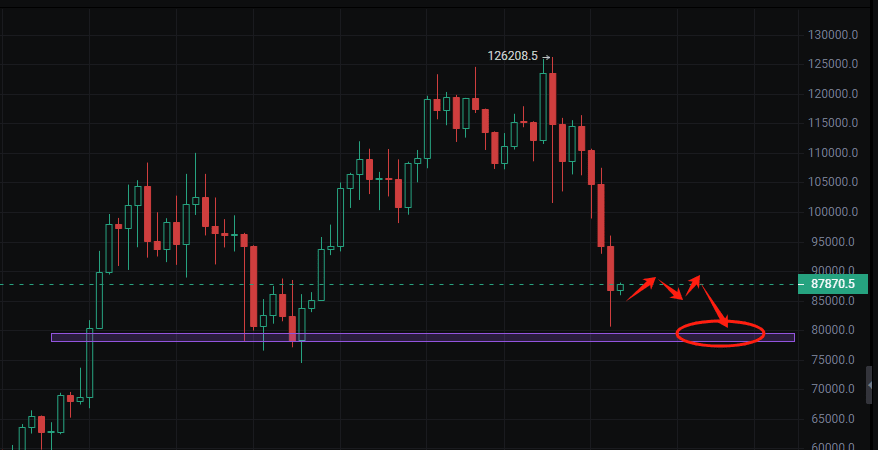
There is an expectation for Bitcoin to test the bottom again or even refresh its lows. Any resistance to the rebound is our opportunity to enter short. Currently, the daily chart shows the first green candle after a spike, but the body is small and does not represent strong momentum. Therefore, it is possible to aggressively test short positions here. If there is an unexpected rebound and the daily chart closes with two consecutive green candles again, then tomorrow’s opening will be our best entry point. In most cases, the third day will show a engulfing downward move; the market is merely a structure that entices buyers.
Many people have already started bottom-fishing. Perhaps the rebound will bring you short-term floating profits, but this is only temporary. Don't think that dropping below 90,000 is the bottom; it may just be the beginning stage of the decline. This round of decline may exceed most people's understanding, retail investors can't withstand the losses and are exiting, and institutions are also cashing out. The so-called long-termists are merely shouting slogans during the rise; when the real test comes, few can endure. This is human nature and the unchanging law of the market. Are we truly in extreme panic now? I think not; there are still many people in the market who are extremely bullish. As long as the last line of defense is not broken, these false believers cannot be washed out.
If you are feeling uncertain about the future, I will share strategic layouts with a small circle! Welcome to join our family to grasp the next hotspots and maximize investment returns together!