

The head of the Federal Reserve of the United States, Jerome Powell, outlined some key points on monetary policy and the state of the economy. During his speech today at Harvard University in Cambridge.
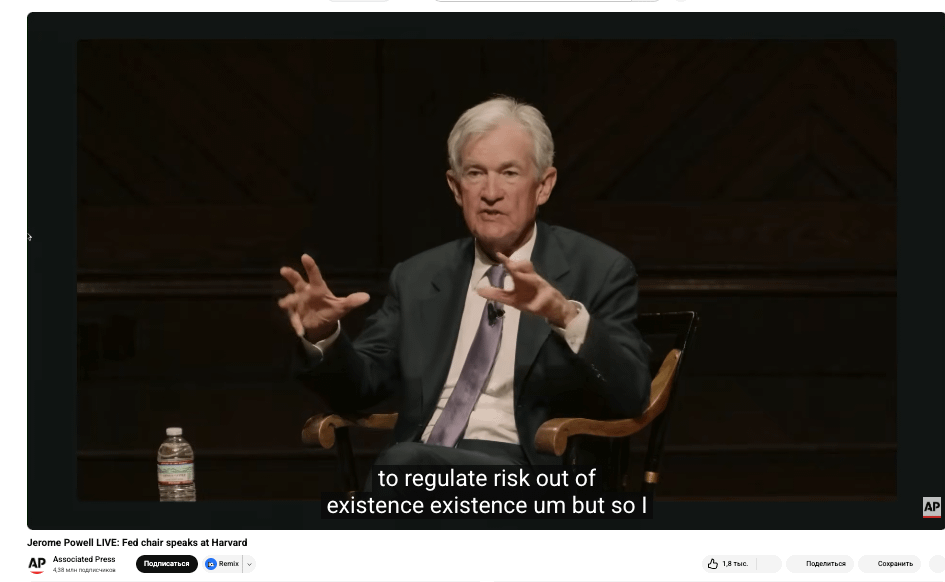
The speech cannot be definitively called "dovish." But it is certainly not a "hawkish" stance either. Powell made several positive remarks about the state of the American economy, while also making it clear that the labor market is clearly not in a strong position (which is positive for the prospects of rate cuts).
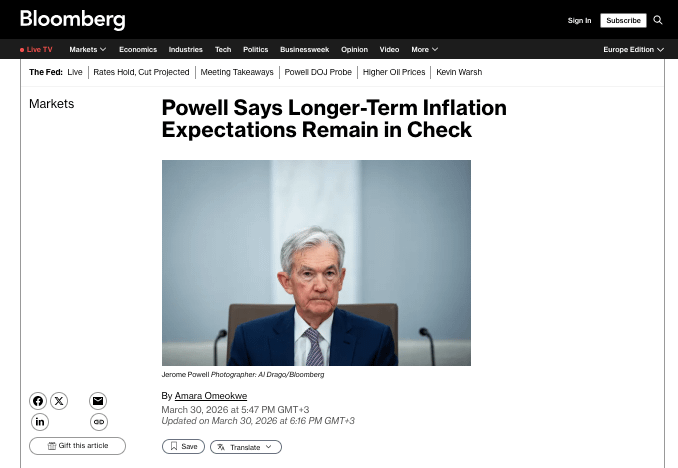
#Bloomberg highlighted Powell's words that long-term inflation expectations are under control. The text added that the Fed is closely monitoring them, assessing the impact of the US and Israeli war against Iran.
Key takeaways from the speech:
- There is a contradiction between the two goals of the Fed (controlling inflation and supporting the labor market).
- Inflation expectations have firmly settled beyond the short-term outlook.
❗️- We intend to bring inflation back to a stable level of 2%.
- Inflation caused by the introduction of tariffs is likely a one-time price spike. It will lead to an increase in inflation of 0.5-1.0%.
- We have not yet observed the inflation growth risks associated with the Fed's large balance sheet that many predicted.
❗️- We must not try to completely eliminate risk through regulation.
- The Fed's tools do not have a significant impact on supply shocks.
- The monetary policy of the Fed is currently in a favorable position.
❗️- It is better to wait and see how the situation develops.
- Research shows that purchasing long-term assets (in the context of the speech - referring to government bonds, - ed.) lowers interest rates and supports the economy.
- We do not know what economic consequences the current situation will have.
- Events in the Middle East affect gasoline and gas prices. We do not know how strong the energy shock will be; it is still too early to judge.
- We currently have a stable financial system.
- We have significantly strengthened the system against the losses that occurred during the financial crisis.
- The US economy remains dynamic and productive.
❗️- I am very optimistic about the medium-term and long-term outlook.
- Private credit constitutes a relatively small part of the vast pool of assets (in the context of issues at companies engaged in private lending, - ed.). We are closely monitoring the situation with private sector lending. So far, there are no signs of a larger systemic crisis.
- Creating great democratic institutions is very difficult, but destroying them is much easier.
❗️- Long-term, fundamental factors are putting pressure on the labor market. It cannot be denied that a difficult period has emerged for entering the labor market.
- AI increases human productivity.