


1. Why does the Middle Eastern narrative amplify the value of Sign?
The Middle East (especially the UAE and Saudi Arabia) is advancing something: digitizing and integrating finance, identity, assets, and compliance. This includes:
• Stablecoins / CBDC
• RWA (real estate and energy assets on the chain)
• Digital identity (KYC, national identity systems)
• Electronic signatures and compliance approvals
The problem is: when these systems start to integrate, the real bottleneck is no longer the 'chain' or 'assets', but how the institutional processes themselves are digitally expressed.
In other words, the system needs to answer:
• Who approved this fund?
• Does it comply with regulatory rules?
• Has the asset undergone compliance review?
• Is this distribution executed according to the rules?
These questions are essentially not transactional issues, but rather the issue of **'verifiable institutional behavior records'**.
II. The essence of Sign: not a protocol, but the expression language of the system
According to the white paper, the core of Sign Protocol @SignOfficial is two things:
• Schema (structure): defines 'what is a compliant behavior'
• Attestation: recording 'this behavior occurred'
For example:
• “A certain user through KYC”
• “Certain fund allocations have been approved”
• “Certain assets comply with regulatory rules”
All these are transformed into signable, verifiable, and queryable structured data.
The key point is:
This is not a business logic, but a standardized expression layer for institutional execution.
III. From application layer products to middleware infrastructure
Most traditional Web3 projects remain at:
• Wallet (entry)
• DeFi (finance)
• NFT (asset representation)
But Sign's positioning is closer to:
👉 The 'verification and recording layer' that connects all systems
In the S.I.G.N. architecture, it supports three major systems:
• Money (fund flow)
• ID (identity)
• Capital (assets and allocation) 
This means:
Whether it is payments, identity verification, or asset distribution, ultimately requires a layer of unified 'evidence recording system'.
This is the typical characteristic of middleware:
• Not directly facing users
• But all systems rely on it
• Once a standard is formed, it has strong stickiness
IV. Mapping real demands in the Middle East scenario

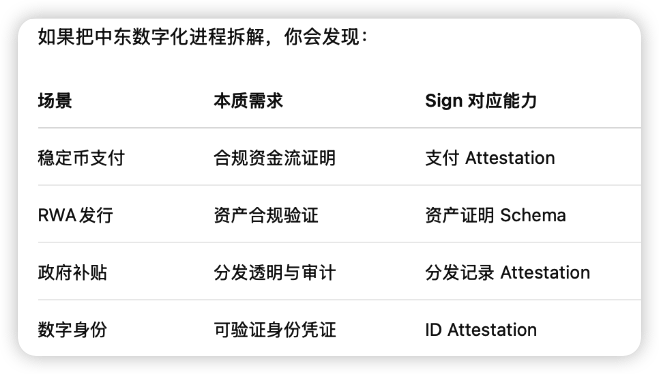
These systems have one thing in common:
👉 Must be 'auditable, traceable, and verifiable'
And this is the core goal of Sign's design:
Turning all 'statements' into 'evidence' that can be repeatedly verified. 
V. Why is this not a short-term narrative?
The current market pricing of SIGN remains at:
• Airdrop tool (TokenTable)
• Signature tool (EthSign)
• Web3 identity infrastructure
But from an institutional perspective, it looks more like:
A combination of the 'database + audit log + notarization system' of the Web3 world
Once entering national-level or regional-level systems:
• The replacement cost is extremely high
• Data migration difficulties
• Once a standard is established, it has path dependence
The value of such projects does not come from user growth, but from:
👉 Depth of institutional embedding
VI. Conclusion: Where is Sign's true odds?
If you still consider SIGN as:
• One coin
• An application
• An airdrop tool
Its ceiling is indeed limited.
But if viewed as:
The 'connection layer' in digital institutional infrastructure
Its potential depends on:
• Whether to enter sovereign-level systems
• Whether to become a cross-system standard
• Whether to carry a unified format of 'trusted record'
The essence of the Middle East narrative is not the influx of funds, but the acceleration of institutional digitalization.
And in this process, what is truly scarce is not the chain, but:
The ability to turn the 'rule execution process' into a machine-verifiable structure
This is exactly where Sign is most worth re-evaluating.