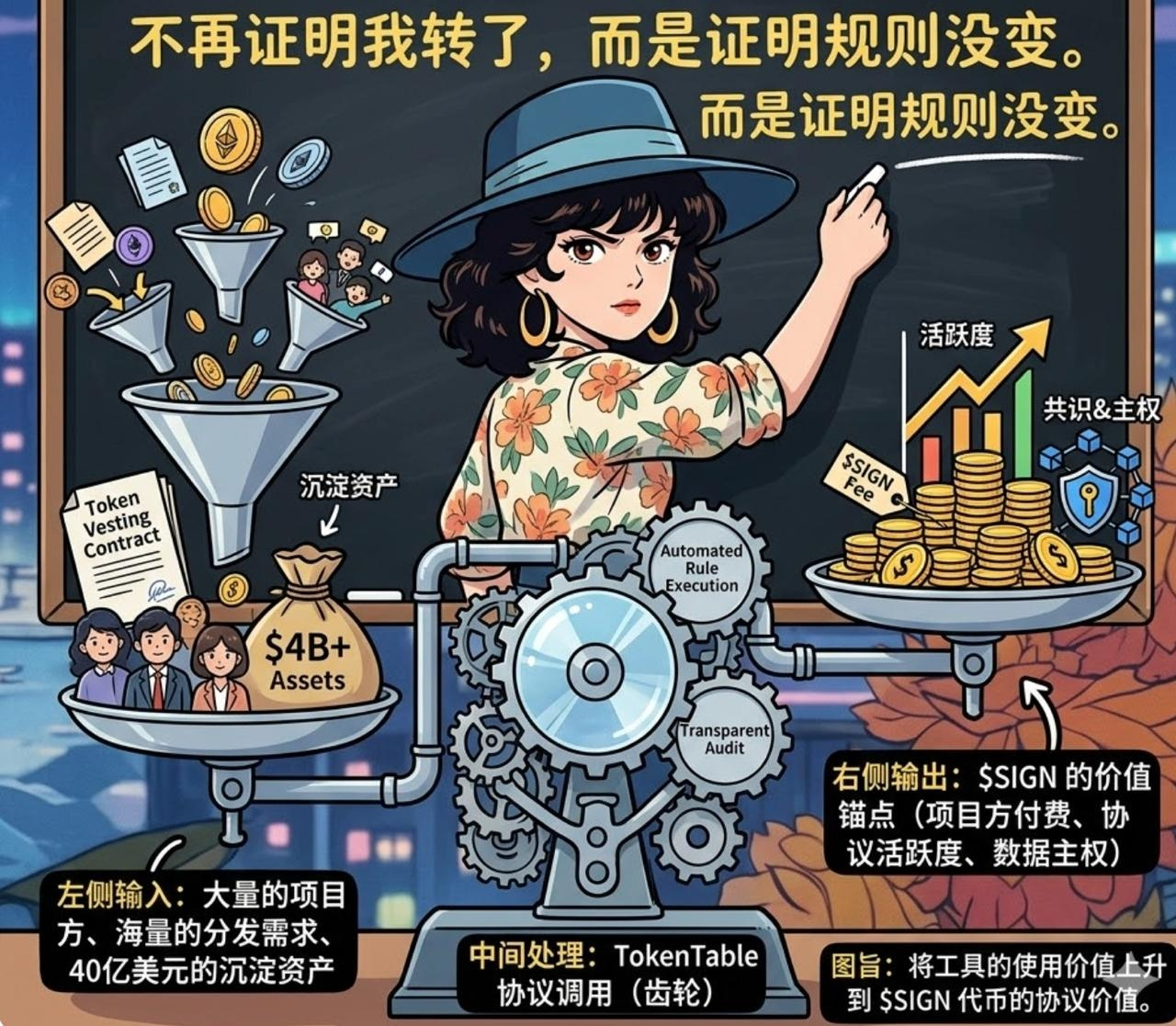
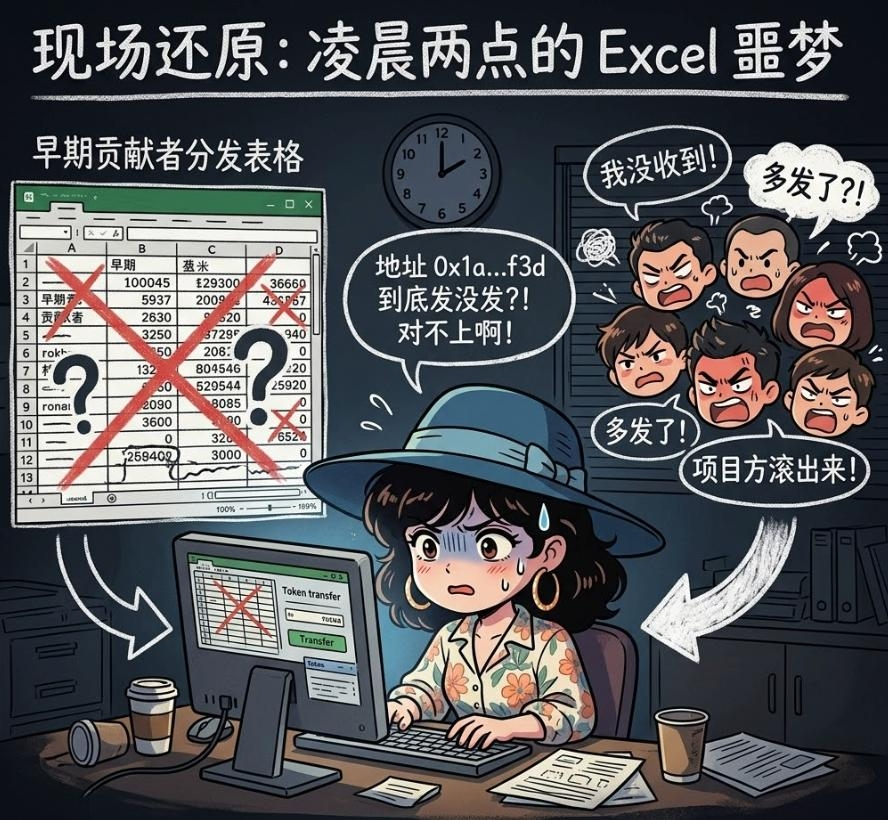
Last month, I helped a DeFi project as a consultant. The founder messaged me at two in the morning: the token lock-up period is over, and we need to unlock for 200 early contributors. I checked the table three times, but still, 12 addresses didn't match. Some said they didn't receive it, some said they received too much, and the community is already starting to curse!
My first reaction after reading it wasn't to help him check the table, but rather to feel that this situation was too familiar. After a while, there will always be some project that falls into the same pit again. Change the project name, change the token name, but the script is still the same script.
Later, he asked me a question, and I felt like he hit the nail on the head.
Bank transfers have never relied on manual checks one by one; why, despite being more transparent, do on-chain distributions still face disputes every day?
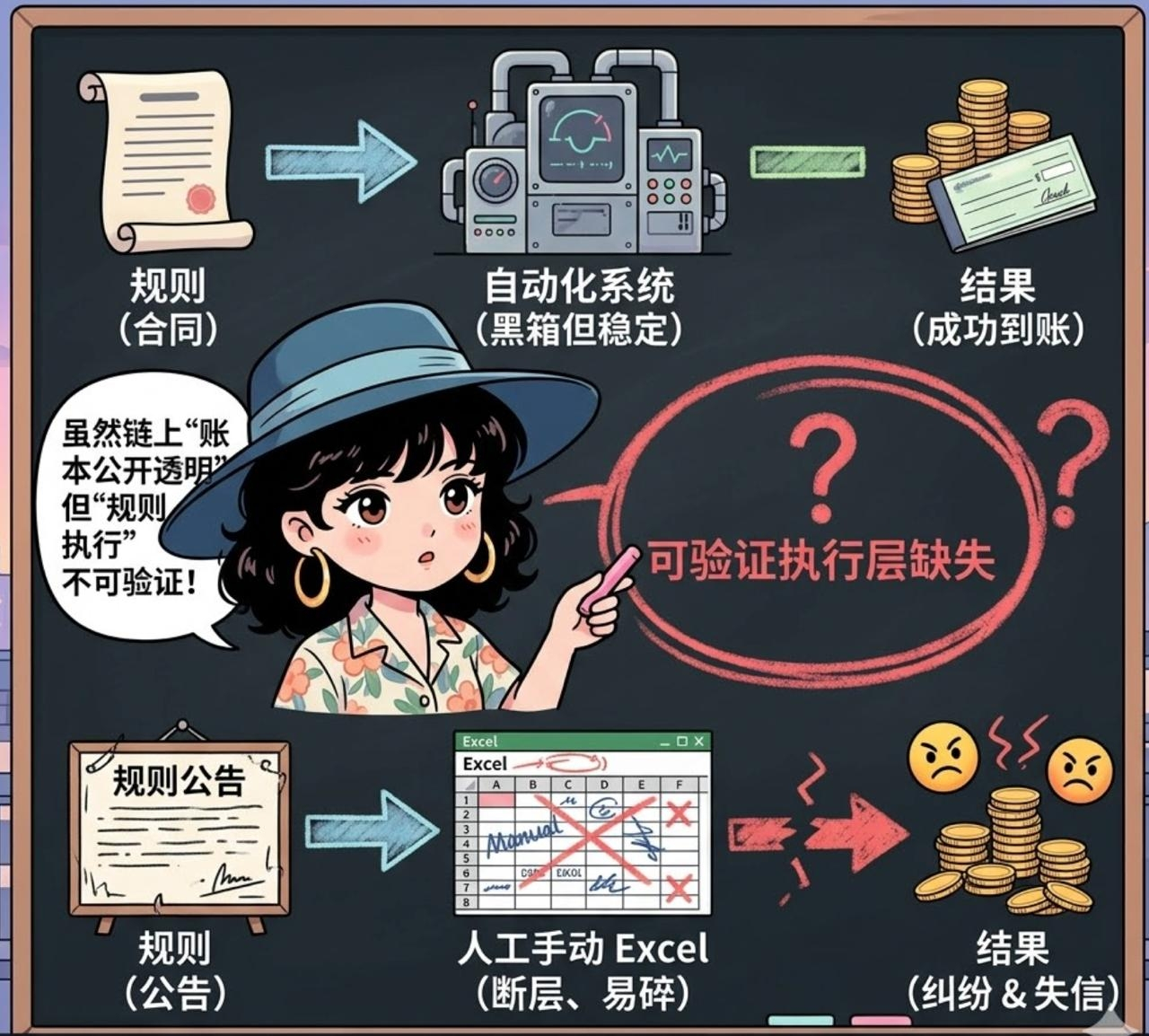
Upon careful thought, the problem does not lie in whether the chain is transparent, but rather in the missing layer in the middle: verifiable execution rules.
You go to the bank to make a fixed deposit, and when it matures, it automatically transfers the money. It's not some teller temporarily grabbing a form and manually entering it one by one, but the system runs automatically according to the rules signed at the beginning. Who gets how much, when it matures, and how the money moves, are all predetermined.
But many projects' token distributions are not like this.
The common practice in reality is: pulling Excel offline and manually transferring online. Who gets how much, when it unlocks, and whether there is over or under issuance all depends on the project party to organize and execute themselves. When problems arise, the project party says they transferred according to the spreadsheet, users say they didn't receive it, and in the end, no one can clarify.
So when I later looked at @SignOfficial 's TokenTable, I realized it's not about making token issuance more convenient, but rather about filling in that layer which is most prone to disputes.
It's not a simple token distribution tool; more accurately, it is a verifiable distribution protocol.
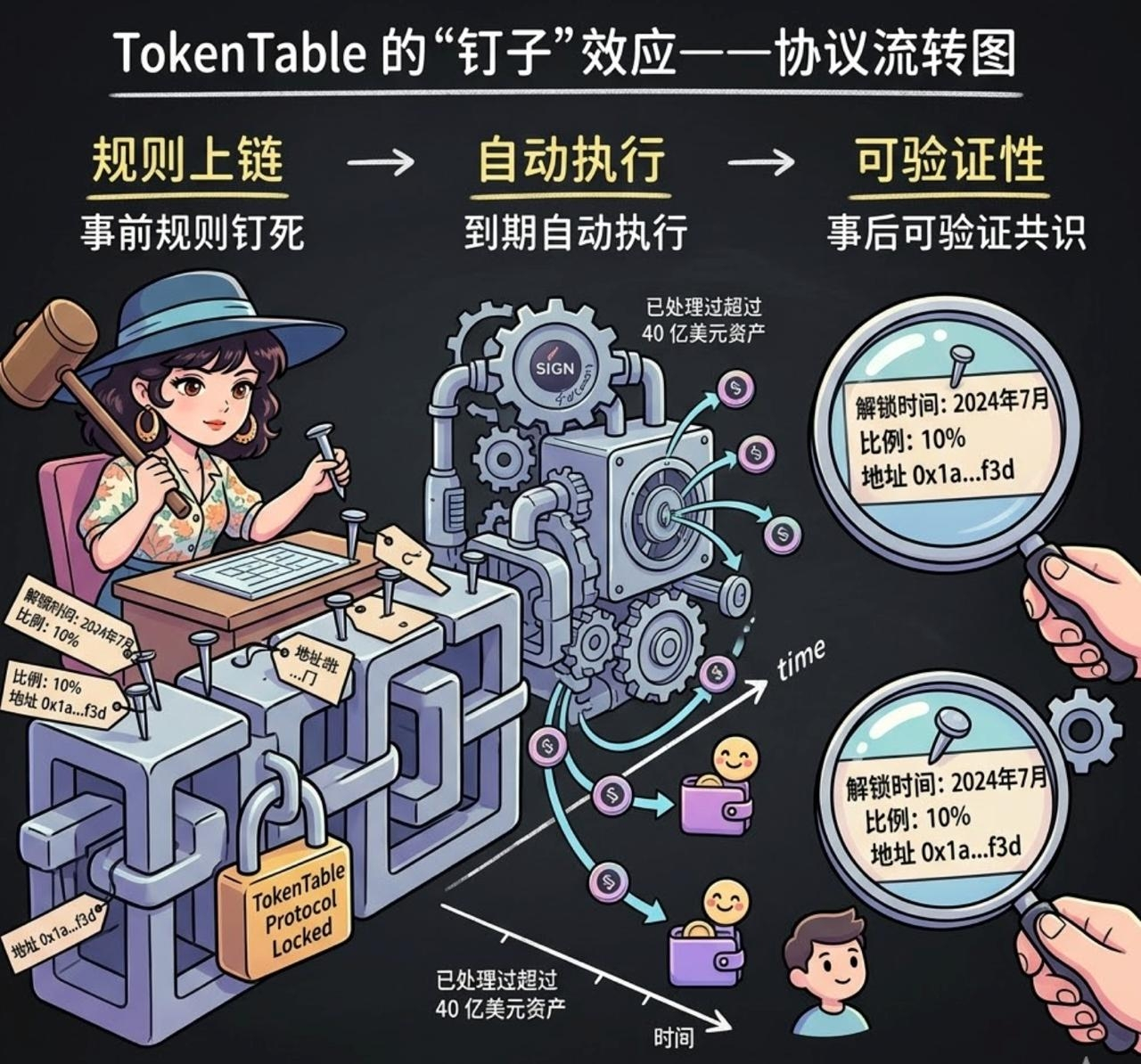
You first write the lock-up period, unlocking time, the amount corresponding to each address, and the distribution rules all on-chain, and after the maturity, the system executes automatically according to the rules. It's not about the team staying up all night to process 200 transactions, nor about the community waiting for the project party to come out and explain, but rather the rules being locked down from the start and running accordingly.
The most crucial point in this is,
In case of disputes, either party can check for themselves whether the rules have been changed and whether execution is according to the original rules.
The biggest difference from traditional project distributions is not that it is more automated, but that it moves the cost of trust from post-event disputes to pre-event consensus.
The previous model was,
Execute first, reconcile later if there are issues.
The current model is,
Nail down the rules before execution, and then let it run automatically according to those rules.
The difference between these two is actually quite significant.
For the project party, what's saved is the most headache-inducing operational accidents.
For users, what's saved is the most disgusting feeling of uncertainty.
Many people participating in early projects are most annoyed not by the lock-up, but by the fact that they have no idea when they will unlock, how much, or whether the rules have been secretly changed. The project party says it is based on the announcement, and the community can only wait.
The benefit of something like TokenTable is that the timeline, unlocking rhythm, and quotas can all be seen clearly in advance. Users can calculate it themselves, without waiting for the project party to notify and without betting on whether the project party will have a conscience at that time.
Looking at $SIGN from this scenario, the logic is also very clear.
The project party pays based on distribution volume; the larger the distribution scale and the more complex the rules, the higher the protocol call volume. TokenTable has now processed over $4 billion in asset distributions, and this number represents not just a narrative but a series of real distribution actions that have occurred.
To put it bluntly, $SIGN what you experience here is not whether the market thinks this story is good or not, but the actual protocol calls that are truly happening in these projects.
That founder later changed the second round of unlocking to TokenTable, resulting in zero disputes.
He later said something that I think has already explained this matter thoroughly,
In the past, I manually proved that I transferred it, but now it's automatically proven on-chain that the rules haven't changed.
I think this is the truly valuable aspect of such protocols.
It's not about saving you a few people in labor, nor about creating a better-looking backend, but about locking down that layer which is most prone to failure and finger-pointing in advance.
The most problematic aspect on-chain has never been whether there was a transfer, but rather what rules were followed for the transfer, which was never nailed down from the start.