
On March 26, 2026, the cryptocurrency market displayed a volatile consolidation trend. Bitcoin hovered around $71,000, with Bernstein analyst Gautam Chughani stating it has "bottomed out" and reaffirming a target price of $150,000 by the end of the year; Ethereum traded around $2,165, with exchange reserves hitting a new low since 2016, over one-third of the supply locked in staking contracts. This Friday, $18.6 billion in Bitcoin options will expire, potentially serving as a key catalyst to break the $75,000 resistance or retest the $65,000 support. The probability of the Federal Reserve maintaining interest rates in April is as high as 94.8%, with the macro liquidity environment still presenting a "higher for longer" pattern.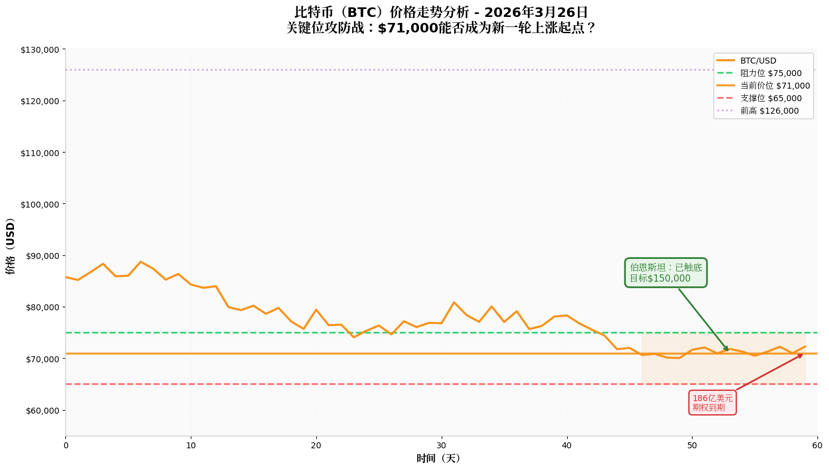
I. Market Overview
Bitcoin (BTC) is currently priced around $71,000, with an intraday fluctuation range between $70,000 and $71,500. Since breaking below $80,000 at the end of January, Bitcoin has oscillated between $65,000 and $75,000 for over seven weeks. Bernstein stated in a report this week: "Bitcoin appears to have bottomed out and is now starting an upward trend," maintaining a target price of $150,000 by the end of 2026. Notably, the net outflow of spot Bitcoin ETFs has reversed, with current ETF holdings accounting for about 6.1% of total supply, showing signs of net inflow from institutional funds.
Ethereum (ETH) is currently around $2165, with slight fluctuations in the last 24 hours. On-chain data indicates that Ethereum's exchange reserves have fallen to their lowest level since 2016, with more than one-third of the circulating supply locked in staking contracts, providing structural support for prices due to supply tightening. However, CryptoQuant data also shows that as of March 2026, 38% of altcoin prices are close to historical lows, even exceeding 37.8% after the FTX collapse in 2022, marking the largest drawdown in this cycle, indicating that crypto assets other than Bitcoin still face severe liquidity challenges.
II. Macroeconomic and Policy Environment
In terms of monetary policy, the CME FedWatch tool shows that the market views a 94.8% probability that the Federal Reserve will keep interest rates unchanged at 4.25%-4.50% during the April FOMC meeting. This indicates that the market has fully digested the expectation of "higher for longer" monetary policy, making it unlikely that the April meeting itself will be a significant source of volatility. However, based on the experience from the pause period from July 2023 to September 2024, Bitcoin rose from around $29,000 to over $60,000 during the 14-month interest rate pause, indicating that as long as the market believes that rate cuts will eventually come, crypto assets can still rise in a high interest rate environment.
In terms of regulatory dynamics, the U.S. Senate recently held hearings on the (2026 Capital Markets Technology Modernization Act) discussing investor protection issues for tokenized securities; the UK Independent Government Committee has suggested suspending political donations in cryptocurrency to prevent foreign funds from infiltrating the political system through untraceable digital assets. Longer-term, Ethereum developers have formed a dedicated "post-quantum" team aimed at protecting the network from potential threats of quantum computing by 2029.
Geopolitical risks continue to affect the market. During the US-Israel-Iran conflict, Bitcoin has outperformed gold and stocks, rising more than 6% since the outbreak of the conflict, while gold has fallen 15%, highlighting its "digital gold" safe-haven attribute is being re-priced by the market.
III. On-Chain and Funding Data Interpretation
ETF Capital Flows: Data from March 24, 2026, shows that overall crypto ETFs are experiencing inflows, with a net inflow of approximately $104 million in a single day, of which Fidelity's FBTC performed strongest with a single-day inflow of $83.3 million. This trend sharply contrasts with the large outflows at the beginning of the year, indicating that institutional allocation demand is warming up.
On-chain holding structure: CryptoQuant data shows that the demand for Bitcoin treasury is currently almost entirely driven by Strategy (formerly MicroStrategy). In the past 30 days, the company has purchased 45,000 Bitcoin, while other companies have collectively bought a negligible amount. This demand structure driven by a single entity reflects institutional confidence in Bitcoin and suggests that market breadth still needs improvement.
Short-term Holder Dynamics: Glassnode data shows that the Bitcoin short-term holder NUPL (Net Unrealized Profit/Loss) indicator has entered the loss zone, indicating that investors who bought recently are under pressure from unrealized losses. Historical experience suggests that surrender events among short-term holders often signal the market entering a reset phase, usually laying the foundation for a new round of asset accumulation.
IV. Technical Analysis
Key Bitcoin Price Levels: Currently, the $71,000 level is a critical point in the battle between bulls and bears. The upper resistance is at $75,000, which is the recent oscillation range's upper limit; if it can hold this position after the $18.6 billion options expiration on Friday, it is expected to open up space towards $80,000 and the previous high of $126,000. The lower range of $65,000 to $68,000 is a dense trading area, providing strong support; breaking below may trigger a deeper correction. The parabolic SAR indicator shows that the upward trend has not yet ended, but caution is advised near the $110,000 round number due to profit-taking pressure.
Ethereum Technical Pattern: ETH/USD is operating within a descending channel, with short-term moving averages in a bearish arrangement. The $2165 level serves as a watershed for bulls and bears, with the upper resistance at $2195 and the lower key psychological level at $2000. Notably, despite price pressure, the continuous decline in exchange reserves implies that selling pressure is weakening; once the macro environment improves, supply tightening may trigger a rapid rebound.
V. Operational Strategy Recommendations
Spot Investors
Bitcoin: The current $71,000 area can be considered a reasonable range for mid- to long-term allocation. It is recommended to adopt a phased entry strategy, entering in three batches within the $68,000 to $72,000 range, with each batch accounting for 30%-35% of the position, reserving 10%-15% of funds for extreme market conditions. Set the stop-loss below $64,000, with the first target at $80,000 and the second target at $100,000.
Ethereum: A trial position can be established near $2160, controlling the position within 20% of total funds. If the price retraces to $2000 with shrinking volume, the position can be increased to 30%. Set the stop-loss at $1850, with the first target at $2500 and after breaking through, the psychological level of $3000.
Altcoins: Currently, 38% of altcoins are close to historical lows, but in an environment of weak liquidity, it is not advisable to blindly buy the dip. Focus should be on the RWA (Real World Assets) sector and AI concept tokens that have actual revenue support, with position limits controlled within 10% of total funds.
Derivatives Traders
Bitcoin Options: The expiration of $18.6 billion in options on Friday will bring significant volatility; it is advisable to avoid establishing high-leverage positions within 24 hours before expiration. If the price breaks above $75,000 with supporting volume, consider buying call options; if it falls below $68,000, consider buying put options as a hedge.
Funding Rate Monitoring: The current perpetual contract funding rate is at a neutral level, with no significant long or short crowding. Continuous monitoring is recommended; once the funding rate rises above 0.05%, be alert for long overheating risks; if it drops below -0.03%, short traps may occur.
Risk Management
1. Position Control: Single product positions should not exceed 30% of total funds, and overall cryptocurrency positions are recommended to be controlled within 40% of investable assets, forming a hedge against safe-haven assets like gold.
2. Macroeconomic Event Monitoring: Closely monitor the April FOMC meeting, non-farm employment data, and geopolitical dynamics; any sudden shocks could quickly change the market structure.
3. Liquidity Management: Maintain at least 20% cash or stablecoin positions to execute reverse operations in case of extreme market panic.
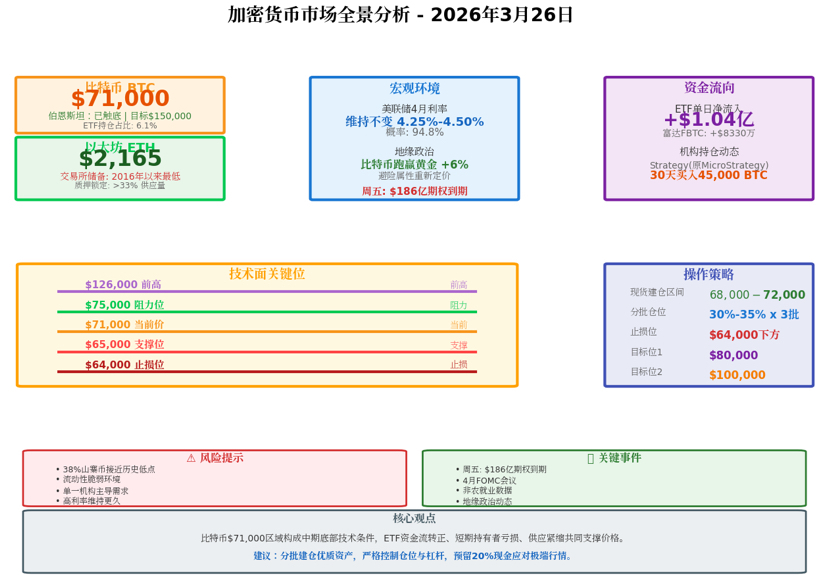
The current market is at a critical turning point. Signs of stabilization for Bitcoin at $71,000, the reversal of ETF capital flows, and the loss state of short-term holders together constitute the technical conditions for a mid-term bottom. However, the Federal Reserve's "higher for longer" monetary policy stance, the liquidity crunch in the altcoin market, and the demand structure dominated by a single institution mean that the road to recovery will still be fraught with difficulties.
Investors should maintain long-term optimism while strictly controlling positions and leverage, using market fluctuations to gradually allocate quality assets. Historical experience shows that adhering to disciplined allocation during the darkest times often leads to excess returns in the next cycle.
Disclaimer: This article is for reference only and does not constitute investment advice. The cryptocurrency market is highly volatile, and investors should fully understand the risks and make decisions based on their own circumstances before investing.#国际油价下跌 #特朗普称对伊战争已胜利 #特朗普缓和局势 #美国暂缓攻击伊朗发电站 #金价连续第十天下跌 $BTC


