
past few days ive been sitting with the TokenTable conditional logic section and the more i read it the more one question keeps surfacing that the documentation never quite answers 😂
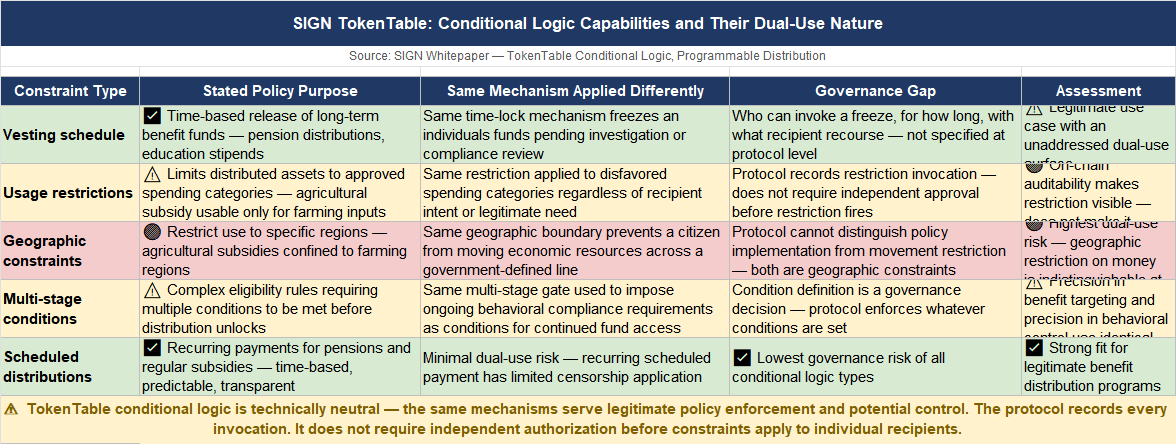
honestly? the capabilities are real and the use cases are legitimate. vesting schedules for long-term benefit programs. multi-stage release conditions that unlock funds when specific eligibility criteria are met. usage restrictions that limit distributed assets to approved categories of spending. geographic constraints that prevent funds from being used outside a defined region. these are tools governments actually need to run responsible public benefit programs.
but here is the thing about programmable money constraints.
the code that implements a vesting schedule for a pension program is structurally identical to the code that freezes an individuals funds pending investigation. the code that restricts a subsidy to agricultural spending is structurally identical to the code that prevents a recipient from spending at politically disfavored vendors. the technical mechanism is the same. the difference is entirely in who authorizes the constraint and for what purpose.
the whitepaper describes conditional logic as serving policy objectives through technical enforcement. the framing is accurate. what it doesnt address is the governance surface that technical enforcement creates.
every constraint capability that exists in the distribution layer is a capability that can be invoked. the question of who can invoke it, under what conditions, with what oversight, and with what recourse for the recipient is a governance question the protocol layer cannot answer.
what the design gets right is the transparency model.
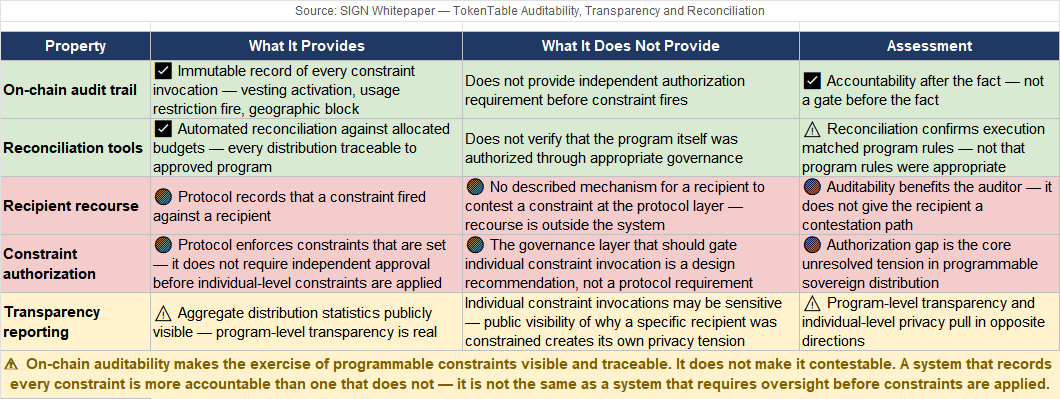
on-chain distribution with immutable audit trails means every constraint that fires is recorded. a vesting schedule that activates, a usage restriction that blocks a transaction, a geographic constraint that prevents a payment - all of it is traceable. that traceability is meaningful. it means the exercise of these capabilities is not invisible.
what traceability doesnt provide is restraint. a system that records every constraint invocation is more accountable than one that doesnt. it is not the same as a system that requires independent approval before constraints are applied to individual recipients.
i kept coming back to the geographic constraint specifically.
the whitepaper describes it as restricting use to specific regions or localities. the stated purpose is policy implementation - agricultural subsidies that only apply in farming regions, for example.
the same mechanism applied differently restricts a citizen from moving economic resources across a boundary the government has drawn. both are geographic constraints.the distribution layer cannot distinguish between them at the protocol level.
honestly dont know if programmable distribution constraints are the right infrastructure for governments that need precise policy enforcement, or whether building this capability into sovereign money infrastructure creates a control surface that outlasts the specific programs it was designed to serve.
technical enforcement of policy objectives that makes government benefit programs more precise - or programmable constraints on sovereign currency that make the money itself an instrument of compliance?? 🤔
#SignDigitalSovereignInfra @SignOfficial $SIGN
