
The current cryptocurrency market is in a critical phase of technical repair. Bitcoin is consolidating in a narrow range of $70,500 to $71,000, having retraced about 44% from its historical high of $126,080, but showing signs of stabilization compared to previous lows. Ethereum has similarly rebounded to the $2,140 to $2,160 region, with a 24-hour increase of about 5.68%, and its technical pattern indicates a short-term bottom feature. On the macro level, the Federal Reserve's Reserve Management Purchase (RMP) mechanism continues to release liquidity expectations, and the market is reassessing the pricing logic of risk assets. This report systematically analyzes the current market situation from technical, macro, and funding perspectives and offers corresponding operational strategy suggestions.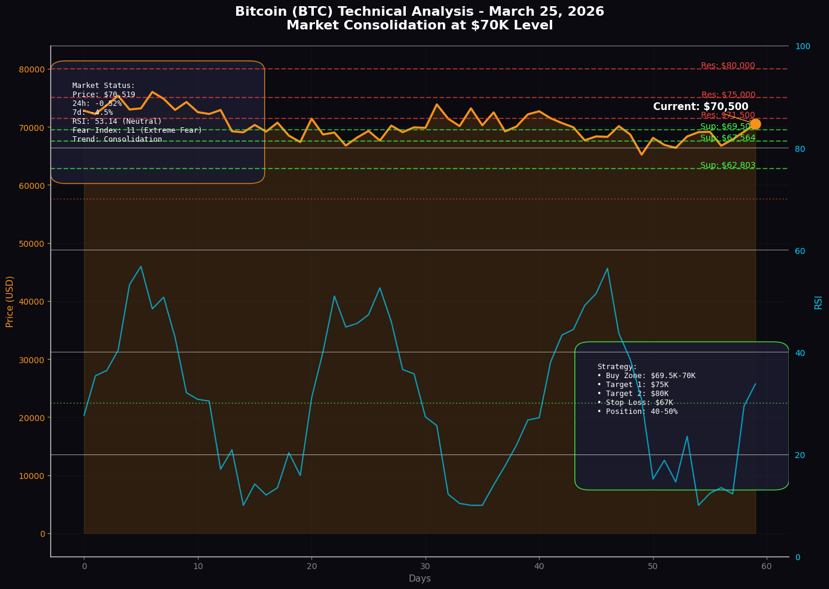
1. Market overview
Bitcoin (BTC): Stabilizing after a high-level pullback.
As of March 24, 2026, the Bitcoin price is approximately $70,519-$71,052, with a market capitalization maintained at around $1.41 trillion. The cumulative decline over the past seven trading days is about 4.5%-5.6%, but when viewed over a 30-day dimension, it still maintains a 4.3% positive increase, indicating that the medium-term trend has not completely deteriorated. The intraday volatility range has narrowed to $68,970-$71,300, with a trading volume of about $39.7 billion, which has shrunk compared to previous periods, indicating strong market wait-and-see sentiment.
From a technical perspective, a bullish engulfing pattern has appeared on the weekly level, signaling a resurgence of bulls after two weeks of correction. The 50-day moving average and 200-day moving average show a bullish arrangement, keeping the long-term upward trend structure intact. However, on the daily level, the 50-day moving average is declining, facing certain pressure in the short term. The fear and greed index reads 11, in the "extreme fear" zone, which is typically a contrarian indicator of market sentiment bottoming out.
Ethereum (ETH): Technical repair in an oversold rebound.
The current price of Ethereum is approximately $2,141-$2,163, with a market capitalization of about $233-$239 billion. It recorded a 5.68% increase in the past 24 hours, indicating strong short-term rebound momentum. From a longer-term perspective, ETH has formed a phase support around $2,000 after a sharp pullback from the previous high and is currently in a technical recovery process.
Technical indicators show that the RSI reading of 53.14 is in a neutral zone, with neither overbought pressure nor oversold risk, leaving room for further price increases. The MACD indicator is converging near the zero axis, suggesting a potential directional shift in momentum. Bollinger Bands indicate that the price is above the middle band, with the upper band at $2,313 constituting short-term resistance, and the middle band at $2,104 providing dynamic support.
2. Macroeconomic environment and liquidity analysis
Federal Reserve policy: Market pricing of the RMP mechanism.
The current market focus is on the Federal Reserve's Reserve Management Purchases (RMP) mechanism. The New York Fed is purchasing Treasury securities at a scale of $40 billion per month, which is essentially equivalent to quantitative easing (QE), injecting liquidity into the banking system to lower short-term rates. However, there is a cognitive divergence regarding this in the market—some investors believe that RMP's credit creation effect is weaker than traditional QE, and this divergence has led Bitcoin to oscillate in the $80,000-$100,000 range.
Historical experience shows that when market consensus equates RMP with QE, the revaluation of asset prices is often sharp and rapid. According to analysis from BitMEX Alpha, March 2026 may be the peak point for market expectations regarding RMP's ability to drive asset prices. If this expectation materializes, Bitcoin could quickly recover to $124,000 and challenge the $200,000 mark. Of course, the realization of this scenario relies on the Federal Reserve's continued accommodative policy stance.
Institutional capital trends
The spot Bitcoin ETF and Ethereum ETF continue to attract institutional capital inflows. Major asset management firms like BlackRock have expanded their crypto investment portfolio from $54.77 billion at the beginning of the year to $102.09 billion, nearly doubling. This institutional allocation trend provides solid bottom support for the market. Meanwhile, several listed companies are mimicking the MicroStrategy model by including ETH on their balance sheets, further tightening the circulating supply.
3. In-depth technical analysis
Key price levels and defensive strategies
Key levels for Bitcoin:
• Strong resistance levels: $71,500 (recently tested multiple times without success), $75,000 (psychological level), $80,000 (target level after RMP expectations materialize)
• Core support levels: $69,500 (recent low), $67,564 (7-day low), $62,803 (30-day low)
Technical analysts point out that if Bitcoin can break through the $71,500 resistance with volume, it will open the way for retesting the previous high. Conversely, if it loses the $69,500 support, it may probe down to $67,000 or even lower levels to seek support.
Key levels for Ethereum:
• Immediate resistance: $2,228, $2,292 (breakthrough confirmation level), $2,500 (mid-term target)
• Core support: $2,070, $1,976 (strong support), $1,820 (extreme cases)
The short-term trend of ETH is highly correlated with BTC, but due to the independence of its DeFi ecosystem and Layer-2 narrative, it often shows greater resilience during rebounds. If it can effectively break through $2,292, there is a chance to test the $2,400-$2,500 range in April.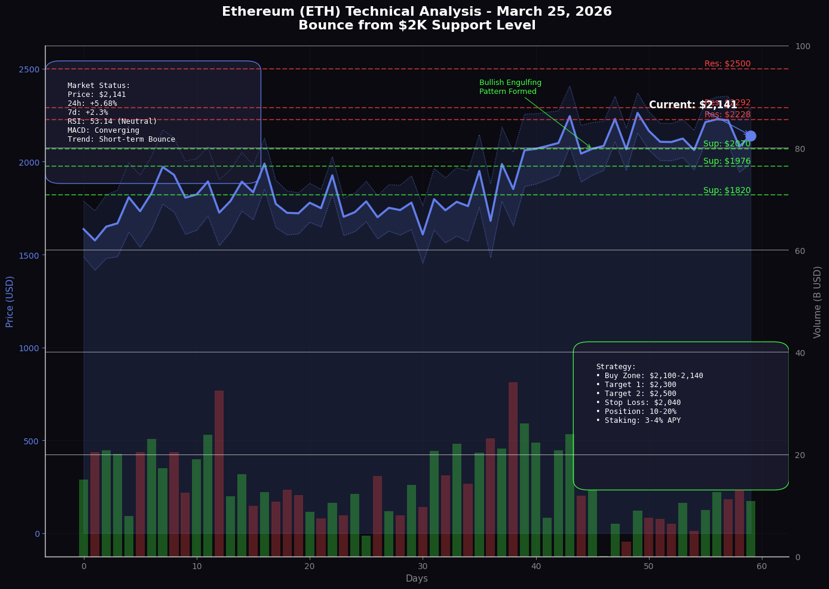
Volatility and risk management
The current 30-day volatility of Bitcoin is approximately 3.63%, and the 7-day volatility of Ethereum is about 0.84%, both are at relatively low levels. A low volatility environment typically indicates the approach of a directional breakout. Investors should prepare for volatility expansion and manage their positions and leverage levels prudently.
4. Operational strategy recommendations
Spot allocation strategy
Bitcoin (BTC):
• Conservative investors: Accumulate positions in batches within the $69,500-$70,000 range, with a target of $75,000-$80,000, and set a stop loss below $67,000.
• Aggressive investors: Chase after breaking $71,500, targeting $80,000-$100,000, with a stop loss set at $70,000.
• Dollar-cost averaging strategy: Utilize the current volatile market to execute weekly or monthly dollar-cost averaging, smoothing holding costs.
Ethereum (ETH):
• Accumulate on dips within the $2,100-$2,140 range, targeting $2,300-$2,500, with a stop loss set at $2,040.
• If the breakthrough of $2,292 is confirmed, additional positions can be added to a target above $2,500.
• Long-term holders focus on the development of the DeFi ecosystem and staking yields; ETH staking annualized yield is about 3%-4%, which can enhance holding returns.
Risk control key points
1. Position management: The recommended position for a single asset should not exceed 30%-40% of total assets, and maintain sufficient cash reserves to cope with extreme market conditions.
2. Stop-loss discipline: Strictly set stop-loss levels, limiting maximum losses per trade to 5%-8%.
3. Caution with leverage: The current market is in a period of directional choice, and high-leverage trading carries significant risks; it is recommended that leverage not exceed three times.
4. Macroeconomic tracking: Closely monitor speeches from Federal Reserve officials, RMP operation scale, and regulatory policy trends; these factors may trigger significant market volatility.
Asset allocation recommendations
Referencing the previously discussed "gold + bitcoin" dual-anchor strategy, it is recommended under the current market conditions:
• Gold allocation of 30%-40% as a risk hedge anchor
• Bitcoin allocation of 40%-50% as a core growth position
• Allocate 10%-20% to Ethereum and other quality mainstream coins as flexible positions.
• Retain 10%-20% cash to respond to unexpected opportunities.
The cryptocurrency market in March 2026 is at the intersection of macro narratives and technical repairs. The defense of Bitcoin at the $70,000 level will determine the direction of the medium to short-term trend, while the strength of Ethereum's rebound reflects the market's confidence in the DeFi ecosystem and Layer-2 narrative. From a longer-term perspective, the Federal Reserve's liquidity policy, continued inflows of institutional capital, and the mainstreaming process of crypto assets provide solid underlying support for the market.
Investors should maintain patience at this stage, avoiding frequent trading in a volatile range, and focus on the breakout situation at key price levels. Whether the market chooses to break upward or downward, strict position management and risk control are always core capabilities to navigate through cycles. Seek certainty in uncertainty, maintain composure in volatility, and take the initiative in this long-term game of digital assets.
Disclaimer: This report is for informational reference only and does not constitute any investment advice. The cryptocurrency market is highly volatile; please fully understand the related risks before investing and make independent judgments based on your own risk tolerance.#国际油价下跌 #特朗普称对伊战争已胜利 #特朗普缓和局势 #美国暂缓攻击伊朗发电站 #金价连续第十天下跌 $BTC


