
#091-2026.03.10
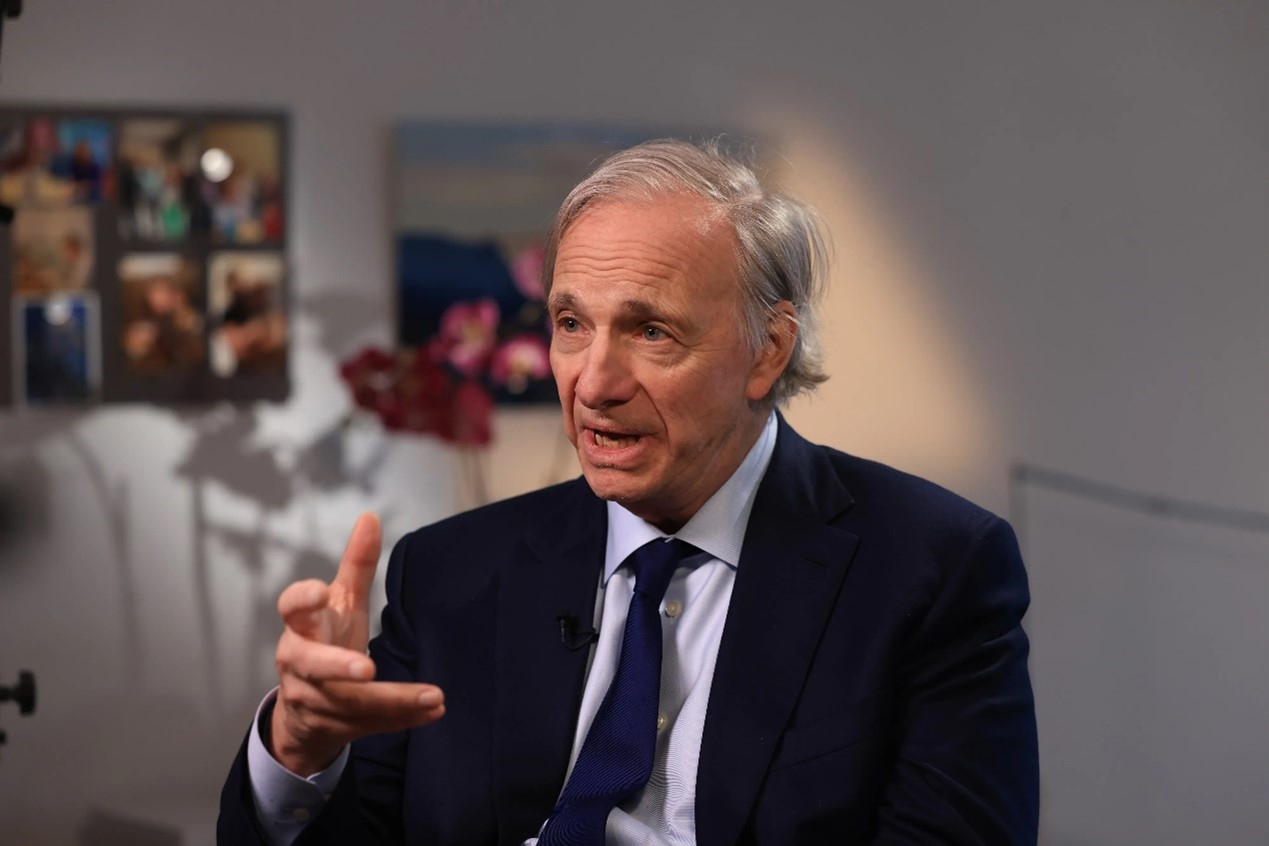
On March 3, 2026, renowned investor and founder of Bridgewater Associates, Ray Dalio, reiterated his doubts about Bitcoin in a recent podcast, firmly stating, "there is only one gold," refuting the claim of Bitcoin as "digital gold." He pointed out that in the past year, gold rose from $2,900 to $5,200 (an increase of 80%), while Bitcoin plummeted over 45% from its October peak to $68,420.
Dalio believes that Bitcoin has three fatal flaws: first, Bitcoin does not possess true privacy, as "any transaction can be monitored"; second, central banks will not buy or hold Bitcoin as a reserve asset; third, quantum computing may threaten the security of the Bitcoin network. He emphasizes that gold is not a speculative precious metal, but rather the "most mature currency," and is the second largest reserve asset held by central banks. In the context of the U.S. debt crisis and currency devaluation, gold is the best choice for protecting wealth.
It is noteworthy that Dalio suggested a portfolio allocation of 15% in Bitcoin or gold last July to optimize the 'best risk-return ratio.' However, since October, Bitcoin has clearly decoupled from gold, which seems to confirm his concerns about Bitcoin.
Evaluation Analysis
Dalio made a fundamental mistake: measuring paradigm shifts by price volatility. The significance of Bitcoin has never been about how much it rises or falls in a year, but rather that it has achieved truly decentralized currency for the first time in human history, enabling value transfer and storage globally without the endorsement of central banks, governments, or any centralized institutions. This is a breakthrough that has never occurred in the 5,000-year history of currency.
The more critical question is: even purely from a price performance perspective, Dalio's argument does not hold water. He uses a year's price performance to argue a long-term value judgment, which is itself a methodological flaw. If we extend the time frame to 5 or 10 years, Bitcoin's growth far exceeds that of gold. In 2015, the price of Bitcoin was about $200, and in 2020 it was around $10,000; even now, with a pullback to $71,000, the ten-year increase is still 355 times. In contrast, gold rose from about $1,050 to $5,120 during the same period, an increase of about 387%. Short-term volatility does not equal long-term failure. To negate the value of a technological innovation based on the performance of a single year is akin to asserting that the Internet has no future right after the dot-com bubble burst.
Looking at the three 'fatal flaws' proposed by Dalio, each one does not hold up to scrutiny. The so-called 'privacy flaw' actually proves the value of Bitcoin’s transparency. In a financial system filled with fraud and opaque operations, an auditable transparent ledger is an advantage. Moreover, second-layer solutions like the Lightning Network are improving privacy protection, and privacy coins are also providing more options. As for the quantum computing threat, this will equally affect all encrypted communications in the existing financial system, not just Bitcoin, and the cryptography community has long been researching quantum-resistant solutions.
As for the argument that 'the central bank does not buy Bitcoin,' it exposes the limitations of Dalio's thinking. This is precisely the core feature of Bitcoin: it does not need and should not rely on central bank recognition. Relying on government-recognized assets may actually become a target for government plunder. It is also worth pondering that the systemic crisis described by Dalio himself, namely the $70 trillion expenditure against $50 trillion in revenue and the debt being six times the income, as well as the statement that 'the world order has collapsed,' are precisely the reasons for Bitcoin's birth. When the traditional financial system collapses due to debt spirals and excessive monetary issuance, isn’t a digital asset with a fixed supply, decentralized, and uncontrollable by any single government the ultimate tool to hedge against such systemic risks?
More importantly, Bitcoin has laid the cornerstone for the entire blockchain economy. From DeFi to NFT, from smart contracts to DAO, the entire decentralized ecosystem is built on the consensus mechanism pioneered by Bitcoin. Even if Bitcoin itself is someday replaced by a superior cryptocurrency (which precisely proves the value of free competition), the idea of decentralization has already become irreversible. It is like after the birth of the Internet; regardless of whether a certain protocol becomes obsolete, the wave of digitalization cannot be stopped.
Dalio is right: balance is important. But he is wrong to judge the assets of the new world by the standards of the old world. The value of gold is validated by 5,000 years of history, while the value of Bitcoin lies in opening up a new financial paradigm that does not require trusted intermediaries. This is not a choice between the two but an understanding of the logic of two different eras.
About Ray Dalio
Ray Dalio is the founder of Bridgewater Associates, one of the world's largest hedge funds, managing assets exceeding $150 billion. Dalio is known for his profound insights into macroeconomic cycles and is the author of bestsellers such as Principles and The Changing World Order. He has long focused on debt cycles, monetary policy, and great power dynamics, and is regarded as one of the most influential investment thinkers of our time.
Main references:
https://cointelegraph.com/news/ray-dalio-cautions-bitcoin-safe-haven-asset