

I’ve seen this movie before.
New project drops. Clean branding. Big words. “Infrastructure.” “Revolution.” “Next-gen.”
Everyone nods along for a few weeks… maybe a few months… and then reality shows up and quietly wrecks the whole thing.
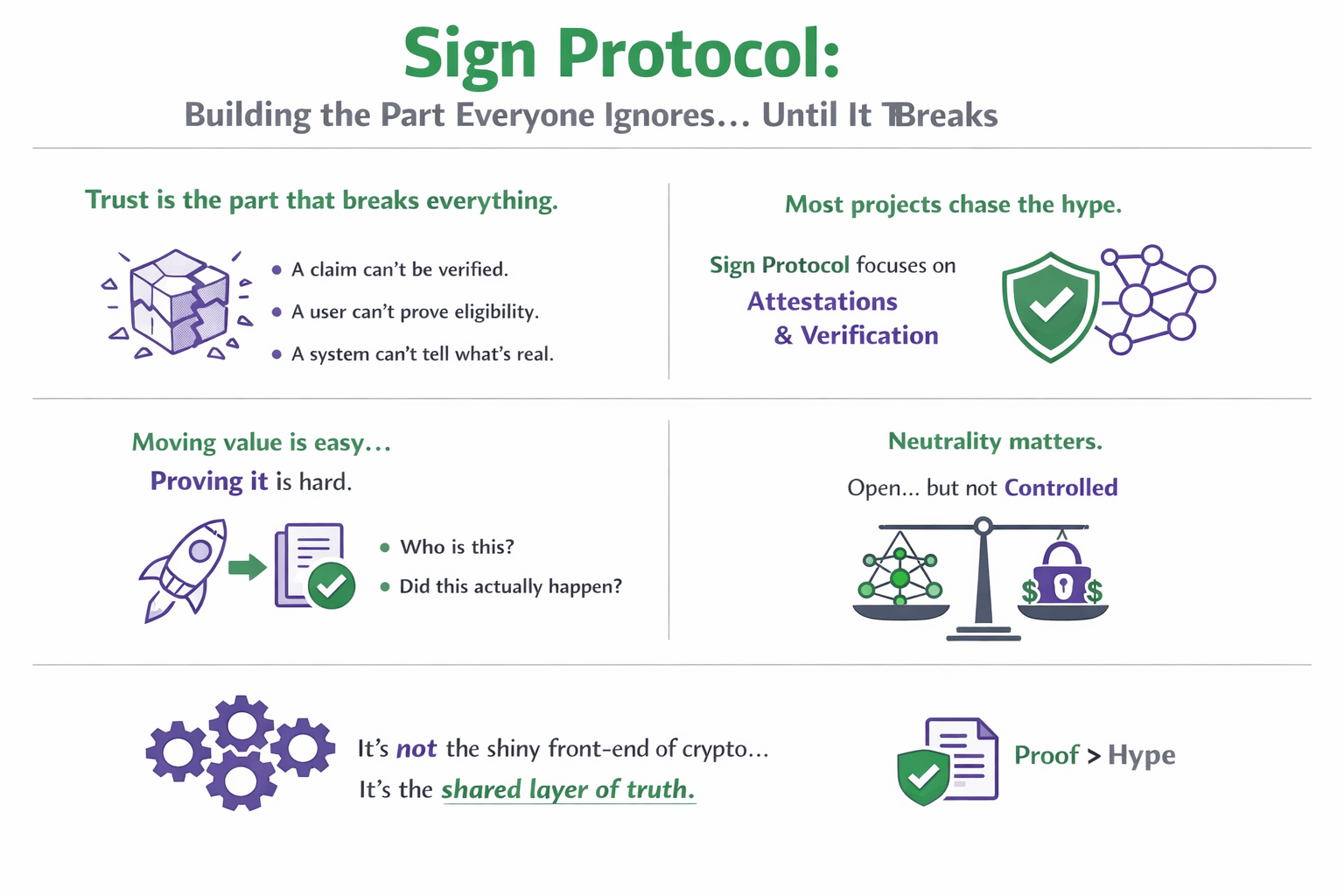
Because under all that polish, there’s usually nothing holding it together.
That’s why Sign Protocol made me stop scrolling.
Not because it’s loud.
Not because it’s promising some impossible future.
But because it’s aiming at the part of crypto that actually hurts once things stop working.
Trust.
Yeah… the boring stuff.
I remember a phase mid-cycle when everything looked unstoppable. Tokens flying. New apps launching every week. Everyone talking like we’d already solved finance, identity, coordination… all of it.
Then something simple would break.
A claim couldn’t be verified.
A user couldn’t prove eligibility.
A system couldn’t tell what was real and what wasn’t.
And suddenly… all that “infrastructure” felt paper-thin.
That’s the gap Sign Protocol is stepping into.
Not the fun layer. Not the part you show in a demo.
The part that sits underneath everything and decides whether any of it can actually be trusted.
Here’s the uncomfortable truth most projects avoid:
It’s easy to move value.
It’s hard to prove anything about it.
And once you move beyond speculation once you start talking about identity, credentials, permissions, real-world use cases that gap becomes impossible to ignore.
You need to know:
Who is this?
Can they do this?
Did this actually happen?
Does this claim hold up?
Most systems? They either fake it… or avoid the question entirely.
Sign Protocol doesn’t look like it’s avoiding it.
What I like cautiously is that Sign Protocol isn’t trying to be flashy.
It’s not chasing whatever narrative is trending this week. It’s not pretending to reinvent everything. It’s focusing on attestations. Verification. Structured proof.
Again… boring.
But necessary.
Because every system no matter how advanced eventually runs into the same wall:
You need a shared layer of truth.
Not opinions. Not assumptions.
Proof.
And here’s where I start paying attention.
Because building a “trust layer” sounds great in theory… until you try to actually do it.
I’ve watched projects attempt this before. They start open. Neutral. Useful. Then slowly…
Things change.
Incentives creep in.
Control points appear.
Neutrality fades.
Suddenly the “trust layer” becomes just another gatekeeper with better branding.
That’s the risk here. A big one.
Sign Protocol, at least right now, feels aware of that tension.
And that matters more than people think.
Because crypto has this habit this ego trip where every project claims to be “for the ecosystem.” Public good. Open access. Decentralized coordination.
Sounds great… until someone has to pay for it.
Then things get messy.
Real messy.
I’ve had moments where I looked at “public good” projects and thought… yeah, this is going to collapse under its own idealism.
Not because the idea was wrong.
Because the structure couldn’t support it.
That’s the line Sign Protocol is walking.
Too open? It risks being unsustainable.
Too monetized? It loses credibility.
Too neutral? It struggles to grow.
Too controlled? It stops being what it claimed to be.
That balancing act… that’s where most projects crack.
But here’s the thing.
Even knowing all that… I keep coming back to Sign Protocol.
Because the problem it’s solving doesn’t go away.
Ever.
If anything, it gets worse as crypto grows.
Think about it.
Right now, most of the ecosystem runs on loose assumptions. Wallets. Transactions. Smart contracts. Everything visible, everything traceable… but not everything meaningful.
You can see activity.
But you can’t always understand it.
You can track movement.
But you can’t always verify intent.
And once you start layering real-world use cases on top identity, credentials, governance, compliance the cracks get wider.
You need systems that can say:
This is true.
This is verified.
This is allowed.
Without turning everything into a surveillance machine.
That’s the hard part.
And honestly… most teams don’t want to deal with that.
It’s not exciting.
It doesn’t pump narratives.
It doesn’t look good in a one-minute pitch.
But it’s where the real work is.
Sign Protocol feels like it’s choosing that harder path.
Not building the shiny front-end of crypto.
Building the plumbing.
And yeah… plumbing isn’t glamorous.
Until it fails.
Then suddenly it’s the only thing anyone cares about.
I think that’s why it sticks with me.
It doesn’t feel like it’s trying to impress me.
It feels like it’s trying to function.
There’s a difference.
A big one.
But I’m not blind to the risks.
Not even close.
I’ve watched too many “serious” projects drift into irrelevance because they couldn’t turn good design into actual usage.
Because here’s another uncomfortable truth:
Being right doesn’t guarantee adoption.
You can have the cleanest architecture in the world… and still end up with nobody using it.
Because it’s too complex.
Too abstract.
Too disconnected from what people actually need right now.
That’s where I’m still cautious.
Can Sign Protocol make this usable?
Not just technically sound… but frictionless enough that builders actually integrate it without hesitation?
Can it become something people rely on… instead of something they admire from a distance?
Because admiration doesn’t scale.
Usage does.
And then there’s the bigger question.
Durability.
What happens when the market cools down? When attention moves elsewhere? When the easy narratives dry up?
Does Sign Protocol still matter then?
Or does it become another “good idea” that couldn’t survive the grind?
I don’t have that answer yet.
But I do know this:
Projects that focus on trust, verification, and coordination… they tend to age differently.
Slower at first.
Less attention.
More skepticism.
But if they work… they don’t disappear.
They become invisible infrastructure.
The kind people don’t talk about… because they just expect it to be there.
And maybe that’s the real test for Sign Protocol.
Not whether it trends.
Not whether it gets hyped.
But whether it becomes something the ecosystem quietly depends on.
Because crypto doesn’t need more noise.
It needs systems that can hold up when everything else starts slipping.
Systems that can answer simple, brutal questions
Is this real?
Can I trust this?
Does this actually hold?
Sign Protocol is trying to sit in that space.
Not the loudest place to build.
Not the easiest.
But maybe one of the few that still matters.
I’m still watching.
Not because I’m convinced.
Because I’m curious.
Because I’ve seen what happens when this layer doesn’t exist… and it’s not pretty.
So the real question isn’t whether Sign Protocol sounds good today.
It’s this:
When the market stops pretending and starts demanding proof will this still be standing?