

I’ve had moments staring at a blockchain explorer where the whole thing just felt… heavy.
Not philosophically heavy. Technically heavy.
Pages of transactions. Random metadata stuffed everywhere.
Smart contracts writing endless blobs of information on-chain like storage was free and someone else would deal with the mess later.
And every time I see it, the same thought hits me.
This wasn’t supposed to feel this clunky.
Crypto sold itself as the frictionless alternative. Lean systems. Verifiable truth. Clean proof. But somewhere along the way, a lot of projects started treating the blockchain like a junk drawer. Throw everything in. Store it forever. Call it transparency.
It works… until it doesn’t.
And that’s the part most teams don’t want to talk about.
The dirty little secret of “on-chain everything”
There’s this unspoken assumption in crypto that more data equals more trust.
Sounds nice. Looks good in a pitch deck.
But in practice? It’s a stomach-turning mess.
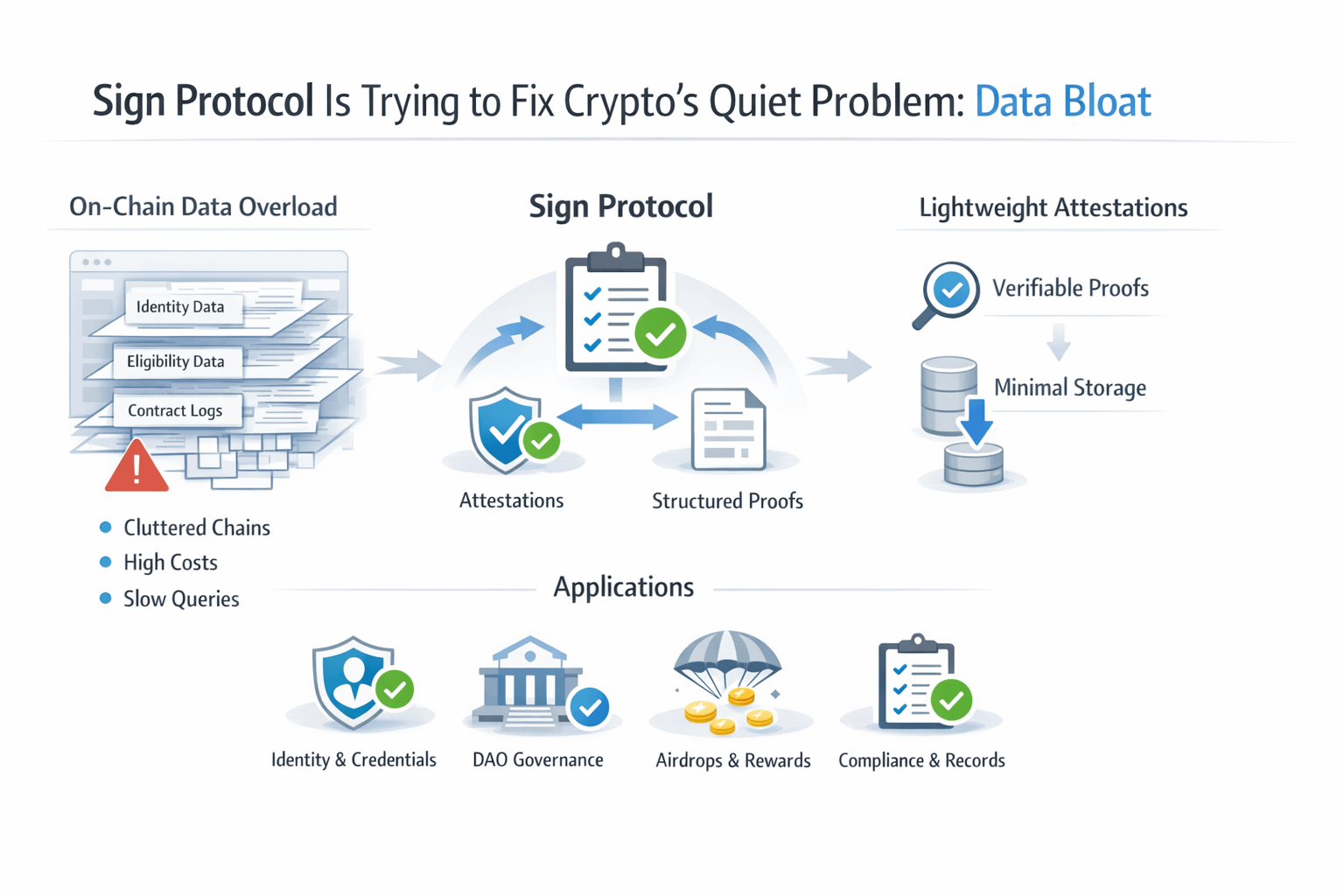
I’ve watched projects balloon their chains with unnecessary data because they wanted to look “fully on-chain.” Identity data. Eligibility data. Credential data. Proof of this. Proof of that.
Every new feature meant another chunk of permanent weight.
Eventually the system starts wheezing.
Gas costs rise. Queries get ugly. Indexing becomes a nightmare. Developers spend more time navigating clutter than building anything useful.
And yet… people keep pretending that’s normal.
It’s not.
Which is why Sign Protocol caught my attention.
Not because it’s flashy.
Because it’s doing something far less glamorous.
It’s trying to make the proof layer lighter.
The problem Sign Protocol seems to understand
I’ve been around crypto long enough to notice a pattern.
Most teams solve problems by adding more architecture.
More layers. More storage. More complexity disguised as innovation.
Sign Protocol is taking the opposite angle.
Instead of asking:
“How do we store everything?”
It’s asking:
“What actually needs to be stored?”
Small difference. Huge implications.
Sign Protocol revolves around attestations. Structured proofs. Verifiable statements that say something happened or someone qualifies for something.
And the key word here is structured.
Not messy. Not bloated. Structured.
Schemas define what the proof should look like. Attestations store the proof itself. Everything stays queryable, verifiable, and lightweight.
That might sound simple.
But crypto has a weird relationship with simple ideas.
Simple ideas don’t trend well on Twitter.
I remember when this problem first clicked for me
A few years back I was digging through a project’s governance system trying to verify who qualified for a particular grant.
It should have taken five minutes.
Instead it took hours.
Data scattered across contracts. Multiple writes. Indexing gaps. Some pieces on-chain.
Some off-chain. Some encoded in ways that made sense only to the original dev team.
Classic crypto infrastructure.
Powerful. Fragile. Slightly chaotic.
I remember thinking at the time: this is the kind of thing that quietly kills usability.
Not hacks. Not regulation.
Friction.
And that’s exactly the kind of friction Sign Protocol seems designed to remove.
Proof without the baggage
Here’s the basic idea.
Instead of dumping massive datasets onto the blockchain, Sign Protocol records the proof that something is true.
The attestation.
Not the entire historical file cabinet behind it.
So if someone needs to verify an identity credential, eligibility condition, ownership claim, or agreement… the system provides the cryptographic proof without dragging along every underlying detail.
Cleaner.
Lighter.
Much easier to work with.
And crucially, easier to verify later.
Because anyone who has tried to audit a tangled web of on-chain data knows the truth: sometimes the hardest part isn’t proving something happened.
It’s figuring out where the proof even lives.
This matters more than people realize
Crypto is heading toward a world where attestations will be everywhere.
Identity verification.
DAO governance.
Credential systems.
Airdrop eligibility.
Compliance layers.
Supply chains.
Even real-world records.
Every one of those systems creates data.
And if every system decides to dump that data directly on-chain… well, you can see where the road leads.
More clutter.
More friction.
More infrastructure that slowly becomes harder to use.
Sign Protocol looks like it’s trying to intervene before that future becomes the default.
The skeptical side of me still kicks in
Because I’ve seen this movie before.
Good architecture doesn’t automatically win.
Sometimes the technically elegant solution loses to the loudest narrative.
Crypto history is full of projects that were right about the problem but too early for the market to care.
So yeah. I’m cautious.
Attestation infrastructure isn’t exactly meme coin material.
It’s plumbing.
Foundational.
Quiet.
And markets aren’t always great at rewarding plumbing.
But the logic is hard to ignore
What keeps me coming back to Sign Protocol is the design philosophy.
Less weight.
Clearer proof.
Less data sprawl.
That approach feels… mature.
Like someone looked at the last ten years of blockchain experimentation and decided the next phase shouldn’t repeat the same mistakes.
And honestly, that’s refreshing.
Because most new projects still behave like the chain has infinite capacity and someone else will clean up the mess later.
Sign Protocol is basically saying:
Let’s stop creating the mess in the first place.
The real test hasn’t happened yet
Right now Sign Protocol is still a design story.
A strong one.
But still a story.
The moment that matters comes later.
When developers start building systems that rely on these attestations. When verification becomes routine. When people stop thinking about the infrastructure because it simply works.
That’s when you know a protocol has crossed the line from interesting idea to invisible backbone.
Until then… everything is still theory.
I’m still watching Sign Protocol closely.
Not because I expect the market to suddenly fall in love with infrastructure.
But because every once in a while, a project shows up that isn’t trying to add more weight to crypto’s already overloaded architecture.
It’s trying to remove some.
And in a space obsessed with building bigger systems…
how often do you see someone focused on making them lighter?