@SignOfficial #SignDigitalSovereignInfra $SIGN
Most audit systems only matter after something has already gone wrong.
That’s the assumption I carried into S.I.G.N., and it’s probably why the design didn’t click for me at first. I kept reading it like another verification layer, something that checks activity once it’s done and flags issues if needed. But the more I sat with it, the more it felt like that framing was off. It wasn’t trying to improve audits in the traditional sense. It was trying to remove the gap where audits usually exist.
Sign Protocol Is Working on the Trust Layer Most Projects Never Reach
Sign Protocol feels different to me. It is not chasing the loudest part of the market. It is building around trust, and that is usually the part most teams never get far enough to solve.
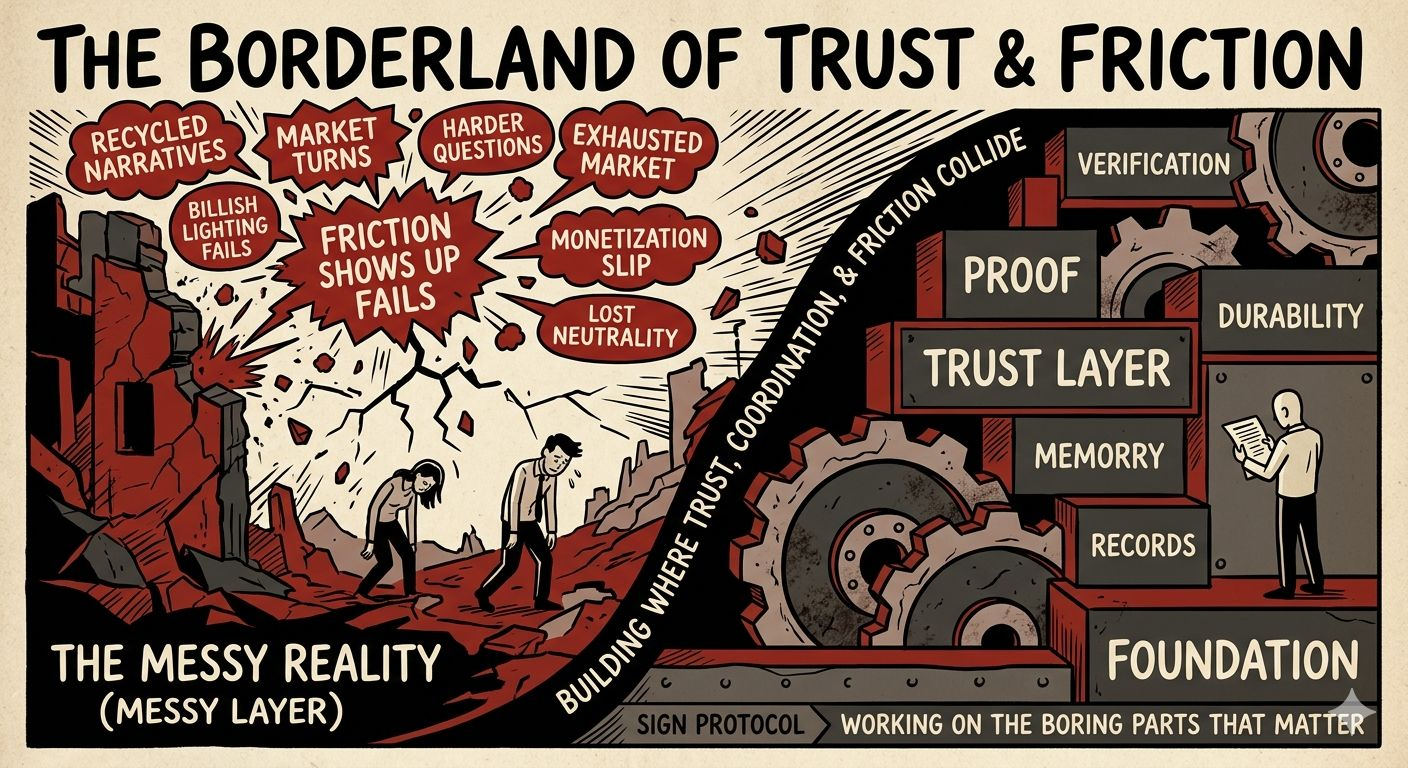
I’ve watched too many of these things play out the same way. Big claims. Clean branding. A lot of talk about fixing broken systems. Then the market turns, the friction shows up, and suddenly the whole thing starts looking thinner than it did under bullish lighting.
Sign doesn’t hit me like that. At least not yet.
I don’t look at it and see some shiny idea dressed up to farm narrative momentum. I see a project trying to work on the part nobody really cares about until it fails. Trust. Verification. Permission. Proof. All the boring parts, basically. The parts people skip over when the market is hot and then start begging for when things get messy.
And things always get messy.
That’s why I think Sign has some weight to it. Not because it sounds exciting on the surface, but because it’s building around a real point of friction. Once you move beyond simple transfers and speculation, every serious system runs into the same wall. You need to know what is true. You need to know who qualifies. You need to know whether a claim holds up when somebody finally bothers to check.
Most projects don’t want to live in that layer because it’s not sexy. It’s a grind. It takes longer to explain. Harder to hype. Easier to ignore.
Still, that’s usually where the real value sits.
I think that’s why Sign has stayed on my radar. It feels less obsessed with looking important and more focused on becoming useful. There’s a difference. A big one. Crypto has no shortage of projects that want to look like infrastructure. Far fewer are willing to deal with the dull, stubborn work of actually becoming it.
But here’s the thing.
I’ve seen enough to know that a decent idea is the easy part. Plenty of projects had decent ideas before the market chewed through them. What matters is whether this thing can keep its shape once the noise fades and people start asking harder questions.
Can it hold up when adoption stops being theoretical? Can it stay neutral while still building something sustainable around itself? Can it avoid turning into another system that starts open, talks a good game, then slowly hardens into something people have to route around?
That’s where I’m at with it.
Because the public good angle sounds nice. It always does. Crypto loves that language. Everyone wants to build for the ecosystem, for open access, for coordination, for trust. Then the bills show up. Then growth slows. Then incentives get weird. And that’s usually when the cracks start to show.
That’s why I pay attention when a project at least seems aware of that tension.
Sign doesn’t look like it’s pretending openness alone is enough. And honestly, that’s refreshing. A public good that can’t sustain itself usually ends up as another abandoned ideal. But if the thing leans too hard into monetization, it loses the neutrality that made it matter in the first place. That balance is where projects usually slip. Slowly, then all at once.
I don’t know yet if Sign can hold that line. I just think it understands the line exists, which already puts it ahead of a lot of the market.
And the market, if we’re being honest, is exhausted. You can feel it. Too many recycled narratives. Too many projects trying to dress up old mechanics as new infrastructure. Too much branding, not enough weight. That’s part of why Sign lands differently for me. It’s working in a zone that actually feels necessary if crypto wants to grow into something more than a machine for rotating attention.
Because sooner or later, systems need memory. They need records. They need proof. They need a way to verify that something happened, and happened the way it was supposed to.
That stuff matters.
Not in the loud way. In the way foundations matter.
I’m not looking at Sign as some perfect answer. I’m past that stage with most projects. I’m looking for durability now. I’m looking for the moment where the idea either survives contact with reality or starts bending under pressure like so many before it.
And I do think there’s something here.
The project feels like it’s trying to build where trust, coordination, and real-world friction all collide. That’s not an easy place to operate. But it’s probably one of the few places left in crypto where the work still feels worth paying attention to.
So yeah, I’m watching it.
And if it stays an option, then nothing about how systems are actually audited has really changed.
@SignOfficial #SignDigitalSovereignInfra $SIGN