
I kept coming back to the same thought… this is the part of crypto most people avoid.
Not the charts. Not the hype. Not the ego trip narratives that spike for a week and disappear just as fast.
The part where money actually has to work.
Because here’s the uncomfortable truth… crypto loves talking about “changing finance,” but the second things get real—regulation, governments, actual users—it usually falls apart. Too messy. Too slow. Too many rules.
That’s where Sign Protocol is stepping in.
And honestly… that’s exactly why I’m paying attention.
I’ve had moments before where I thought a project “got it.”
Then reality showed up.
I remember watching early DeFi protocols promise frictionless global finance… and then watching people get stuck dealing with failed transactions, confusing interfaces, and systems that only made sense if you already lived inside crypto. It wasn’t broken… but it wasn’t ready either.
That’s the gap.
And Sign Protocol feels like it’s trying to sit right in the middle of it.
Here’s the core problem. Simple, but brutal.
Governments and central banks are experimenting with digital currencies. That part is real now. Not theory. Not whitepapers. Actual movement.
But they keep hitting the same wall.
They want control.
They want privacy.
They want stability.
Meanwhile, the global crypto market runs on the opposite energy.
Open systems.
Liquidity.
Speed.
Two completely different worlds.
And they don’t fit together naturally. Not even close.
So what does Sign Protocol do?
It doesn’t try to force them into one system.
That’s the first thing I noticed.
Instead, it builds two lanes.
One private. One public.
The private lane feels familiar if you think like a government.
Controlled. Regulated. Quiet.
This is where something like a central bank digital currency (CBDC) lives. Transactions can stay confidential. Rules can be enforced. Everything can be monitored without exposing it to the entire world.
No chaos. No guesswork.
But also… no flexibility.
Then there’s the public lane.
This is the part crypto already understands.
Open access. Global liquidity. Fast movement.
Money can move across borders. Interact with other assets. Plug into markets that never sleep.
But it comes with tradeoffs.
Less control. More exposure. More noise.
And here’s where it gets interesting…
Sign Protocol doesn’t pick a side.
It connects them.
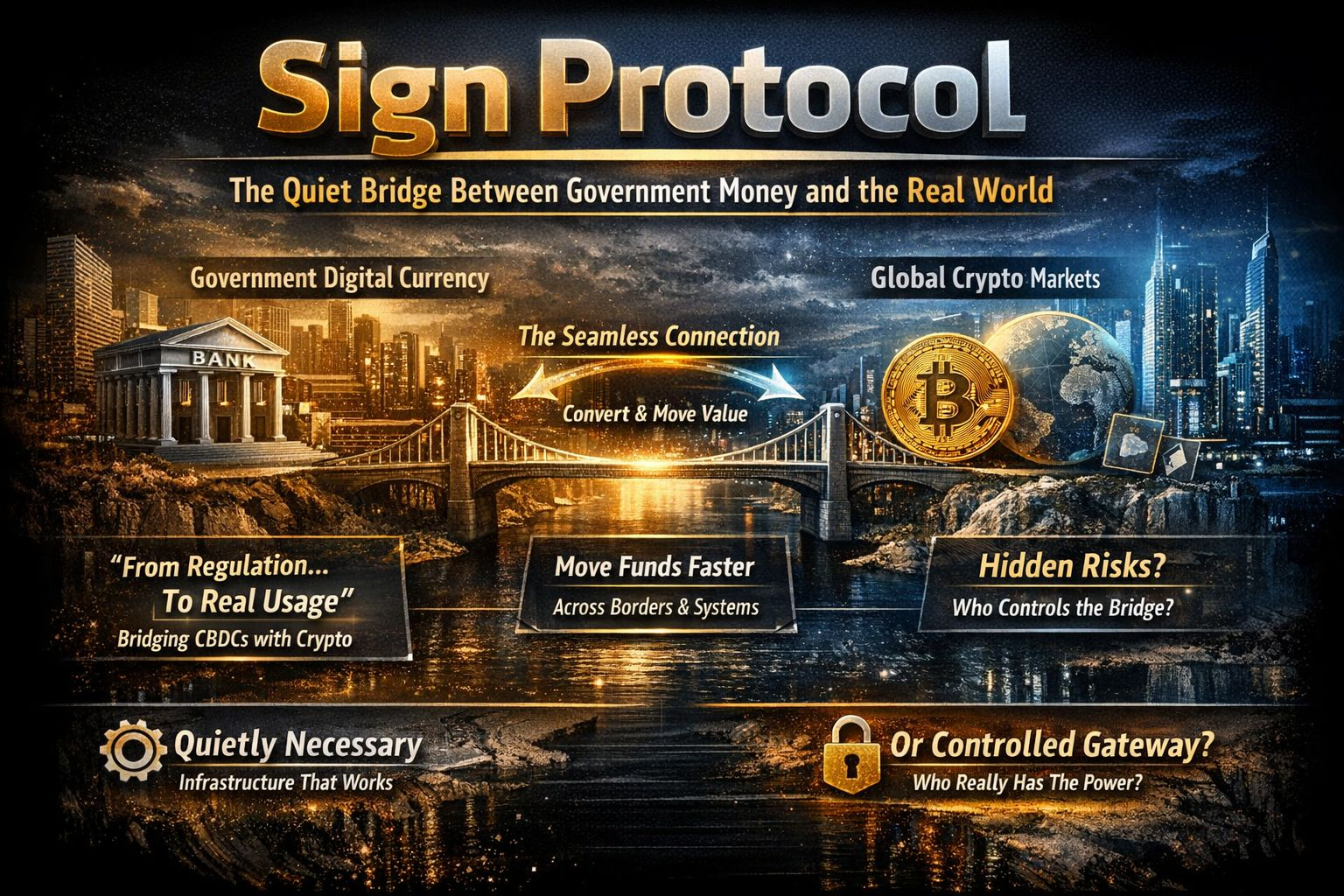
That bridge is the whole story.
Not the tokens. Not the branding. The bridge.
Because right now, without something like this, these systems stay isolated.
Governments build digital currencies that can’t really leave their own ecosystem.
Crypto builds open markets that governments don’t fully trust.
Everyone builds… but nothing connects.
I’ve seen this kind of fragmentation before.
Different systems. Different rules. No shared language.
And it slows everything down.
You end up rebuilding the same logic again and again just to move value from one place to another.
That’s the hidden friction nobody talks about.
Sign Protocol tries to remove that.
Let’s make it real.
Imagine someone gets paid in a government-issued digital currency.
That money sits in the private lane. Safe. Controlled. Compliant.
Now they want to send it abroad. Or use it in a global marketplace.
Normally… that’s where things get clunky. Delays. Conversions. Middle layers.
But with this model?
They move it across the bridge.
It converts into a public asset.
It enters the open system.
It flows.
Fast. Traceable. Verifiable.
Then if needed… it can move back.
That back-and-forth matters more than people realize.
Because it turns isolated money into usable money.
And that’s the difference between a system that exists… and one people actually use.
But I’m not blindly sold on this.
Let’s be real.
This kind of system comes with its own risks.
Control doesn’t disappear… it just moves.
If the bridge is too tightly managed, then you’re not really building openness… you’re building a controlled gateway.
And I’ve seen that before too.
Systems that look frictionless on the surface but quietly decide who gets access and how.
That’s where things get… uncomfortable.
Still… there’s something here.
Because Sign Protocol isn’t just thinking about movement.
It’s thinking about usage.
And that’s where most projects fall apart
Take something like government subsidies.
Today, it’s messy.
You verify identity.
You check eligibility.
You distribute funds.
You track everything manually.
Delays everywhere.
Now imagine that running through a structured system.
Identity verified once.
Eligibility confirmed instantly.
Funds delivered based on rules.
Everything recorded automatically.
No missing data. No endless reconciliation.
It’s not flashy.
But it works.
And that’s the shift I keep noticing.
Sign Protocol doesn’t feel like it’s trying to win attention.
It feels like it’s trying to become invisible.
Infrastructure-level invisible.
The kind where people don’t even think about it… they just use systems that happen to run on it.
I’ve learned to respect that kind of build.
Because hype fades.
But systems that quietly become necessary?
Those stick.
Still… there’s a long road here.
Government deals move slow.
Politics can flip overnight.
One policy change can stall everything.
And scaling something like this across multiple countries?
That’s not just hard… it’s borderline stomach-turning in complexity.
So I don’t look at this and think “guaranteed success.”
Not even close.
I look at it and think…
This is where things either get real… or fall apart.
Because if Sign Protocol works, even partially, it doesn’t just become another crypto project.
It becomes part of how money actually moves.
Behind the scenes. Across borders. Between systems that used to ignore each other.
Quiet. Functional. Necessary.
And if it doesn’t?
It turns into another well-structured idea that couldn’t survive real-world pressure.
I’ve seen plenty of those too
So yeah… I’m watching it.
Not for hype.
Not for short-term noise.
But for something much simpler.
When money moves between these two worlds… does it actually feel natural?
Or does the bridge start to crack the second real pressure hits?