
The shift from "trust me" handshakes to hard-coded enforcement is exactly where the industry is heading, and it’s about time. If you’ve ever had to manage a distribution list or a real-world asset transfer, you know the nightmare of manual oversight. Sign Protocol essentially takes the legal "fine print" and turns it into the "circuitry" of the transaction itself.
@SignOfficial #SignDigitalSovereignInfra $SIGN
Here is an organic, deep-dive story into why this matters and how it actually functions in the wild.
The End of the "Honor System" in Digital Infrastructure
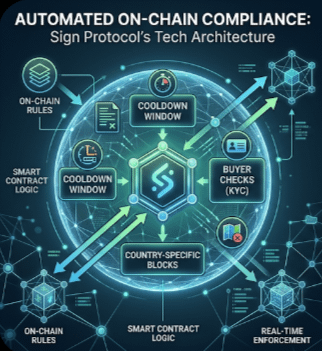
For years, we’ve operated on a system of "verify after the fact." You launch a project, you move assets, and you pray your legal counsel caught every jurisdictional nuance. If someone from a restricted region slipped through or a whale dumped their entire holding five minutes after a transfer, the fallout was your problem to fix.
Sign Protocol flips the script by moving those safeguards from a PDF document directly into the smart contract rules. It’s the difference between a "Keep Out" sign and a locked vault door.
1. The Power of the Forced Pause (Cooldown Windows)
In a typical "wild west" environment, volatility is often driven by instant exits. By baking cooldown windows into the protocol, you aren't just asking for patience; you are enforcing it. If you grab an entity or a high-value asset, the smart contract literally prevents a "dump" until the window expires. This creates a stabilized environment for real value—not just speculative noise.
2. Programmable Compliance: No More Excel Sheets
The most impressive part is how it handles buyer checks and country-specific blocks. Usually, checking IDs and verifying accredited status involves a mountain of paperwork and a dozen third-party services.
Proof Systems: Sign Protocol taps into decentralized ID verification.
Instant Logic: If a wallet tries to interact with an asset but doesn't meet the ID requirements or is pinged from a restricted country, the transaction simply fails.
Privacy First: It validates that you are "allowed" to buy without necessarily storing your private sensitive data on a public ledger for the world to see.
3. Real-World Utility Over Hype
This isn't just for "magic internet money." This is built for Digital PropertyThink about shifting real estate or corporate equity. You can’t afford for those deals to "sink" because of a paperwork error. Sign Protocol automates the "grind," allowing heavy hitters to move value with the confidence that the rules of the deal are locked in on-chain.
The Reality Check
Is it a "golden touch"? Not necessarily. Like any tool, the output is only as good as the input. If a government changes a regulation overnight or if you misconfigure your smart contract rules, you still have to navigate the fallout. However, compared to the "Excel sheet and prayer" method, the efficiency gain is massive.
Try the "Small-Scale" Stress Test
If you’re skeptical, don’t take the marketing at face value. Run a tiny test transfer.
Set up a dummy buyer check.
Drop in a 24-hour cooldown timer.
Attempt to bypass your own rules.
If the tech holds firm and snaps into place without needing a lawyer to mediate, you’re looking at the future of sovereign infrastructure. If it drags, the market is big enough to keep shopping—but for those looking to move serious loads, this is where the bar is being set.

Mass adoption doesn't happen through hype; it happens through education and utility. When the tech is so good it becomes invisible, that’s when we win. Keep learning, keep testing, and don't let the "real world grind" slow down your digital sovereignty.
Do you think hard-coded smart contract rules will eventually make traditional escrow services obsolete, or will we always need a human intermediary for the "big" deals?