

Sign Protocol is one of those projects I keep circling back to, not because it’s loud or constantly in front of me, but because it sits in a part of the stack that most people don’t spend much time thinking about. It’s not trying to be the next chain, or the next consumer app, or even the next obvious narrative. It feels more like it’s trying to define something underneath all of that—something quieter, but potentially more fragile.
I’ve been noticing how it approaches trust, and more importantly, how it doesn’t try to pretend that trust can be removed entirely. Crypto has always had this instinct to eliminate trust, to replace it with verification, math, and code. But in reality, trust just moves around. It shows up in different places—interfaces, communities, issuers, social consensus. It never really disappears.
Sign seems to acknowledge that, at least indirectly. The idea of attestations—people or entities making claims about something, recording those claims in a structured way—sounds straightforward at first. But the more I sit with it, the more it feels like opening a door to a much messier system than it initially suggests.
Because once you allow claims to exist, you also allow incentives to shape those claims.
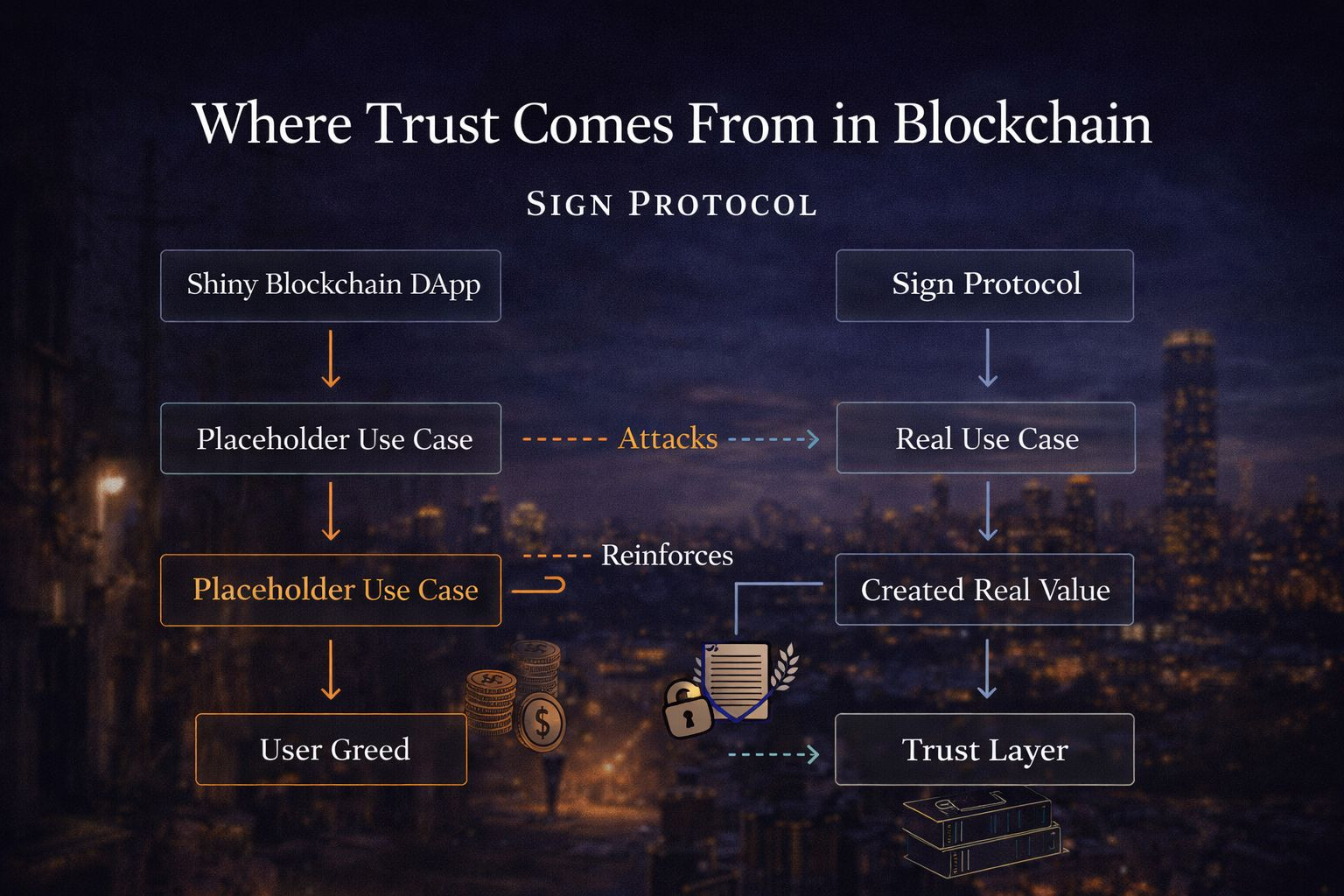
And incentives are where things usually start to bend.
I’ve watched similar systems before. Reputation layers, identity frameworks, credential graphs—they often begin with a kind of purity. The assumption that if you give people a way to signal something meaningful, they will use it honestly, or at least responsibly. But that phase never lasts very long.
Eventually, someone figures out how to benefit from the system in a way it wasn’t fully designed for. Then someone else refines that behavior. And before long, what was supposed to be a signal starts turning into something that can be produced, optimized, even sold.
I keep wondering how Sign holds up when it reaches that point.
Because it will reach that point.
There’s a kind of openness in the way it’s structured—different schemas, different issuers, different contexts. That flexibility is probably necessary. A rigid system wouldn’t survive long in crypto. But flexibility has its own trade-offs. It makes the system harder to pin down, harder to evaluate, and easier to stretch in directions that weren’t originally intended.
If anyone can issue attestations, then the question becomes which ones actually matter. And that’s not something the protocol can fully answer on its own. That gets decided socially, over time, through usage and recognition.
That’s where patterns tend to form.
Some issuers will naturally become more trusted than others. Certain attestations will carry more weight, not because of their structure, but because of who is behind them. Over time, you don’t just have a network of claims—you start to see a hierarchy emerge.
And once that happens, the system starts to look less like a neutral layer and more like a reflection of existing power structures.
I’m not sure that’s avoidable.
Another thing that lingers in the back of my mind is permanence. Recording attestations on-chain gives them a kind of durability that feels reassuring. But permanence assumes stability—that what is recorded will remain relevant, accurate, or meaningful.
That’s rarely how things play out.
People change. Relationships change. Context shifts. Something that was true at one moment can become misleading later, but the record stays. It accumulates. And over time, the system becomes a mix of signals—some still useful, some outdated, some possibly manipulated.
I’ve been paying attention to how crypto systems behave once they accumulate enough history. It’s not always clean. The longer something exists, the more it carries with it—good data, bad data, forgotten context. And interpreting that history becomes its own challenge.
Sign is stepping into that, whether intentionally or not.
What makes it interesting, at least to me, is that it’s not operating in the safer parts of crypto where things are more contained. It’s closer to the layer where meaning is assigned, where data starts to influence decisions, access, and reputation. That’s not an easy place to build in.
Because if it works, it becomes important.
And if it becomes important, people will try to game it.
That’s the part I keep thinking about. Not whether the system functions technically, but how it behaves when people start leaning on it—when there’s something to gain from shaping perceptions, from issuing certain attestations, from withholding others.
Most systems don’t break immediately. They erode slowly, in ways that aren’t always obvious at first. A small shift in incentives here, a workaround there, a gradual normalization of behavior that wasn’t originally intended.
And then one day, the system still exists, still runs, but it doesn’t quite mean what it used to.
I don’t know if Sign avoids that, or if it simply delays it.
It might be one of those things that only reveals itself over time, through use rather than design. The kind of system that looks stable until it’s tested in ways no one fully predicted.
For now, it feels like something still forming. Not unfinished in a technical sense, but unfinished in a behavioral sense. The rules are there, the structure is there, but the real shape of it hasn’t emerged yet.
And maybe that’s why I keep watching it.
Because the interesting part isn’t what it claims to be—it’s what it becomes once people start using it in ways that aren’t written down anywhere.