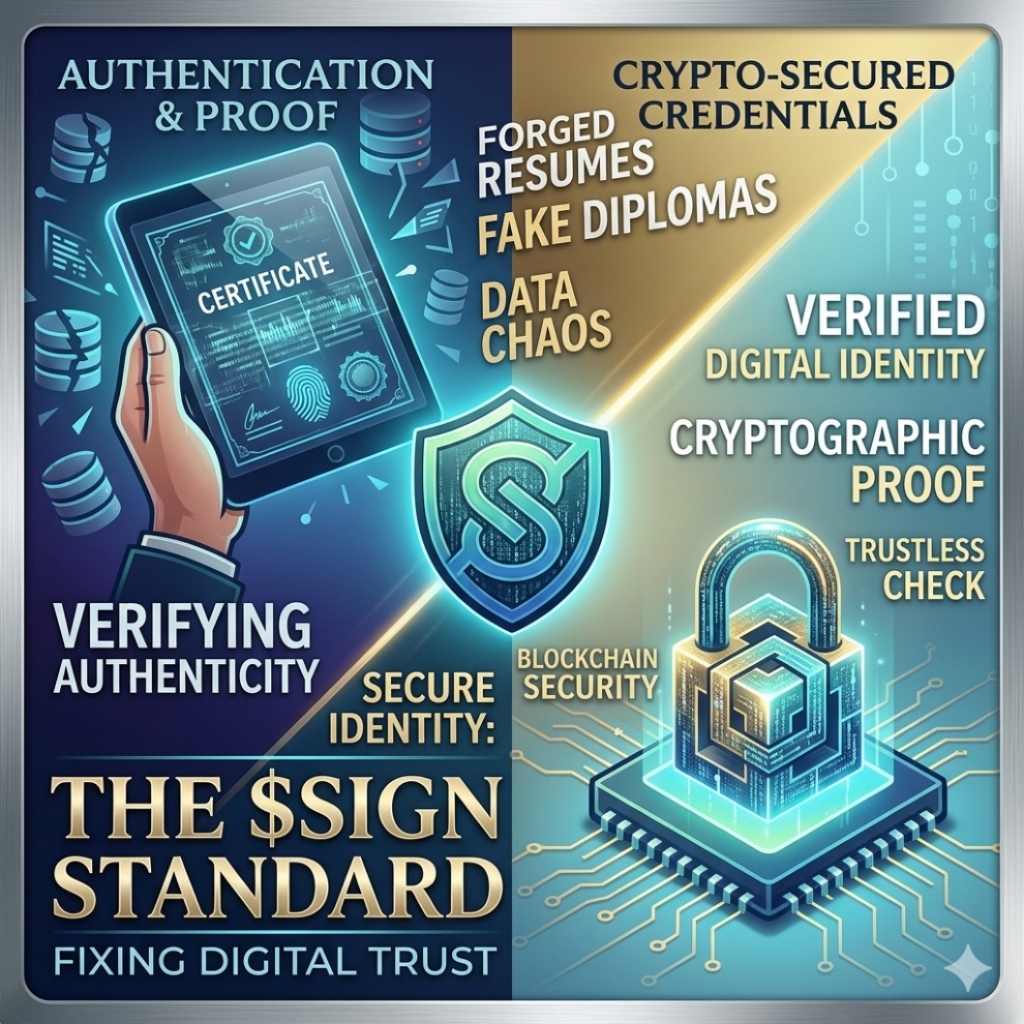
#signdigitalsovereigninfra $SIGN
The first time I ran into $SIGN, it wasn’t some big launch or viral post—just this half-buried conversation about digital credentials. Somebody, predictably, was griping about fake certificates sneaking around LinkedIn again. Same old merry-go-round. And I remember just staring at my screen, thinking, wow, we’re still not past this? It never really disappeared, huh?
Thing is, if you look at credential verification—really look—it’s sort of a quiet disaster. Not the spectacular, headline-making kind. Just… quietly flimsy. Diplomas, resumes, certifications—all that stuff. We swap PDFs, dig through semi-ancient emails, or tap into these creaky old databases that, honestly, could be tampered with or just poof, gone. Now throw in AI-generated fakes that look almost too good, and suddenly you can’t even trust your own instincts half the time. It’s chaos, honestly.
So yeah, this is where $SIGN actually starts to click. Not as some flashy crypto moonshot, but as a pretty sober response to this nagging, boring-but-important mess.
At the heart of it, the problem’s embarrassingly basic: online trust just doesn’t scale. Verifying someone’s credentials almost always means dragging a third party into the mix—schools, employers, certification bodies—and let’s face it, those systems don’t play nicely together. Some are still running on manual spreadsheet voodoo. I remember in 2022, I tried verifying a friend’s certificate—sent a couple emails, then had to nudge them again after nothing came back. Days passed, and I thought, really? For something we now call “digital,” it felt more like mailing a letter than tapping a database.
$SIGN, from what I can tell, flips the script a bit. Rather than piecing together results from these siloed institutions, it plants the credential onto a blockchain-based identity layer. No jumping through hoops with, “Hey, can you double-check this for me?” Instead you’ve got, “Here’s a cryptographic proof. Does it match?” End of story.
Here’s the gist, as far as I get it. The issuer—let’s say a university—generates a digital credential and stamps it with a signature. That credential gets anchored on-chain through $SIGN. You (the holder) get a wallet reference. When someone wants to check it, boom, they compare signatures and tap the public data. No emails. No hurry-up-and-wait. It just works.
Or, well, it should—assuming people actually use it.
What kind of hit me is how this sidesteps all those “let’s make a better database” efforts. Instead of big new gatekeepers, it spreads the act of verification around, makes that part the thing that’s trustless. Not saying it’s perfect, but it’s a weirdly refreshing twist.
Of course, there’s the elephant: adoption. None of this means anything unless the major issuers get on board. Universities and big employers? They move like glaciers. Painfully slow. Plus the user side isn’t exactly seamless. Managing credentials through a wallet is second nature for crypto folks. For my mom? Forget it. That’ll take years or just never happen. And the immortal blockchain record—what happens when a certificate gets revoked or someone makes a typo? Suddenly, you’re wrestling with “permanent mistakes.” That’s not nothing.
But even with all that, I keep circling back to the same gut feeling: if we’re barreling toward a future where identity and reputation live online (and we totally are), then the way we verify has to level up. We can’t stay stuck in the land of PDFs and awkward email chains. It’s just not going to cut it.
Maybe $SIGN and stuff like it are scrappy first drafts. Clunky, early. But they’re pointing in the right direction—making trust fast, simple, and honestly, kind of automatic.
And when you really step back and squint at that… it’s sort of bananas. Like, in a way that actually feels overdue.