
This professional analysis provides a data-driven comparison of $ETH Ethereum, the leading established smart contract platform, and Solana$SOL , the primary high-throughput alternative. As of early 2026, the market has settled into a bifurcated landscape: Ethereum serves as the "Global Settlement Layer," prioritizing security and decentralized value, while Solana serves as the "Performance Utility Layer," optimizing for speed and transactional efficiency.
The following data and analysis illuminate the distinct market positioning of each network.
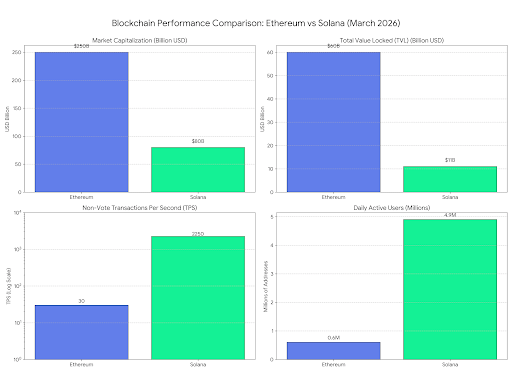
Key Metric Comparison (Visual Analysis)
The provided data visualization captures four critical performance and adoption indicators that define the trade-offs between the two networks.
Core Analysis and Specialization
The diverging data in the graphs reflects two fundamentally different architectural paths chosen to address the Blockchain Trilemma (Decentralization, Security, Scalability).
1. Ethereum: The Modular Security Hub
Ethereum (represented in blue) continues to define its legacy by prioritizing Decentralization and Security. Its transition to Proof-of-Stake established a secure, sustainable base layer (L1). However, as shown by its L1 TPS of \approx30 (on a log scale in the graph), it is not designed for high-frequency user transactions.
Modular Approach: Ethereum delegates scaling to Layer 2 (L2) Rollups (e.g., Arbitrum, Base). The L1 is the final settlement point for billions in assets, which explains its massive TVL (\approx\$60 Billion) and leading Market Cap (\approx\$250 Billion).
Professional Take: Ethereum is the institutional gold standard. It is the network of choice for protocols where finality, deep liquidity, and asset security are non-negotiable, such as high-value DeFi, stablecoin issuance, and tokenized real-world assets (RWAs).
2. Solana: The Monolithic Performance Engine
Solana (represented in green) was engineered specifically for Scalability at the base layer (L1), adopting a "Monolithic" architecture. It relies on a unique Proof-of-History (PoH) mechanism that allows for parallel transaction processing.
Transactional Dominance: This architecture translates to a usable, non-vote TPS of \approx2,250—roughly 75 times faster than Ethereum L1, and achieving near-instant finality (400ms).
Adoption Engine: These capabilities, combined with transaction fees that are effectively negligible (<\$0.001), have made Solana the dominant chain for retail activity. As visualized, Solana holds a significant lead in Daily Active Users (4.9 Million) on its base layer, fueling its growth to an \$80 Billion Market Cap.
Professional Take: Solana is the utility engine. It is the prioritized network for high-frequency DEX trading, complex gaming actions, fast payment systems (Solana Pay), and consumer-facing mobile applications where user experience requires speed and zero friction.
#GoogleStudyOnCryptoSecurityChallenges #BitmineIncreasesETHStake #solana #Ethereum #BitcoinPrices