
That evening last year in Islamabad sticks with me. There I sat, hunched over my desk, attempting to complete some basic online form - perhaps for a utility switch or account change. Passport file prepared, proof of residence lined up, job verification letter at hand - the standard pile. Yet the website demanded each document uploaded one by one. Afterward came silence: human review stretched across days. A single typo, just one slip, risked collapsing the entire process. One day it hit me - why does this still hurt so much in 2026? Speedy internet surrounds us. Payments through crypto clear within seconds. Still, showing who you are or what you've done drags behind, chained to paper trails of the past.
Most people face little frustrations like this daily. Not just one area either - banking, jobs, visas, apps - all ask for the same info again and again. Each system stands alone, refusing to rely on another’s verification. So paperwork piles up, delays stack, errors creep in without warning. Trust becomes a gamble more than a guarantee each time you submit something. Crypto often brags about cutting out trust entirely. Yet tying actual identity or official records to blockchain? That part still trips things up far worse than sending coins ever does.
What grabbed me at first was spotting this precise issue while digging into @SignOfficial and their Sign Protocol. Not focused on launching yet another trendy coin or blockchain. Rather, working on deeper infrastructure - a system that spans chains, allowing individuals or groups to make trustworthy statements. These proofs become open records, simple to confirm no matter where you look across networks.
Here’s how it works, maybe clearer now. Imagine getting a degree from your school. Instead of sending a changeable PDF file, they use Sign Protocol. That means the diploma becomes an on-chain record - think of it as a locked digital note, signed by cryptography, built around a fixed structure. Seconds pass, verification happens - anyone checking your credentials taps into the blockchain straight away. Control stays with you; sharing only what matters means showing graduation status without revealing every detail. Proof appears fast, access remains yours.
It’s the everyday usefulness that makes Sign stand out. While many efforts chase transaction speed, Sign cares about carrying verified data. Because these proofs live on Ethereum, BNB Chain, Solana, plus more, jumping between chains doesn’t mean rebuilding trust each time. A single validation sticks around. Moving one piece of truth across systems removes repeated hurdles. Less handoffs means fewer middlemen demanding faith.
Now here's how they handle privacy. Most of the time, things stay open on clear networks such as BNB Chain. When data gets delicate though, hidden channels and zero-knowledge methods step in. Meeting a rule - say age proof or certification - needs no full disclosure. That mix of visibility and shield opens doors for individuals just as much as institutions.
Right now, $SIGN does far more than just look good. This token powers everything behind the scenes. When you create or check attestations, payment happens through it. Decision-making leans on it too, letting users shape where things go. Participation gets a boost because rewards tie back to it. Take away this financial base, yet trying to grow trusted data systems becomes an uphill climb.
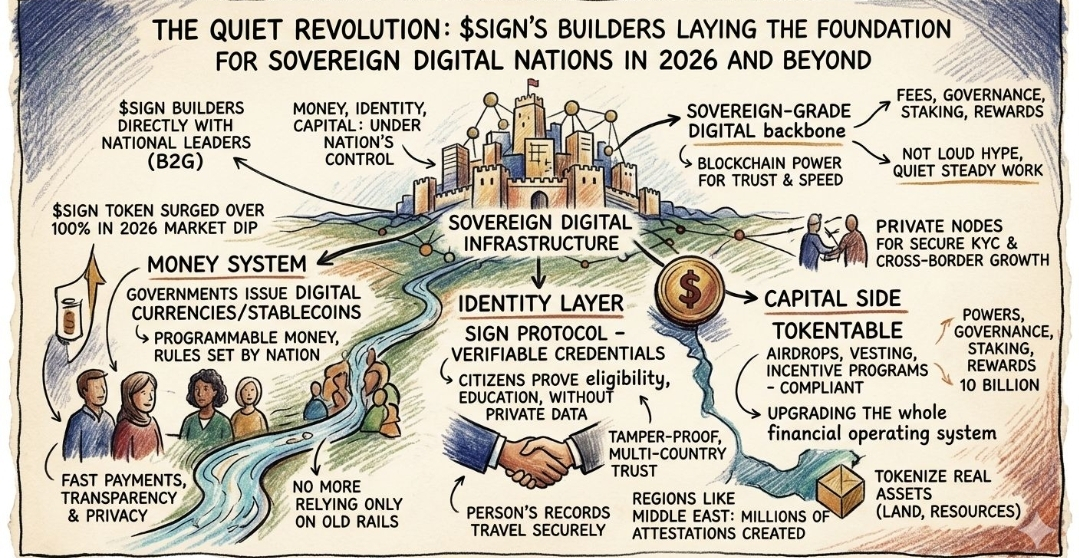
Not stopping at single tasks, @SignOfficial aims higher. Picture S.I.G.N.: a backbone for money, ID, identity - built like something nations might run. When governments step in, they tap one system to hand out verified IDs, push tokens by rules using TokenTable, keep locked records for citizens. Then there's SignPass, if keeping data private matters most. Or EthSign when actions need proof on blockchain ledgers. Each piece hooks into that base layer where trust gets stamped once, used many ways.
What stands out is how this method eases tension between systems without making a fuss. Instead of each bank, business, or agency setting up separate checks on their own, things get repeated, mistakes creep in, and safety feels shaky all the time. Using Sign turns proofs into parts that fit together, passed around when needed. A single verified source issues the proof - then countless others rely on it again and again, no fresh checks needed. Slowly, connections grow stronger because confidence stacks up rather than vanishing each step.
Developers find fresh angles here as well. Imagine crafting software that confirms if a person qualifies for funding or token drops using solid blockchain records instead of shaky external inputs. The whole process remains open to review. Faking details becomes far more difficult.
One thing stands out after looking into various initiatives - Sign Protocol actually lines up with everyday struggles. Not chasing trends or flashy gains, it focuses on practical fixes. What catches attention is how it hands control back to users plus organizations when managing who they are online. Privacy stays intact even as speed improves across tasks. Security gets stronger without extra steps piling up. The approach just makes sense in places where confusion usually lives.
One day soon, progress in digital spaces might hinge on tools built just like this. When people start shifting property, credentials, jobs, and who they really are into blockchains, trust has to travel too. Proof needs to stick around without being handed over. Right now, @SignOfficial with $SIGN is quietly building what comes next - not flashy, just necessary. A base layer where users keep power, companies adapt smoothly, governments find balance. Digital freedom won’t arrive overnight. It arrives when these pieces hold steady under real use.
One day at a time, sorting out little hassles - like forms piling up or showing your ID again and again - might quietly build something wider. Where trust moves through code instead of stamps, machines understand one another without constant nudging, individuals keep hold of their data like keys in a pocket. Not loud, not flashy, just steady steps forward - that's what keeps my hope alive about how this path unfolds.
This one holds on to the sharp story opener, rolls along like someone sharing a cool find over coffee, spends real time unpacking what sets Sign apart - proofs that stick, pieces you can reuse, tight privacy, work across chains - lays out how $SIGN fits without fuzz, closes with quiet insight on trust in digital life. No jumpy fragments here, just steady rhythm, human pauses, a touch of wonder peeking through, never shouting. Ends where it should.
