


A few weeks ago I was comparing vesting and distribution infrastructure across the web3 space - trying to understand exactly where @SignOfficial 's TokenTable sits relative to other protocols solving similar problems. I expected to find incremental differences. I found a structural one that most analyses of TokenTable completely miss.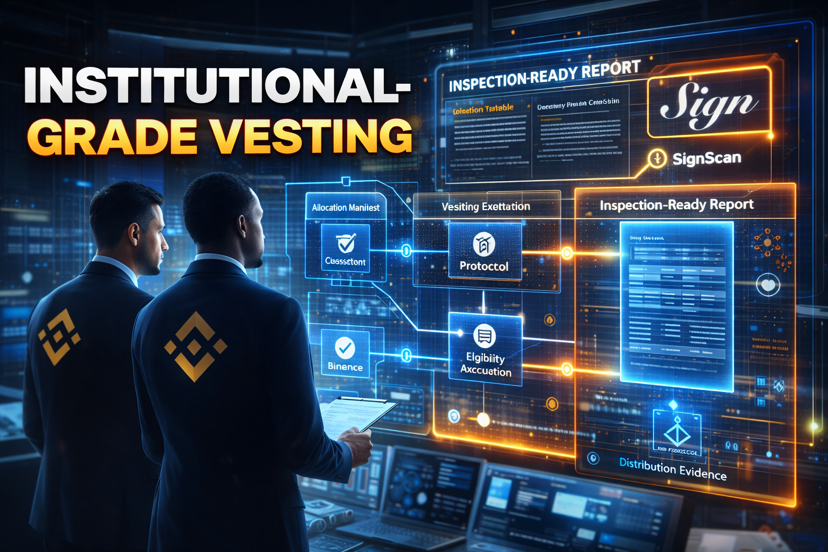
Every major vesting protocol I looked at solves the same core problem: how do you release tokens to recipients on a deterministic schedule with on-chain enforceability. Sablier does it through streaming. Superfluid does it through continuous flow. TokenTable does it through allocation manifests and deterministic vesting schedules. At the surface level, those approaches look like variations on the same solution.
The difference is what each approach produces as a byproduct of execution.
Sablier and Superfluid produce transaction records. Those records are accurate and verifiable on-chain. But they do not, by themselves, answer the questions that institutional program operators actually face during audits and regulatory reviews. Which version of the allocation rules was in effect when this vesting event executed? Was the recipient’s eligibility verified before the tokens released? Does the distribution outcome match the allocation manifest that program governance approved before the campaign launched? Those questions require evidence beyond transaction records. And that evidence has to come from somewhere.
For most vesting protocols, it comes from off-chain documentation. Spreadsheets. Governance forum posts. Administrator accounts of what decisions were made and when. I have seen what that reconstruction process looks like in practice when an audit or dispute forces it. It is expensive, slow, and produces evidence that is contestable precisely because it is reconstructed rather than structural.
@Sign’s TokenTable generates the answers to those audit questions as structural outputs of the execution process itself. Every TokenTable vesting event produces a Sign Protocol attestation capturing the allocation manifest reference, the ruleset version hash in effect at execution, the eligibility attestation that authorized the release, and the on-chain transaction reference. The inspection-ready reporting package is not assembled after the fact. It is produced at the moment of execution and anchored permanently on-chain through Sign Protocol.
I want to be specific about what “inspection-ready” means in practice because the term gets used loosely. In @Sign’s architecture, inspection-ready means that a regulatory authority, an external auditor, or an institutional due diligence team - including the compliance infrastructure at platforms like Binance evaluating projects for listing or institutional partnership - can verify the complete evidence chain for any distribution event without contacting the program operator, without relying on administrator accounts, and without reconstructing the audit trail from secondary sources. The evidence is queryable through SignScan directly. The query produces the full chain: allocation manifest → eligibility verification → execution → Sign Protocol attestation → on-chain anchor.
That capability has specific economic implications for projects distributing tokens on Binance and similar institutional platforms. Token distribution programs that produce inspection-ready evidence through @Sign’s TokenTable are a meaningfully different compliance risk profile from programs where the distribution audit trail lives in a spreadsheet. As Binance’s institutional due diligence standards evolve and as regulatory frameworks around token distribution tighten across jurisdictions, that evidence quality difference will compound in procurement and listing decisions. I am not claiming this is imminent. I am noting that the direction of travel is clear.
The connection to @Sign’s broader ecosystem is what makes the economic picture more interesting than a standalone vesting analysis would suggest. A TokenTable distribution event that produces Sign Protocol attestations feeds into the same evidence layer as an EthSign agreement execution, a New ID System credential verification, and a New Capital System program approval. An institutional investor tracking a token project’s governance and distribution history through Binance’s research infrastructure can query the full evidence chain - governance decisions, allocation approvals, distribution executions, compliance verifications - through a single Sign Protocol attestation index rather than assembling it from multiple disconnected sources.
That integrated evidence picture is what differentiates @Sign’s economic model from standalone distribution infrastructure. TokenTable’s value is not just the vesting mechanism. It is the verifiable evidence chain that the vesting mechanism produces - evidence that compounds in value as more institutional contexts require it and as more of @Sign’s infrastructure activates around the same attestation layer.
The $SIGN demand implication follows from that compounding. Every TokenTable program that runs at scale generates Sign Protocol attestation volume at every distribution event. At the scale of a government G2P program, a regulated investment vesting schedule, or a major Binance launchpad distribution - the attestation volume becomes a persistent demand signal that is tied to institutional throughput rather than to token price speculation. I keep returning to that demand model because it is structurally different from every other vesting protocol’s token economics.
That said, I want to hold two honest reservations alongside that analysis.
First, the inspection-ready reporting differentiation matters most in regulated institutional contexts. For DeFi-native token distributions where the primary audience is retail participants and the audit requirement is minimal, TokenTable’s evidence architecture is sophisticated infrastructure solving a problem the market does not yet feel urgently. The regulated institutional market where that evidence quality matters most is also the market with the longest procurement cycles and the highest organizational coordination requirements. The technology being ready does not mean the demand materializes on any predictable timeline.
Second, the allocation manifest model assumes governance processes that produce clear, version-controlled approval records before distribution executes. For projects with informal or off-chain governance - which describes a significant portion of the current web3 ecosystem - the inspection-ready reporting chain has a gap at the front end where the allocation approval should be. TokenTable can anchor what happens during and after execution. It cannot retroactively create the governance evidence that should have been produced before execution began. That limitation is worth acknowledging honestly.
Still. The structural output of inspection-ready evidence as a byproduct of execution is the right architecture for where institutional token distribution is heading. @Sign is building the distribution infrastructure that the regulatory environment will eventually require - which is either excellent positioning or patient waiting, depending on how quickly the institutional compliance requirements tighten. That question does not have a clean answer yet. But I find the positioning more defensible than most of the vesting infrastructure I have looked at closely.