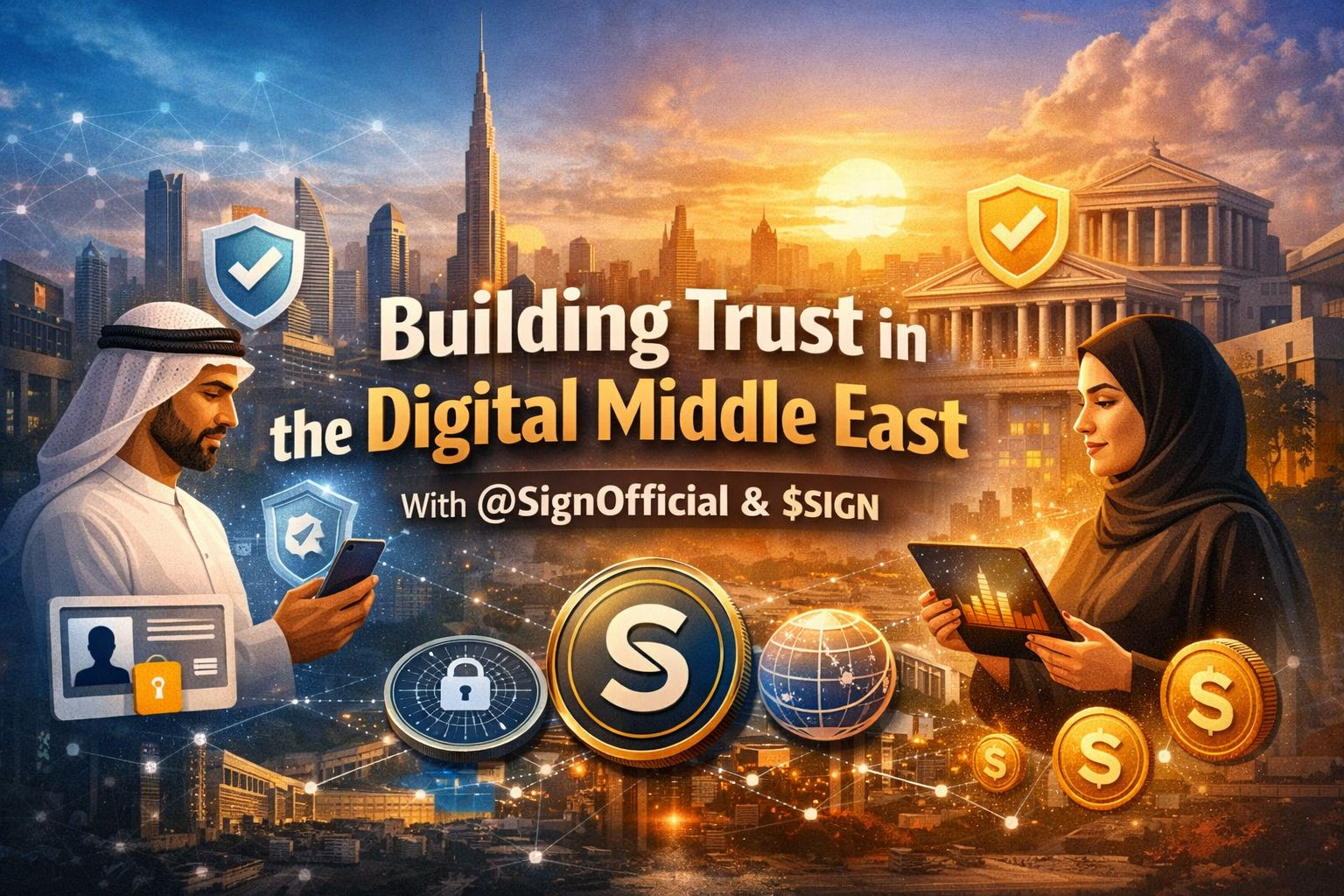
If you really think about it, most of our online systems still run on one fragile thing — trust. We trust platforms with our data, institutions with our identity, and systems with our money. But honestly, a lot of the time that trust feels forced rather than earned. That’s exactly why something like @SignOfficial starts to stand out. It doesn’t just talk about innovation, it focuses on fixing something very real that people deal with every day.
I’ve noticed that in normal situations, whether it’s signing up for a service, verifying documents, or moving funds, the process is often slow and repetitive. You keep proving the same things again and again. It’s frustrating, and more importantly, it exposes more of your personal data than necessary. Sign approaches this differently. Instead of asking you to share everything, it lets you prove only what’s needed. That small shift actually feels big when you think about privacy and control.
For a region like the Middle East, this kind of system feels timely. There’s already a strong push toward digital growth, smart infrastructure, and global positioning. But behind all of that, there’s a quiet need for systems that people can actually rely on. From what I see, Sign fits into that gap. It creates a layer where information can be trusted without constant verification loops, and that can make a real difference for businesses and institutions trying to move faster.
What makes $SIGN interesting to me is that it’s not just sitting there as a token with no purpose. It’s part of how the whole system works. It supports transactions, keeps the network active, and gives people a voice in how things evolve. When a project is designed this way, it feels less like something you just use and more like something you’re part of building over time.
Another thing that stands out is the approach to privacy. Right now, most systems ask for too much just to confirm something simple. That never really made sense, and people are starting to realize it. With Sign, the idea is more practical — prove what matters, keep the rest yours. That balance between transparency and privacy is something that could become very important, especially as regulations and expectations grow in the region.
In my opinion, what makes Sign valuable isn’t just the technology, it’s the timing. The Middle East is at a stage where the right infrastructure can shape the next decade of growth. If trust becomes easier, faster, and more reliable, everything else builds on top of that more smoothly.
At the end of the day, people don’t adopt technology just because it’s advanced. They adopt it because it makes life easier and feels safe to use. That’s where @SignOfficial and $SIGN seem to be heading. It’s not about hype, it’s about solving something fundamental. And if it continues in this direction, it could quietly become one of those systems that a lot of digital progress depends on without people even realizing it.