
Most public systems don’t fail because they lack data.
They fail because they ask for too much of it.
That’s the part that doesn’t show up in design discussions.
In environments like clinics, schools, transport, licensing, or assistance programs, the system isn’t trying to understand a person completely. It’s trying to answer something specific.
Are you eligible here.
Do you qualify for this.
Is this still valid.
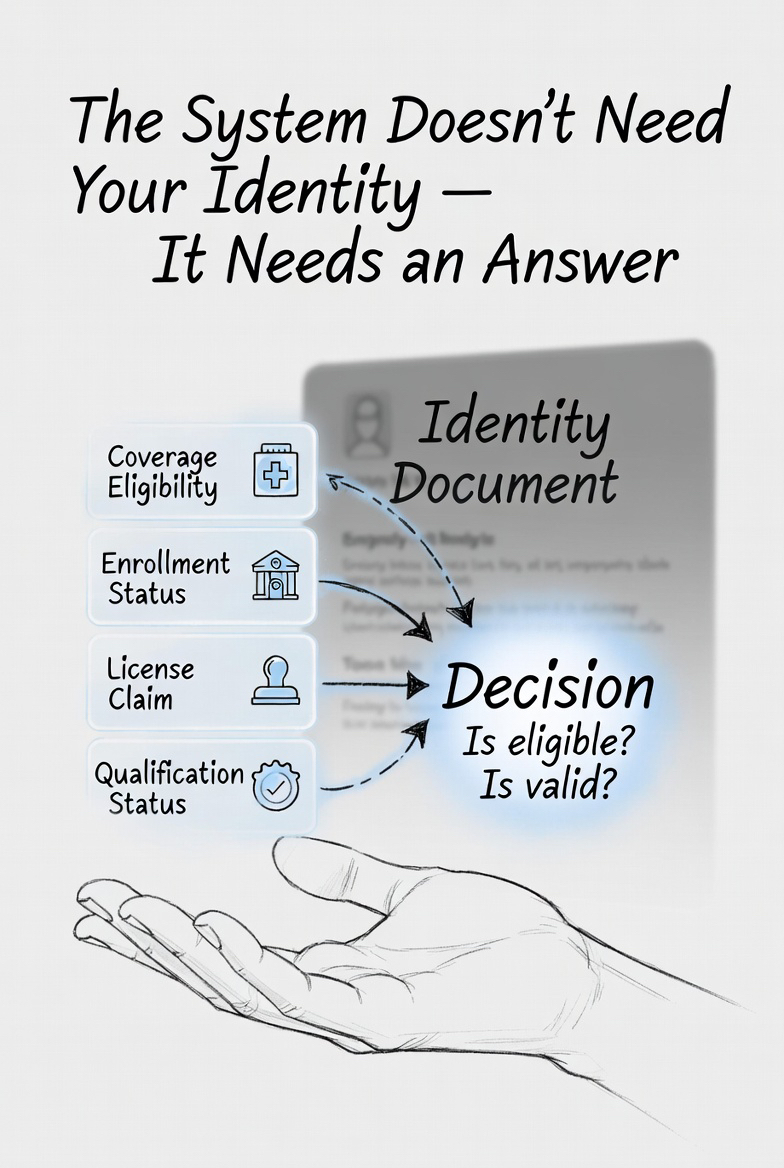
But the system doesn’t ask those questions directly. It asks for identity.
And once identity enters, everything expands.
I didn’t really think selective disclosure was a real requirement until I saw how public services actually operate.
On paper, everything sounds clean. A person shows a credential, the system verifies it, access is granted. But in real environments, the question being asked is almost never who are you in full?
It’s always narrower.
Take a public clinic.
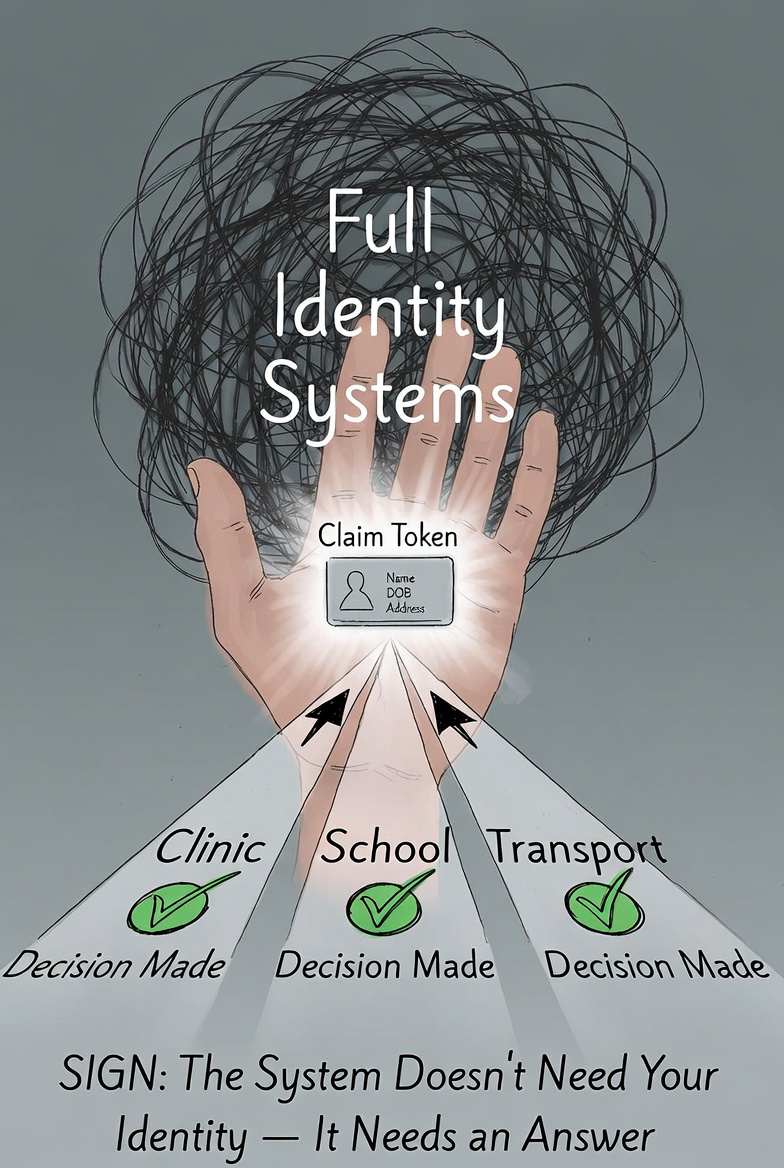
The system doesn’t need your full identity profile. It needs to know if you are covered under a program. But today, the easiest way to answer that is still full ID verification.
So the system collects everything, then extracts what it actually needs.
The system doesn’t need your identity. It needs an answer.
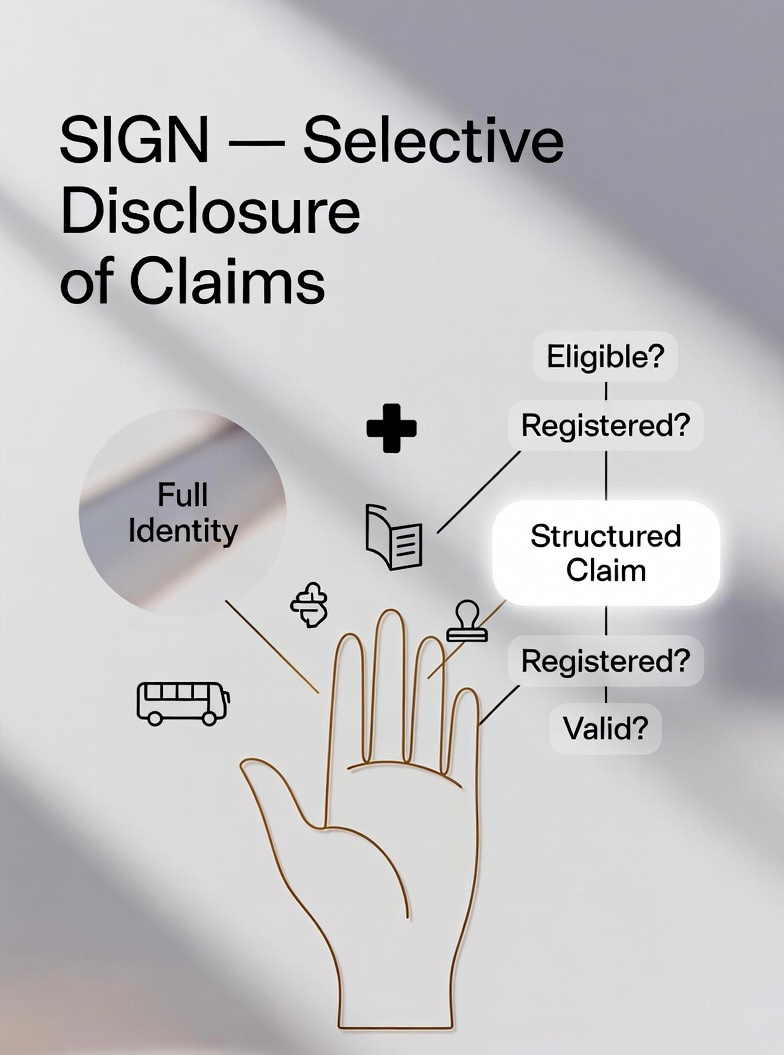
The problem is structural. Most systems don’t have a smaller unit of truth to operate on. Identity becomes the default because nothing else is standardized enough to replace it.
Same pattern shows up in schools.
Enrollment systems verify identity, but what matters day to day is something else. Is the student registered. Are they eligible for transport. Do they qualify for a program.
Yet identity becomes the gateway to all of it.
Not because it’s required. Because nothing else is structured enough to replace it.
Transport systems follow the same logic.
Discount eligibility, residencybased access, concession passes. These are condition based decisions. But instead of verifying the condition, systems verify the person and then infer the condition internally.
Again, identity is doing more work than it should.
Licensing systems already have the right abstraction.
A license is a claim. It represents that a person is allowed to do something under defined conditions. But many systems still pull full identity into the flow, even though the license already contains the relevant truth.
So the system verifies both the identity and the claim, instead of trusting the claim on its own.
Assistance programs show the failure more clearly.
Eligibility changes. Conditions update. But once identity is collected, systems keep relying on it as a persistent reference, even when the underlying state has changed.
So the system continues to verify something that is no longer true.
Identity doesn’t break loudly. It drifts.
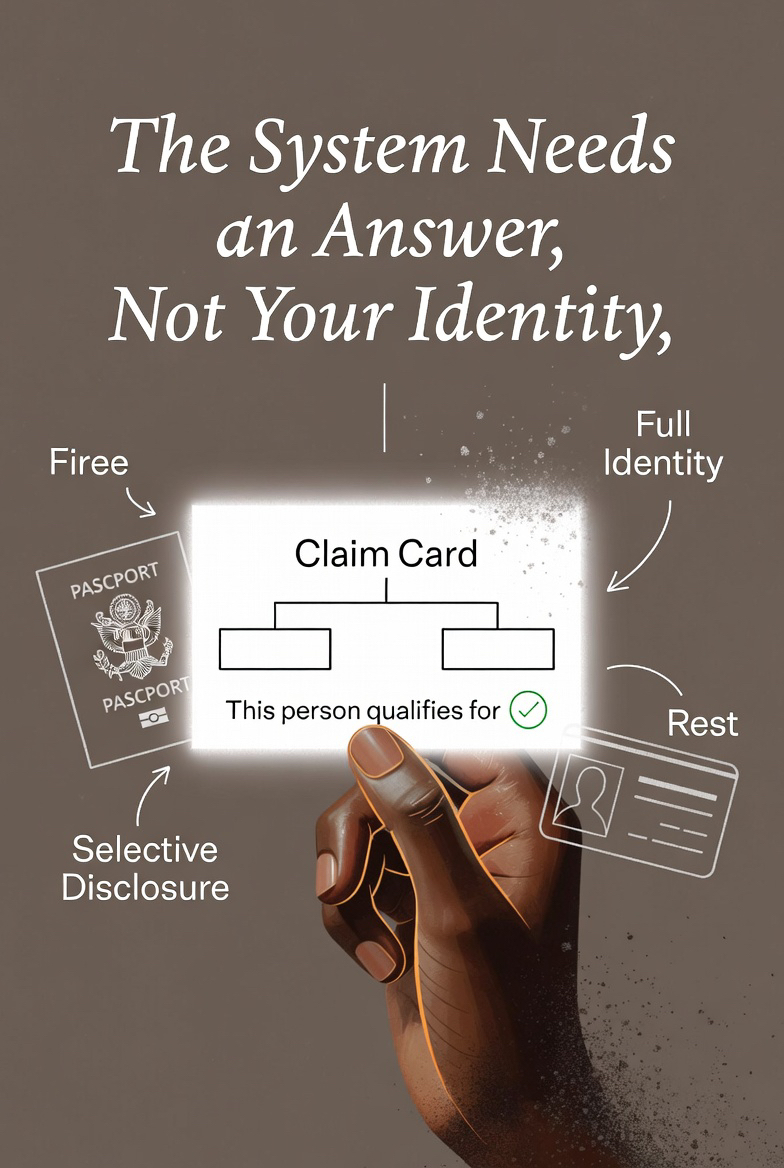
That drift exists because identity is static, while real-world conditions are not. Most systems verify correctness at one point in time, but they don’t enforce freshness at the moment of use.
That’s where selective disclosure becomes more than a privacy feature.
It becomes a correction to how systems ask questions.
What selective disclosure actually does is limit what is revealed at the moment of verification.
Not everything about the user. Only what is required.
But for that to work, the system needs something smaller than identity to operate on.
Without that unit, even zero knowledge systems fall back into identity reconstruction.
That’s where SIGN becomes necessary.
Without a system like SIGN, selective disclosure doesn’t hold. It collapses back into identity again.
This is not an improvement path. It is a replacement layer.
SIGN structures credentials as claims.
Not raw identity containers.
Each claim is tied to a schema, issued by an entity responsible for that decision, and designed to be consumed directly by verifiers.
Hospitals issue coverage eligibility.
Schools issue enrollment status.
Regulators issue licenses.
Programs issue qualification status.
The user doesn’t define the claim. The institution does.
These claims are not just presented. They are proven.
Using zero-knowledge verification, the system can confirm that a claim satisfies required conditions without exposing the underlying data. The verifier checks validity, not identity.
The verifier does not trust the issuer or the user directly. It trusts the proof generated against the schema.
Now selective disclosure changes meaning.
It’s not about hiding data.
It’s about selecting the correct unit of truth.
The verifier doesn’t need to reconstruct the person.
It evaluates the claim.
And because the claim is schema bound, interpretation doesn’t drift across systems. The same condition carries the same meaning, regardless of where it is used.
Schemas act as deterministic interpretation layers. They ensure that a claim verified in one system is understood identically in another.
This changes system behavior in a quiet but important way.
Identity stops being the default input.
Claims become the interface.
That reduces more than exposure.
It reduces system weight.
Because systems no longer need to store unnecessary identity data, reconcile across departments, or rebuild decisions from scratch.
There’s also a timing problem most systems don’t handle well.
Public services operate in changing conditions.
Eligibility updates.
Licenses expire.
Programs shift.
Identity stays static once collected.
Claims don’t.
Claims can be re evaluated at the moment of verification, or revoked by the issuer, allowing the system to depend on current truth instead of historical validation.
That’s the difference.
Identity tells you who someone was verified as.
Claims tell you whether something is still true.
Most systems don’t verify truth. They verify identity and assume the rest.
That’s where most systems quietly fail.
They verify correctly.
But they don’t stay correct.
With structured claims, the system doesn’t rely on outdated identity.
It resolves current conditions.
SIGN doesn’t remove complexity.
It constrains it.
By structuring claims, assigning issuer responsibility, enforcing schemas, and enabling verifiable proofs, it gives systems a way to operate on exactly what they need.
No more.
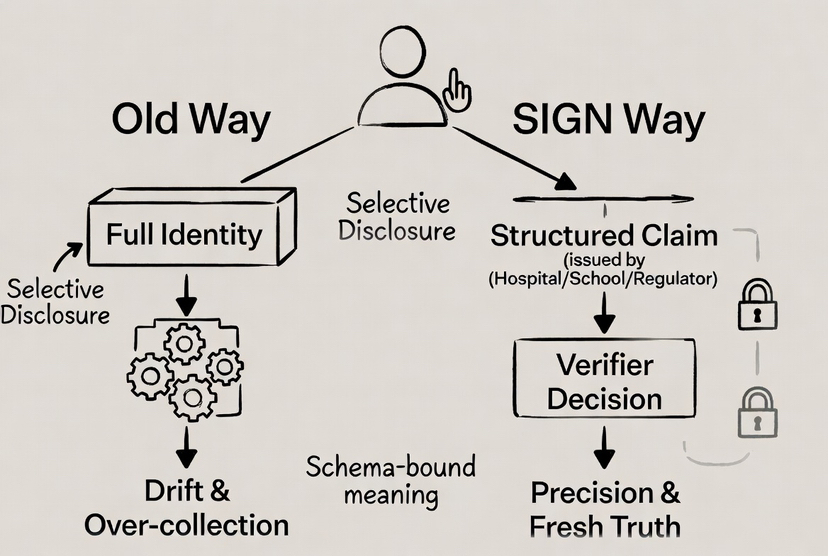
This is where most alternative systems break. They either preserve identity as the core primitive or introduce proofs without standardizing what is being proven. In both cases, systems fall back to reconstructing the user instead of evaluating the condition.
SIGN avoids that failure by making the claim not the identity the atomic unit of verification.
That’s where selective disclosure stops being about privacy.
It becomes about precision.
And in public systems, precision matters more than completeness.
Because the system doesn’t need to know everything about you.
It just needs to know enough to make the right decision.
If a system still needs full identity to answer every question,
then it hasn’t become more secure.
It has just become heavier.
#SignDigitalSovereignInfra $SIGN @SignOfficial
