I’ll be honest, I didn’t go looking for S.I.G.N. It kind of found me. One of those late-night scrolls where everything starts to blur together new tokens, bold claims, “next-gen infrastructure” promises. I’ve seen enough of those to be skeptical by default. But this one felt different. Not louder. Not flashier. Just quieter, almost like it wasn’t trying to sell me anything.
At first, I didn’t even get what it was. It’s not an app. Not a token you ape into. Not even something you “use” in the traditional sense. And that’s probably why I kept reading.
The more I dug in, the more it started to click. S.I.G.N. isn’t really a product it’s more like a blueprint. The kind of thing you’d expect governments or massive institutions to think about when they’re trying to rebuild how their digital systems actually work. And I mean everything money, identity, public spending. The core stuff.
What pulled me in wasn’t the scale though. It was the simplicity of the idea underneath it all.

I started thinking about how most digital systems work today, and it hit me almost everything runs on claims. Someone says they’re eligible for something. A company says it’s compliant. A system logs that a payment happened. And most of the time, we just accept it. Not because it’s perfect, but because it’s been “good enough.”
But now everything is connected. Systems don’t live in silos anymore. Agencies overlap, vendors change, data flows across borders. And suddenly, that quiet assumption of trust starts breaking in weird, subtle ways.
That’s where S.I.G.N. really started making sense to me.
Instead of trusting claims, it pushes everything toward proof. Not in a philosophical way, but in a very literal, technical sense. Every claim gets tied to whoever made it, signed cryptographically, and stored in a way that others can verify later. They call these things “attestations,” which sounds complicated, but honestly, it’s just proof attached to a statement.
And yeah, I know that sounds obvious when you say it out loud. But the more I thought about it, the more I realized how few systems actually work like this.
Once you have that kind of verifiable proof, things start to shift. You don’t need ten different databases trying to reconcile the same information. You don’t have to keep re-checking everything from scratch. You carry proof with you, and anyone with permission can verify it.

From there, S.I.G.N. builds outward. I noticed it splits the world into three big areas: money, identity, and capital. At first I thought, “Okay, standard framework stuff.” But it’s deeper than that.
The money side isn’t just about putting currency on-chain and calling it innovation. It’s about control and clarity at the same time. Think digital currencies with built-in rules limits, approvals, even emergency controls if something breaks. But also real-time settlement, where there’s no ambiguity about whether a transaction actually happened.
What really stuck with me was the tension it tries to handle visibility versus privacy. Regulators need oversight, obviously. But people don’t want their entire financial lives exposed. S.I.G.N. doesn’t pretend that problem goes away. It just tries to balance it in a structured way.
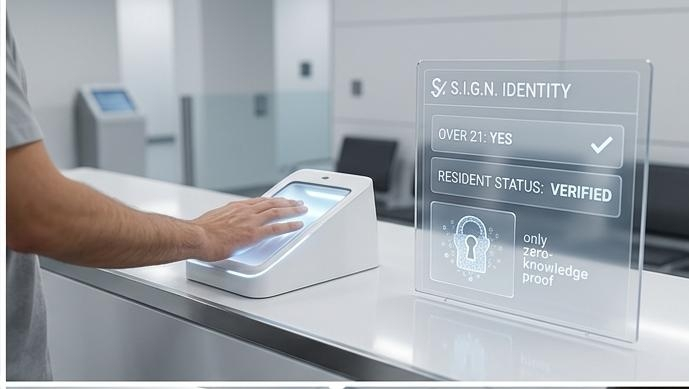
Then there’s identity, which honestly feels like something we’ve needed for a long time. Instead of constantly querying central databases, the system leans into verifiable credentials. I started imagining what that looks like in practice proving I’m over a certain age, or that I qualify for something, without handing over everything about myself.
That idea alone feels like a shift. Less exposure, more control.
But it’s not naive about it either. Not everyone gets to issue these credentials. There’s a trust registry in place basically a system for deciding who is allowed to vouch for what. Without that, the whole thing would fall apart.
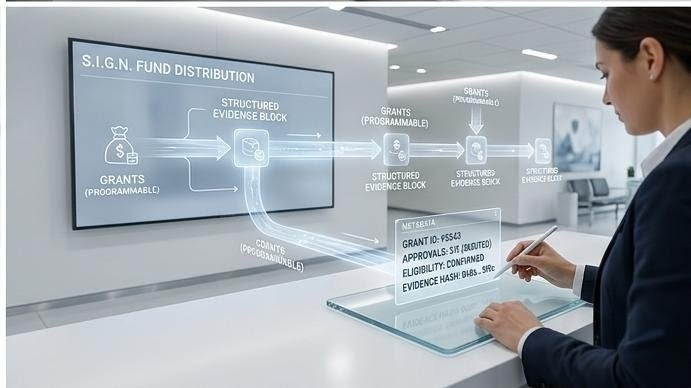
And then there’s the capital side, which I think is where things get really real. Distributing funds whether it’s government aid, grants, or incentives is messy. I’ve seen how easily it breaks. Wrong people get included, right people get missed, rules change halfway through.
S.I.G.N. approaches that by making distribution programmable and, more importantly, provable. Every decision, every transfer, every rule it all leaves evidence. Not just logs buried in some backend system, but structured proof that can actually be verified.
That idea of an “evidence layer” kept coming back to me as I read. It’s like everything feeds into this one core principle: every action should answer the same questions. Who approved it? Under what authority? When did it happen? What rules applied at that moment?
And instead of scattering those answers across disconnected systems, it gets recorded in a consistent, verifiable way.
What I also found interesting is that it doesn’t force everything onto a public blockchain. That would be chaos, especially for sensitive data. There’s flexibility fully on-chain, fully off-chain, or some mix of both. It feels practical, not ideological.
Now, stepping back from the tech for a second, I couldn’t help but think about the market side of things. Because let’s be real most investors aren’t looking for infrastructure blueprints. They’re looking for narratives, momentum, something that moves fast.
And S.I.G.N. doesn’t really play that game. It’s not flashy. It doesn’t scream “next 100x.” If anything, it feels slow, methodical, almost boring on the surface. But sometimes that’s where the real shifts happen.
That said, I can also see the challenges. Systems like this don’t just need adoption they need alignment. Governments, institutions, regulators they all have to move in some kind of coordination. And that’s never easy. There’s also the question of trust ironically enough. Even if everything is verifiable, people still need to trust the system enough to use it in the first place.
I keep going back and forth in my head. Part of me sees this as foundational like something that quietly reshapes how digital systems work over time. Another part of me wonders if it’s too ambitious, too dependent on slow-moving institutions to ever fully take off.
But I can’t shake the core idea. Fix how systems prove things, and everything built on top of them starts to feel stronger.
So now I’m left with this question I can’t quite answer am I looking at the early stages of real digital infrastructure or just another well-designed experiment that the world isn’t ready for yet?