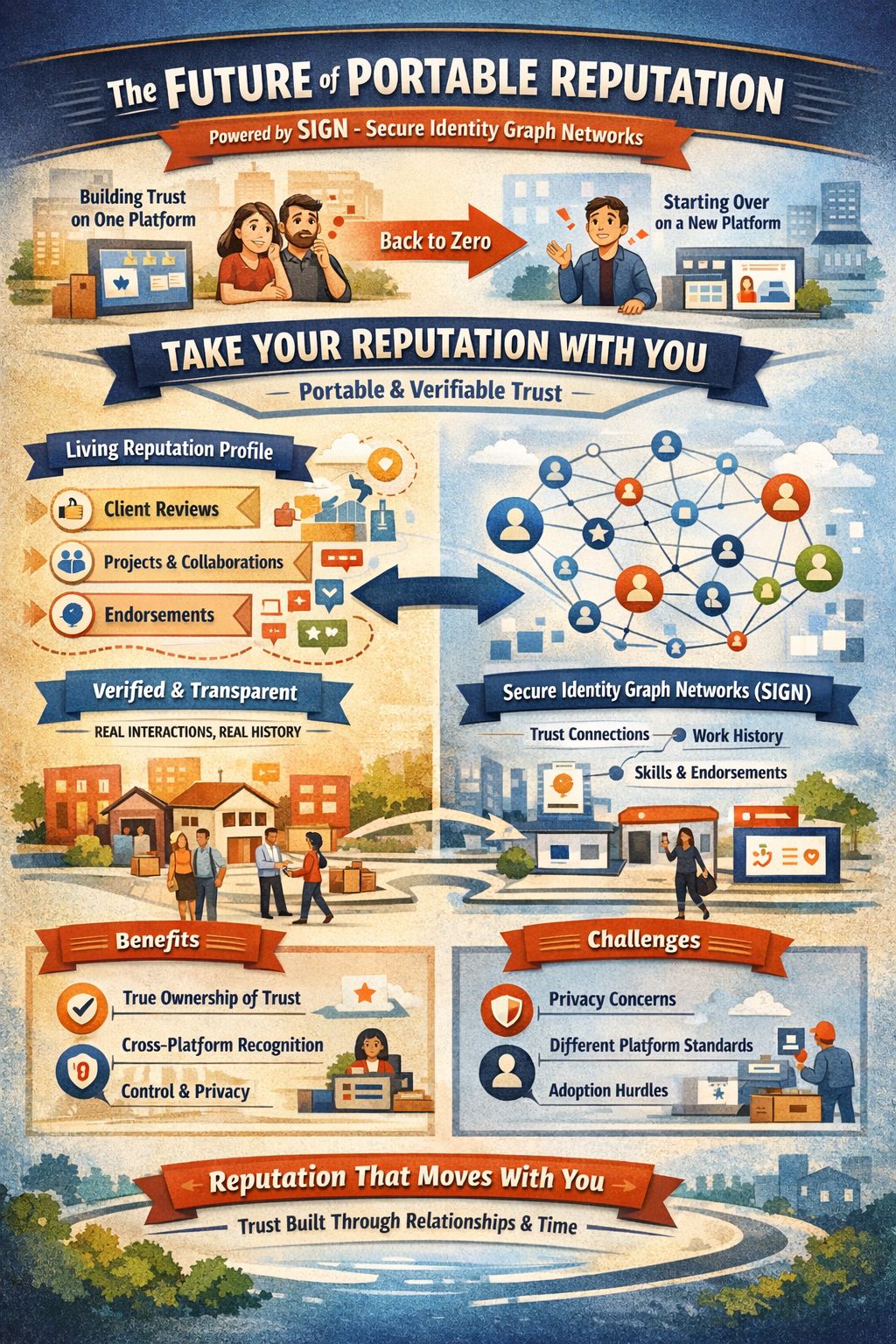
Reputation online has always felt a bit… trapped. You can spend years building trust somewhere—earning good reviews, doing honest work, showing up consistently—and then the moment you step onto a new platform, it’s like none of it ever happened. You’re back to zero, standing in a crowd of strangers, trying to prove yourself all over again.
It’s something people quietly deal with all the time. A freelancer switches platforms and suddenly looks inexperienced. A seller with hundreds of happy customers has to convince new buyers from scratch. Even someone active in online communities—answering questions, helping others—loses that sense of recognition the second they move elsewhere.
Portable reputation systems come from that frustration. The idea is simple in spirit: your reputation should belong to you, not the platform you happened to build it on. But actually making that work is much harder than it sounds.
This is where SIGN—Secure Identity Graph Networks—starts to feel interesting, not because it promises some magical fix, but because it approaches the problem in a more human way. Instead of turning trust into a single number or badge, it looks at the relationships behind it.
Think about how trust works in real life. You don’t trust someone because of a score floating above their head. You trust them because of experiences—what they’ve done, who they’ve worked with, how they’ve behaved over time. SIGN tries to capture that same idea digitally.
It doesn’t just store “you have 4.9 stars.” It connects the dots. Who gave those reviews? What kind of work were you doing? Were those one-off interactions or long-term collaborations? Over time, this builds a kind of living map of your reputation, not just a snapshot.
Imagine a designer who has spent years working with clients. On one platform, they’ve built strong relationships—clients come back, recommend them to others, trust their judgment. Normally, if they move somewhere new, all of that gets reduced to a few lines in a bio or a portfolio link that may or may not be taken seriously.
With a system like SIGN, those past interactions don’t disappear into vague claims. They become verifiable signals. A potential client doesn’t just see “experienced designer”—they see patterns. They can tell this person tends to keep long-term clients, delivers consistently, and earns positive feedback in specific types of work.
There’s something reassuring about that. It feels closer to how we naturally judge trust anyway—not by a single metric, but by looking at the story behind someone’s track record.
Another subtle shift here is verifiability. Right now, a lot of trust online depends on what a platform tells you. If a site says someone is highly rated, you either believe it or you don’t. There’s not much room to question how that conclusion was reached.
SIGN changes that dynamic a bit. Each piece of reputation—reviews, endorsements, interactions—can be independently verified. It’s not just a claim sitting on a profile. It’s something that can be traced back to an actual interaction.
That doesn’t just make things more trustworthy—it changes how people behave. When reputation is more transparent and harder to fake, there’s less incentive to game the system and more reason to actually earn trust.
Of course, it’s not all smooth and perfect.
One thing that comes up quickly is privacy. Not everything you’ve done should follow you everywhere. There are moments in anyone’s history that are context-specific or just… personal. A system like this needs to give people real control over what they share and where.
Then there’s interpretation. Even if all the data is accurate, different platforms might read it differently. One place might care about long-term relationships, another might focus on speed or volume. The same reputation could mean different things depending on where you go.
And then there’s the biggest hurdle of all: getting people to actually use it. A portable system only works if multiple platforms agree to recognize it. Otherwise, it risks becoming just another layer that doesn’t quite connect anything.
Still, even with those challenges, the direction feels right. There’s a growing sense that people should have more ownership over their digital identity—not just their data, but the trust they’ve built over time.
When your reputation moves with you, it changes your mindset. You’re less afraid to try something new. You’re more willing to leave spaces that don’t serve you anymore. You’re not constantly starting over, proving the same things again and again.
It also quietly shifts the balance of power. Right now, big platforms hold onto users partly because they hold onto their reputation. If that reputation becomes portable, people have more freedom to move—and smaller platforms have a fairer chance to compete.
At its core, this isn’t really about technology. It’s about something much simpler: continuity. The idea that what you’ve done should matter, no matter where you go next.
SIGN is just one way of approaching that idea, but it captures something important. Trust isn’t a number. It’s a pattern. It’s built through interactions, through consistency, through time.
And maybe, finally, we’re starting to build systems that reflect that.
#SignDigitalSovereignInfra @SignOfficial $SIGN