Trust has never been something you solve neatly with a slogan or a protocol. People are messy. Systems are fragmented. Incentives get distorted. Even strong ideas can start to break the moment real human behavior enters the picture.
That’s a big part of why SIGN caught my attention.
What stands out to me is that it doesn’t feel like it comes from the assumption that people will suddenly behave like perfect actors inside a perfectly designed system. It feels more grounded than that. It feels like it understands trust is always moving, always contextual, and never as simple as most systems want it to be. Instead of trying to erase that complexity, SIGN seems to be building around it.
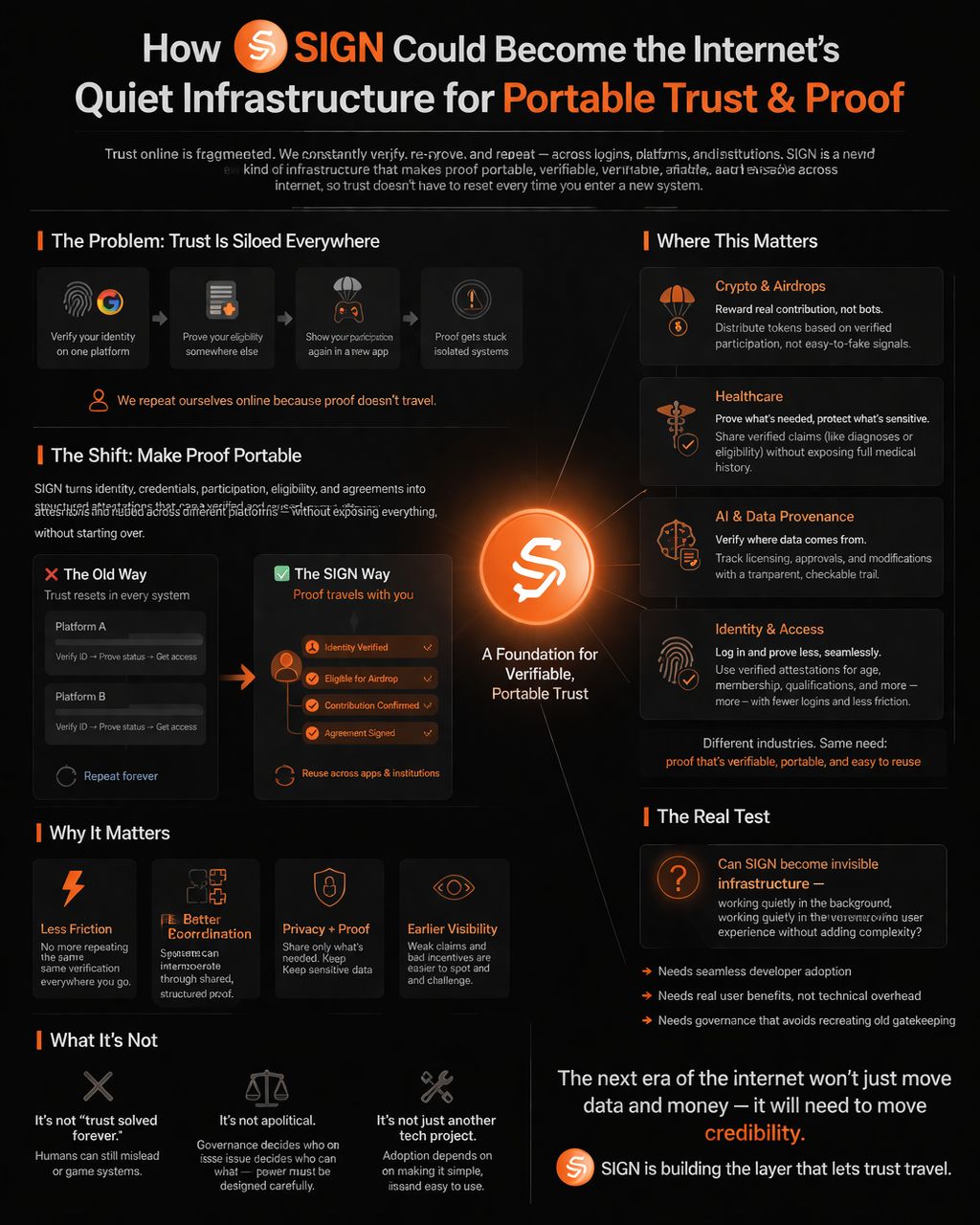
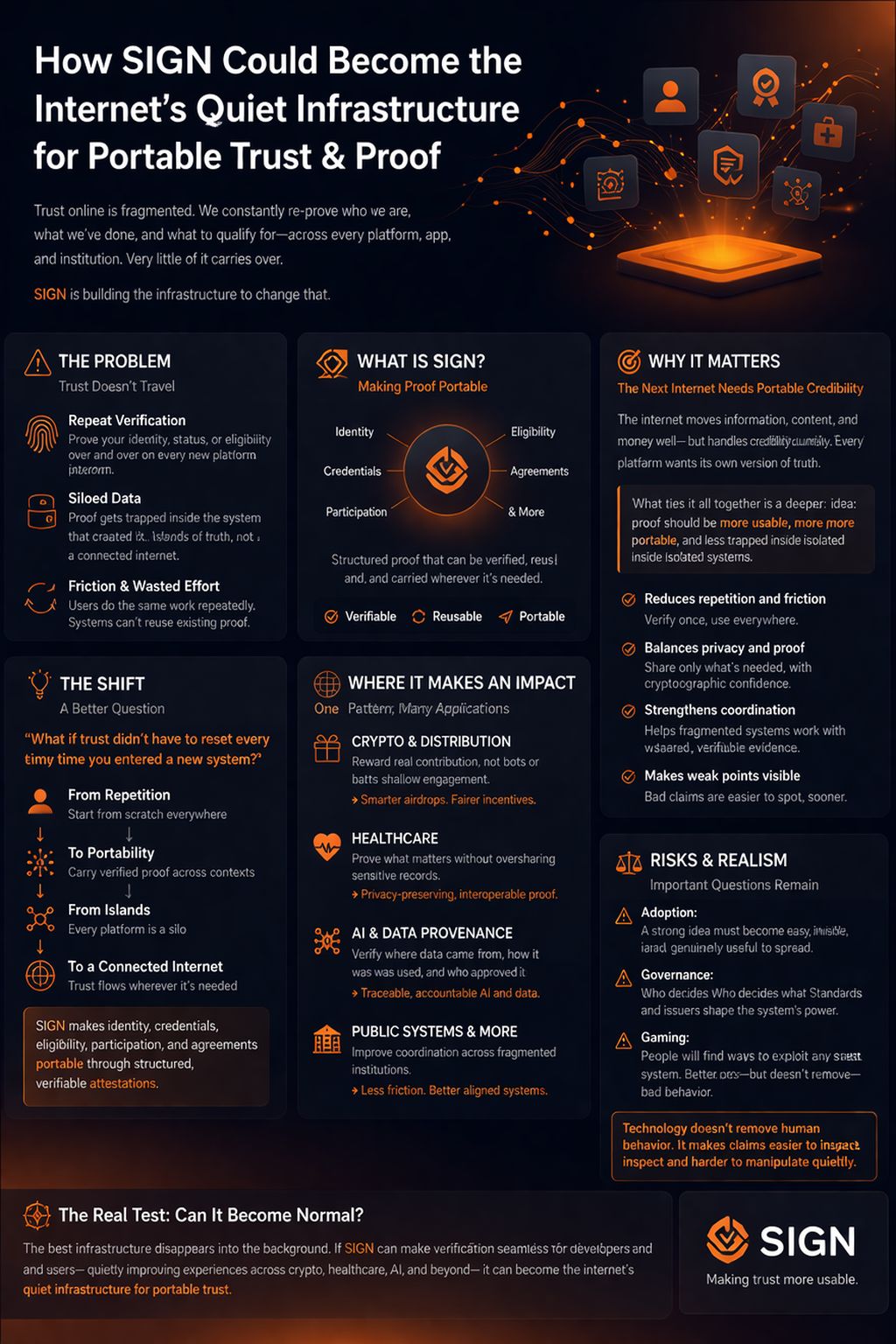
The easiest way I think about it is this: SIGN is trying to make proof more portable.
Right now, almost everything online forces us to repeat ourselves. We verify who we are on one platform, then do it all over again somewhere else. We prove eligibility in one place, then start from zero in another. We show what we’ve done, what we own, what we qualify for, and most of that proof stays locked inside the system that first checked it.
Very little carries over in a natural way.
That’s where SIGN starts to feel important to me.
It’s trying to make things like identity, participation, credentials, eligibility, and agreements into something that can actually travel. Not as vague reputation, but as structured proof that can be verified later and reused somewhere else. On the surface that sounds technical, but the impact is actually very human. It means less repetition, less friction, and less dependence on isolated platforms acting like they’re the only place where trust can exist.
And to me, that’s the real shift here.
The internet has gotten very good at moving information, content, and money. But it still handles credibility in a clumsy way. Every app wants its own version of truth. Every platform becomes its own little island. SIGN seems to push against that by asking a better question:
What if trust didn’t have to reset every time you entered a new system?
That idea opens up more than people realize.
In crypto, it immediately changes how I think about distribution. So many airdrops and reward systems have been shallow, noisy, and easy to exploit. Bots farm rewards. Users learn how to mimic engagement. Projects end up distributing value based on weak signals because they don’t have better ways to measure meaningful participation.
If contribution or eligibility can be expressed through real attestations, then distribution becomes more intentional. It starts feeling less random and more aligned with what a project actually wanted to reward.
And that alone already makes the idea useful.
But I think the bigger story exists outside crypto too.
Take healthcare. Right now, people constantly deal with fragmented records, disconnected institutions, and repeated verification. In a better system, you wouldn’t always need to reveal your full history just to prove one important thing. You could present a verifiable claim showing you’re eligible for a treatment, or that a diagnosis has already been confirmed, without exposing everything behind it.
That balance between privacy and proof is powerful.
It respects the fact that some information is sensitive while still allowing systems to act on what matters.
The same pattern shows up in AI, and that’s one of the reasons SIGN feels timely to me.
We’re moving into a period where provenance matters more and more. People want to know where data came from, whether it was licensed properly, how it was modified, who approved it, and whether any of that can actually be verified instead of just claimed. Right now, a lot of that still depends on trust in institutions and documentation most people never fully see.
A system built around attestations changes that dynamic. It gives data, workflows, and decisions a trail that can be checked instead of simply assumed.
That doesn’t solve everything, obviously.
But it feels like a much stronger foundation than vague trust and scattered paperwork.
And maybe that’s what makes SIGN interesting to me. It doesn’t just feel like an identity project or a token infrastructure project. It feels more like coordination infrastructure. It sits underneath other systems and helps them work with evidence in a cleaner, more reusable way.
That matters because a lot of the internet’s deeper problems are really coordination problems. It’s not always that we lack data. It’s that we can’t verify it smoothly, move it responsibly, or reuse it across contexts without starting over. Proof gets stuck. Trust gets siloed. Institutions don’t communicate well. Platforms create their own closed loops.
And users are left doing the same work again and again.
SIGN seems to be addressing that broken pattern at the root.
At the same time, I don’t think it makes sense to get carried away.
A strong idea is not the same as strong adoption. I’ve seen too many technically smart systems go nowhere because they never crossed the gap between potential and actual use. For SIGN to matter at scale, it can’t just be conceptually elegant. It has to become easy. Developers need to integrate it naturally. Users need to benefit from it without feeling like they’re learning a new language.
The best version of this kind of infrastructure is almost invisible.
It should quietly improve the experience in the background.
That’s a hard thing to achieve.
There’s also a governance question I can’t ignore. Any system that tries to formalize trust eventually runs into the same issue: who decides what counts? Who gets recognized as a valid issuer? Who defines the standards? Who has the power to shape what credibility looks like inside the system?
That’s where things get complicated, because trust infrastructure is never purely technical. It always reflects power somewhere. Even a decentralized system can end up recreating old gatekeeping structures if a small group becomes the default source of legitimacy.
That’s not just a SIGN problem. It’s a deeper issue with any system trying to structure credibility.
But it’s still something worth taking seriously.
Then there’s the simplest reason for skepticism: people will always find ways to game systems.
Even with better verification, people can still mislead, selectively reveal information, exploit edge cases, or design incentives in bad faith. A protocol can be sound and still produce bad outcomes if the human layer around it is flawed.
That’s one of the most important things to remember in this space.
Technology doesn’t remove human behavior. It just shapes the environment human behavior moves through.
What I appreciate about SIGN is that it seems more aware of that than a lot of projects are.
It doesn’t feel like it’s pretending trust becomes pure just because it becomes cryptographic. It feels more like it’s trying to make claims easier to inspect, easier to verify, and harder to manipulate quietly.
That’s a much more realistic goal.
It doesn’t eliminate failure, but it may reduce the amount of invisible failure that builds up underneath a system before anyone notices.
And honestly, that’s a meaningful improvement.
Most breakdowns don’t happen all at once. They happen slowly. Weak assumptions pile up. Bad incentives go unchecked. Unverifiable claims become normal. Coordination gets sloppy. By the time the system visibly fails, the damage has usually been forming for a while.
Better evidence layers don’t magically stop that, but they can make the weak points more visible earlier.
That’s why the timing feels right to me too.
The conversation around AI is shifting toward accountability. Digital identity is becoming more important, but people are also more wary of surveillance and centralized control. Healthcare and public systems still need better interoperability without exposing everything. Crypto, at least in some corners, is gradually moving away from pure hype and toward infrastructure that actually helps systems coordinate better.
SIGN sits right in the middle of that shift.
It touches identity, but it isn’t only about identity.
It touches incentives, but it isn’t only about token distribution.
It touches agreements, but it isn’t only about signatures.
What ties it all together is a deeper idea that proof should be more usable, more portable, and less trapped inside isolated systems.
That’s why I think it’s easy to underestimate.
On the surface, it can look like just another protocol talking about attestations. But underneath that, it’s making a much bigger bet: that the next version of the internet will need credibility to move more freely than it does today.
Not just data.
Not just money.
Credibility itself.
And if that turns out to be true, then projects like SIGN become much more important than they first appear.
Still, I think the real test is very simple.
Can it become normal?
Can it become the thing that works so smoothly in the background that people stop thinking about the verification layer at all? Can it make digital trust feel less repetitive, less fragmented, and less dependent on closed platforms? Can it actually move from interesting concept to infrastructure people quietly rely on?
That’s the part that matters most.
Because in the end, I don’t think SIGN is interesting because it claims to solve trust once and for all.
I think it’s interesting because it’s trying to make trust more usable in a world where everything is connected, but credibility still isn’t.
And that feels like a real problem worth paying attention to.
#SignDigitalSovereignInfra @SignOfficial $SIGN