A world where people can prove who they are, what they studied, where they worked, what they built, and what they are qualified to do without digging through old emails, chasing institutions, or waiting weeks for someone to confirm a document should not feel unrealistic. It should already exist. It feels like the kind of thing modern systems should have solved by now.
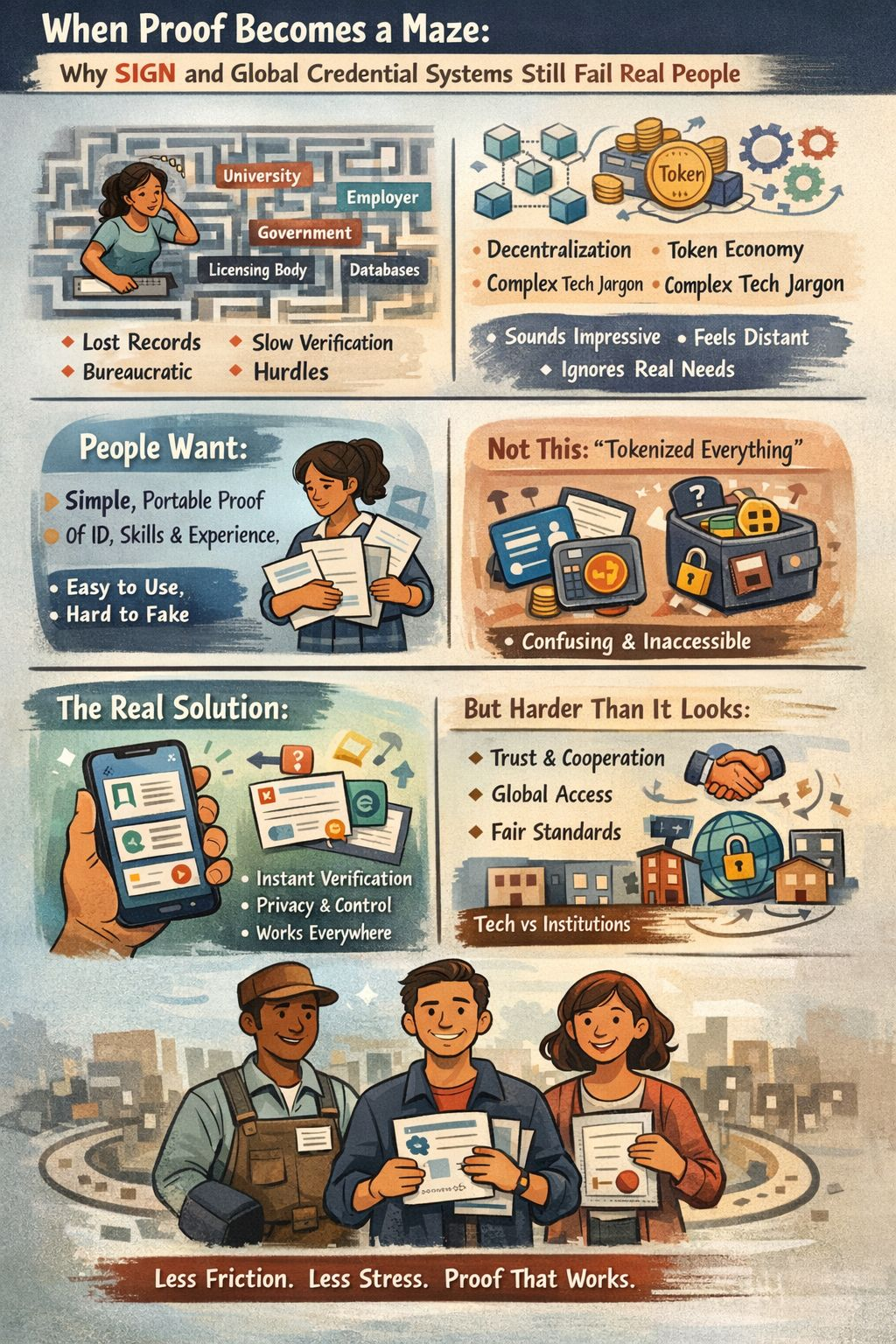
And yet somehow, we are still stuck in this strange in-between stage where important parts of a person’s life are scattered across universities, employers, governments, training platforms, licensing bodies, and databases that do not really speak to each other.
That is the part people ignore when they start using big futuristic language.
The real problem is actually very simple. People do not truly control the records that define huge parts of their lives. You can earn a degree, complete a certification, build years of experience, or gain a professional license, but when the time comes to prove any of it, you often have to go back and ask someone else to confirm your own story.
That process is slow. It is repetitive. It is frustrating. And for something so important, it is surprisingly fragile.
One delayed email, one missing record, one institution taking too long to respond, and suddenly something that should be easy becomes stressful for no real reason.
So when people say there should be a better way, I agree.
There absolutely should be.
The idea that a person could hold verifiable proof of their identity, achievements, qualifications, or work history in a form that is portable and easy to present makes perfect sense. It feels overdue. If someone finishes a course, gains a skill, earns a credential, or spends years building experience, that proof should not feel trapped in someone else’s filing cabinet. It should move with them. It should be easy to share when needed and easy to verify without turning the whole experience into another bureaucratic obstacle.
That part is not hard to believe.
What becomes harder to believe is everything that gets added on top of it.
Because this is usually the point where the conversation stops sounding human and starts sounding like a product pitch. Suddenly it is all decentralization, tokenization, trustless systems, wallet infrastructure, incentive design, programmable distribution, onchain identity, and all the other phrases that sound impressive in theory but feel very far away from how normal people actually live.
And somewhere in the middle of all that language, the person at the center of the problem disappears.
That is where my skepticism starts.
Not because the problem is fake. The problem is real. The skepticism comes from how quickly useful ideas get buried under unnecessary complexity. Especially once tokens enter the picture.
Because then it starts to feel like the entire thing is being pulled away from usefulness and toward economics. Toward speculation. Toward incentives. Toward systems that seem more interested in creating activity than solving the original problem.
And not everything needs that.
Not everything becomes smarter because a token is attached to it. A certificate is not a coin. A skill is not something to be farmed. A credential is supposed to mean something stable. Something trusted. Something real. The more it gets wrapped in reward mechanics or market logic, the easier it becomes to lose sight of what it was supposed to do in the first place.
That is when it starts feeling strange.
Because people do not actually wake up wanting tokenized proof systems. They want simple outcomes. They want their qualifications to count. They want their experience to be recognized. They want to prove something once without repeating the same exhausting process every time life changes.
Most people are not asking for an entire economy around identity and credentials.
They are asking for less friction.
That is it.
And honestly, I think that is why the strongest version of this future is probably the quietest one. Not the loud version. Not the one wrapped in giant claims about reinventing trust for the world. Just the simple version. The boring version, even.
The version where someone earns a credential, keeps it, presents it when necessary, and has it recognized without jumping through endless hoops.
The version where verification happens in seconds instead of weeks.
The version where records are harder to fake but easier to use.
The version where the system helps people without constantly demanding that they care about the machinery behind it.
That is what real infrastructure usually looks like when it works.
You barely notice it.
Still, even if the technology improves, there is a deeper issue that never really goes away. Some people in this space talk as if cryptography or verification tools can solve trust entirely. But they cannot.
They can prove that something came from a certain issuer and that it has not been tampered with. That matters. That is useful. But they cannot decide whether the issuer itself is credible. They cannot force universities, employers, governments, or regulators to agree on what counts as valid. They cannot magically create shared meaning across institutions that already struggle to align on basic standards.
So even when the technical side improves, there is still a very human layer underneath everything.
Recognition. Reputation. Authority. Agreement.
And that is where things become difficult.
Because this has never been only a technology problem. It is also a coordination problem, a governance problem, and honestly a power problem too.
Who gets to issue credentials?
Who decides what they mean?
Which standards matter?
What happens if one institution accepts a format and another does not?
What happens across borders?
What happens when governments want one model, companies want another, and educational systems want to protect their own authority?
These are not side questions. These are the actual reasons progress feels slow.
Everyone says they want interoperability until it requires giving up some control. Everyone says they want portability until it means accepting standards they did not create.
That is why so many big promises in this space never fully land.
Not because the technology is always fake, but because the social part is much harder than people like to admit.
And there is another part of this conversation that deserves more honesty.
A lot of so-called global systems are imagined from the perspective of people who are already comfortable with digital tools. People with secure devices. Stable internet. Decent technical confidence. Enough familiarity to deal with apps, recovery processes, permissions, keys, and digital identity tools without panicking.
But that is not everyone.
So when people describe something as global, it is worth asking who that system is really built for. Because if a person can lose access easily, cannot recover their credentials, does not understand the interface, or does not even have reliable access to the devices needed to manage all this, then the system is not really expanding trust.
It is just shifting the burden into a newer format.
That does not mean the whole idea should be dismissed. It just means it should be approached with more humility.
There is a version of this that could genuinely improve people’s lives. A version where educational achievements, work history, licenses, and certifications become easier to carry across systems and across borders. A version where proving something about yourself does not depend on chasing institutions every single time. A version where privacy is respected, where people can share only what is necessary, and where verification becomes far less painful.
That future makes sense to me.
It feels useful.
It feels worth building.
I just do not think it needs all the noise around it.
It probably does not need to be sold as a revolution. It probably does not need to become a giant token economy. It probably does not need to be framed like a total replacement for every institution in the world.
Most of the time, the strongest systems are the ones that fit into real life without demanding that people completely reshape themselves around the technology. Good infrastructure usually earns trust slowly. It proves itself through reliability, not excitement. It becomes valuable because it reduces friction, not because it creates another narrative for people to chase.
That is why I keep coming back to the same thought.
The real success case here is not some dramatic reinvention of the world.
It is much smaller than that.
Much more human than that.
It is a person being able to prove what they have done without feeling powerless. It is someone moving to a new place without having their history collapse into paperwork. It is a worker, a student, a freelancer, or an ordinary person not having to rebuild their credibility from scratch every time life changes.
That would already be enough.
And maybe that is the part people forget when they get too deep into systems language. Most people do not care about the ideology behind credential infrastructure. They do not care whether it is decentralized enough for a whitepaper, elegant enough for a conference demo, or financially optimized enough for a token model.
They care whether it helps.
They care whether it reduces stress.
They care whether their proof holds up when it matters.
They care whether it works.
If it does, people will use it without needing to be convinced.
If it does not, then all the talk about global infrastructure and token distribution is just another polished layer of distance between technology and the people it is supposed to serve.
At the end of the day, the future of credential verification does not need to feel flashy. It does not need to feel ideological. It does not need to feel like a giant machine hanging over ordinary life.
It just needs to feel fair, simple, and dependable.
That alone would already be meaningful.
#SignDigitalSovereignInfra @SignOfficial $SIGN