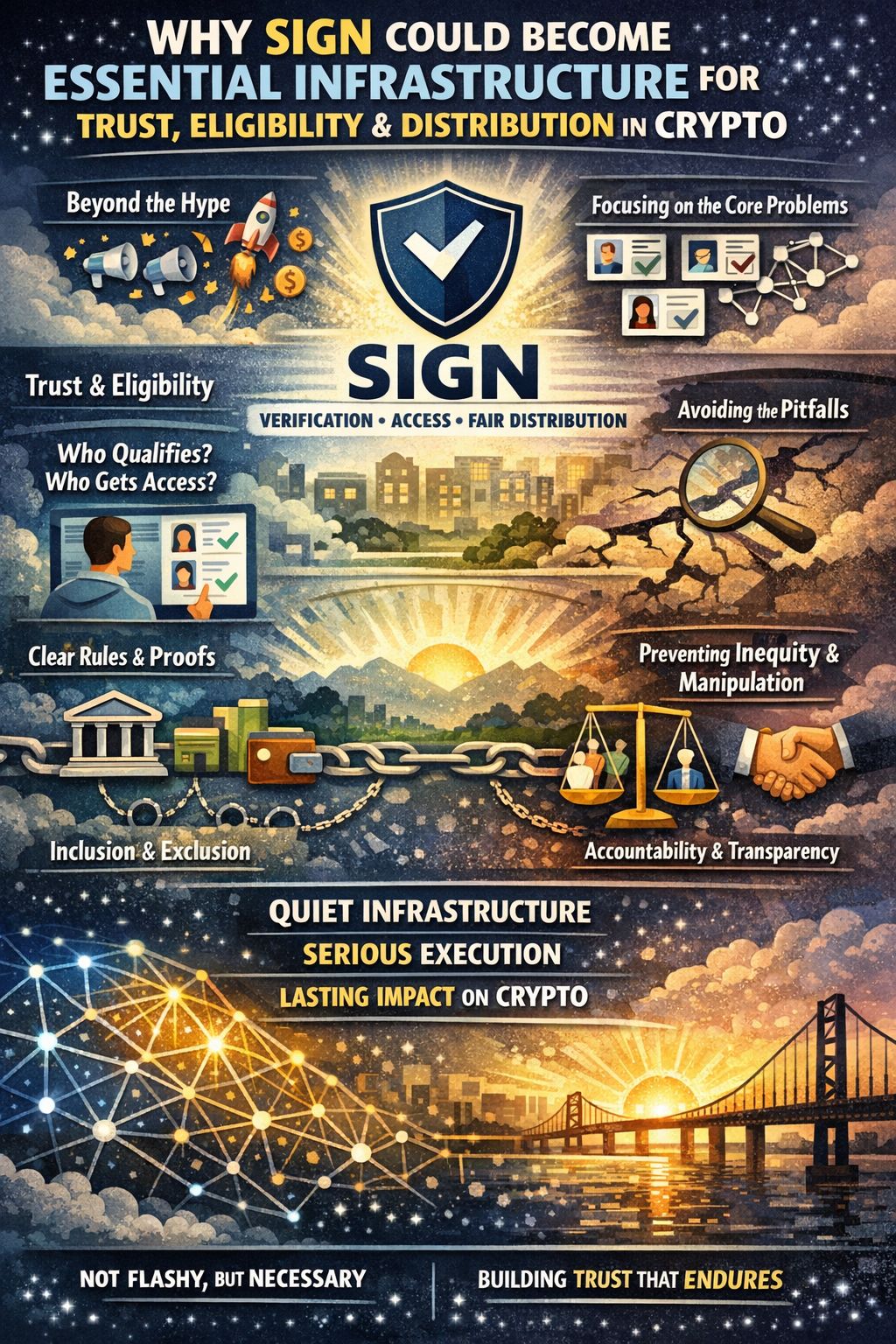
What keeps pulling me back to SIGN is how easy it is to miss the first time around.
I’ve watched too many projects in this market arrive looking flawless on the surface and still end up meaning very little. Strong branding. Sharp messaging. A polished pitch. Big promises. For a moment, it all sounds important. Then you look a bit closer and realize it is the same noise again, just wrapped in better packaging.
SIGN does not feel like that.
If anything, it has the opposite issue. It does not immediately demand attention. At first, it sounds almost too dry. Verification, credentials, claims, distribution. That is not the kind of language that creates instant excitement. It does not try to manufacture a huge emotional reaction. And because of that, it is very easy to scroll right past it.
I almost did.
But after spending enough time in this market, I’ve started trusting a different instinct. The things that seem boring at first are sometimes the things worth studying most closely. Not every time, but often enough that I no longer ignore that feeling.
That is where SIGN started to stay with me.
Because once you strip crypto down to its essentials, the real problem was never only about moving assets around. We solved the basic part of that a long time ago. Sending value from one place to another is not the difficult part anymore. The real difficulty starts after that. Who qualifies. Who gets access. Who gets excluded. Who receives what. Why they receive it. What rules determined that. And whether anyone can actually verify those rules after the process is over.
That is where things usually fall apart.
A lot of projects still treat that entire layer as something secondary, like a backend detail they can deal with later. But it is not secondary at all. That is the layer that shapes trust. That is the layer that decides whether people feel included, ignored, rewarded, or burned. And once those feelings settle in, they are very difficult to undo.
That is why SIGN feels more important to me than it first appears.
The easiest way to understand it is to force it into a simple category. Call it an attestation project. Call it identity infrastructure. Call it verification tooling. That is usually what the market does when something takes more effort to understand. It gives it a label and keeps moving.
But the more I look at SIGN, the less that framing feels right.
It does not feel like a narrow tool to me. It feels more like infrastructure for one of the most uncomfortable parts of crypto — the place where trust, access, and distribution all collide.
And that part matters much more than most people want to admit.
Because proof by itself is not enough. A claim sitting onchain does not automatically become something useful. Verification only matters if it can actually operate inside a system with rules, decisions, and consequences. Otherwise, it turns into another object that people point to without doing much with it.
That is the part I think SIGN understands.
It feels like the project is not only interested in proving something once. It feels like it cares about what happens after the proof. How that proof gets used. How it shapes access. How it influences allocation. How it holds up once people begin asking harder questions later on.
And in crypto, those harder questions always come later.
At first, everything looks fine. The token launches. The community arrives. People are excited. Everyone is focused on momentum. But eventually the mood shifts. Then people start asking who got what. Why they got it. Why somebody else did not. Whether the process was fair. Whether the rules were clear. Whether the entire thing can actually be explained in a way that makes sense.
That is usually when the cracks begin to show.
And that is exactly why the distribution side of SIGN continues to stand out to me.
People talk about distribution as if it is just an operational task, but it really is not. Distribution is one of the clearest expressions of power in any network. It determines who becomes part of the story and who ends up feeling excluded from it. It shapes loyalty, resentment, participation, and trust more than a lot of teams seem to understand.
You can damage a strong project very quickly with weak distribution.
So when I look at SIGN, I do not see some minor background utility. I see a project trying to work directly on one of the market’s most sensitive fault lines. Not the flashy part. Not the easy part. The part that usually gets exposed after the surface excitement fades.
That is what makes it feel heavier to me.
Not heavier in a hype sense. Heavier in a responsibility sense.
It feels like the kind of project that already knows the mess is coming. It knows systems eventually get tested. It knows people will ask questions. It knows trust has to be structured properly, not just implied while things are still going well.
And honestly, I respect that.
I respect it more than another project trying to sound bigger than it really is. I respect it more than another team pretending that fairness, qualification, and distribution are details that can be sorted out later. They are not details. They are the system, whether people want to admit that or not.
That does not mean I think the risk is low.
It is not.
A project like this carries real execution pressure. The idea is serious, but serious ideas are not always the ones the market notices quickly. Sometimes the market is too distracted by cleaner stories, louder branding, or easier narratives. Sometimes timing alone buries a good project. Sometimes a project identifies the right problem and still struggles to translate that into traction people can actually recognize.
So I am not treating this like a guarantee.
I am not saying SIGN definitely wins.
I am only saying I understand why it could matter much more than people think.
And that feels like the more honest position anyway.
Because a lot of crypto right now feels repetitive. The same language, the same urgency, the same recycled structures, just with different names attached to them. You can feel the exhaustion underneath it. Even when people are still active, even when the market is still moving, there is a kind of tiredness there. Too many things are asking for attention without giving much back.
SIGN does not feel like it is doing that.
It feels quieter. More patient. More focused on a problem that remains painful whether the market is hot or cold. Whether people are euphoric or burned out. Whether they want to think about infrastructure or not.
And usually those are the problems that matter most over the long run.
That is why I keep watching it.
Not because it is flashy. Not because it sells itself immediately. But because it seems willing to work in the part of crypto that is slower, less glamorous, and far more important than people think. The part where trust has to be clearly defined. The part where eligibility has to mean something. The part where distribution has to survive scrutiny, not just survive launch day.
Projects doing that kind of work rarely get understood early.
Maybe that is just how it goes.
Maybe the market is not ready yet for something this grounded. Or maybe people do see it, but have not really said it out loud yet. Either way, I keep watching for the moment when something that looked like quiet infrastructure stops feeling optional and starts feeling necessary.
And with SIGN, I am not sure that moment has fully arrived yet.
#SignDigitalSovereignInfra @SignOfficial $SIGN