I opened my phone the other night just to check the market for a minute.
That was the idea anyway.
A few minutes turned into a full scroll session, and before I knew it, I was back in the same place crypto always seems to take you lately — endless launches, endless threads, endless people claiming they’ve built the thing that changes everything.
New chains.
New narratives.
New promises.
Faster. Cheaper. Smarter. More scalable. More revolutionary.
After a while, it all starts sounding the same.
And that’s the strange thing about this space right now: the louder it gets, the less real it feels. Not because nothing is being built. There’s clearly a lot happening. But so much of it feels like performance now. Like projects are competing to sound important before they’ve proven they’re useful.
That’s probably why Midnight stayed in my head.
Not because it’s everywhere.
Not because people won’t stop talking about it.
Honestly, it’s kind of the opposite.
It feels quieter than most of what’s around it. Less eager to be the center of attention. And maybe that’s exactly why it stands out.
Because underneath all the noise, there’s a very simple problem crypto still hasn’t really solved.
We made everything public.
At first, that felt like the point. Transparency was part of the magic. You could verify transactions, inspect the chain, remove the need to blindly trust anyone. That was powerful. It still is, in some ways.
But somewhere along the line, transparency became overexposure.
Now every wallet can be watched. Balances can be tracked. Activity can be followed. Patterns can be pieced together by anyone patient enough to look. For a space that talks so much about freedom, that’s a pretty strange outcome. We built systems that let people own their assets directly, but in many cases we also made it easier for the world to watch what they do with them.
Most people don’t really think about that until they have to.
Until they realize their activity isn’t just theirs.
Until they see how easy it is for on-chain behavior to become a trail.
Until they understand that transparency sounds noble in theory, but feels different when it becomes personal.
That’s where Midnight starts to feel important.
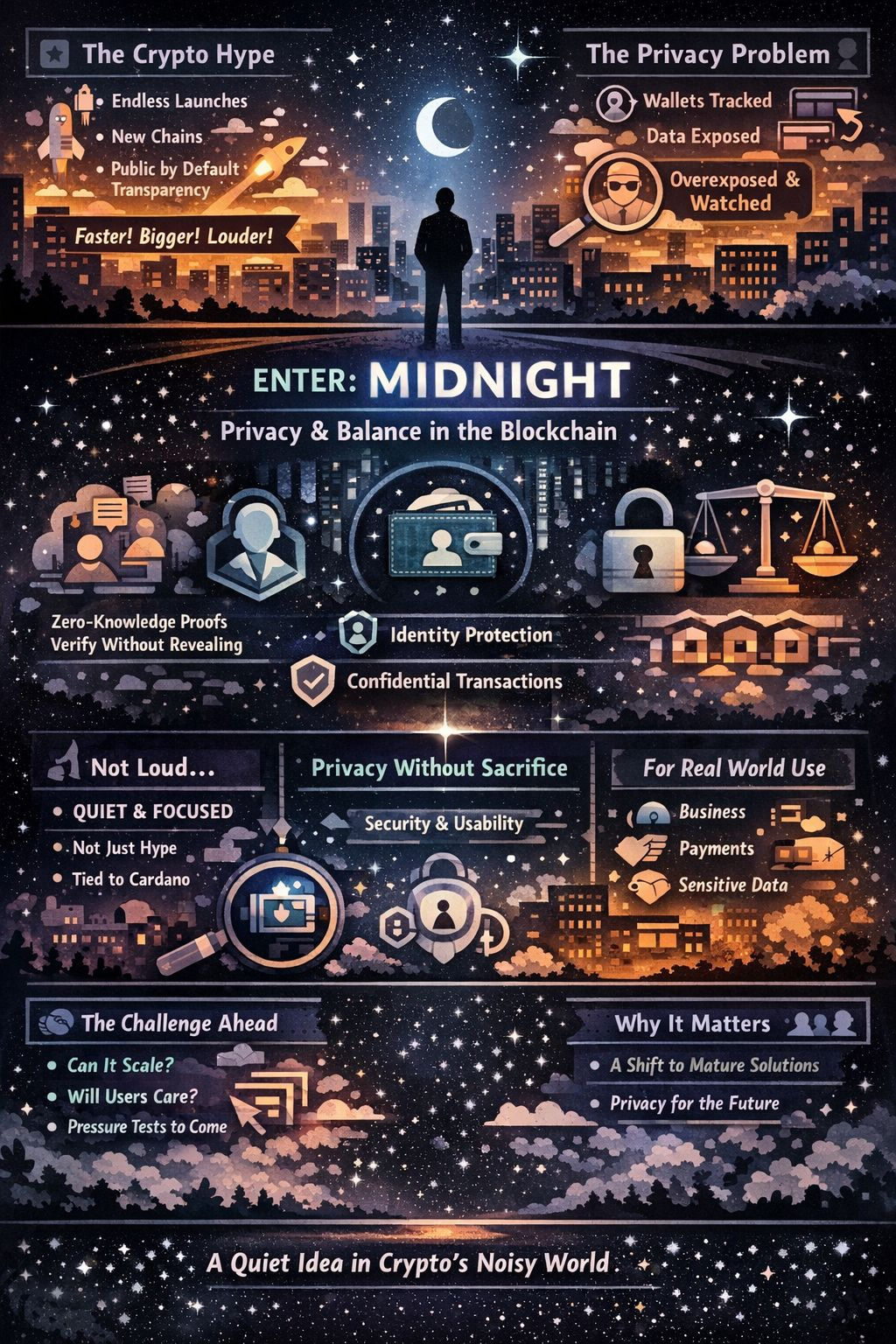
What makes it interesting isn’t hype. It’s the fact that it’s trying to deal with something crypto has brushed aside for too long: the idea that blockchains should be able to verify things without forcing people to reveal everything.
That’s the heart of it.
Midnight is built around zero-knowledge technology, which sounds technical until you strip it down to what it really means. It means being able to prove something is true without exposing all the details behind it. A system can confirm that a rule was followed, that a transaction is valid, that a condition has been met — without turning all the underlying information into public property.
And honestly, that just feels more aligned with real life.
Because in the real world, people don’t want every detail exposed just to participate in a system. They want to be verified when necessary, but they also want some level of privacy, some level of control, some sense that using a network doesn’t mean handing over everything by default.
That’s not asking for secrecy.
It’s asking for balance.
And that’s what keeps pulling me back to Midnight as an idea.
Crypto has spent years obsessing over scale, speed, fees, throughput, and transaction counts. All of that matters, obviously. But while everyone was chasing performance, a more human question kept getting ignored:
What does it actually feel like to use a system where everything about you can be seen?
That question matters even more now.
The space is trying to grow up. It wants real users, real businesses, real applications, real financial activity, real infrastructure. But once you start talking about serious use cases — identity, payments, enterprise workflows, regulated environments, maybe even AI systems handling sensitive information — the limits of radical transparency start showing up fast.
You can’t build every future system around the assumption that all data should be visible all the time.
That’s just not how people live.
Midnight seems to understand that.
It’s tied to the Cardano ecosystem, but it doesn’t really come across like it’s trying to be just another extension or side experiment. The bigger idea is more interesting than that. It’s trying to create a system where privacy and verification don’t have to fight each other. Where you don’t have to choose between usefulness and confidentiality. Where people can participate without putting every detail of their digital life on display.
That middle ground is hard to build.
Too much privacy, and a system becomes difficult to trust.
Too much transparency, and it becomes difficult to actually live inside.
Midnight seems to be aiming for that uncomfortable but necessary space in between — where rules still exist, verification still matters, but disclosure isn’t total and automatic.
That’s a much more mature problem than how to make transactions cheaper.
And maybe that’s also why it feels harder for people to get excited about immediately.
Midnight doesn’t really feel like a quick trade. It doesn’t feel like the kind of thing people scream about at the top of a cycle because they think it’s going to explode in two weeks. It feels more like infrastructure. The kind of thing that becomes important slowly, almost quietly, if the world around it starts demanding what it offers.
That’s not always a popular position to be in.
Most of this market still rewards immediacy. People want momentum. They want visible attention. They want liquidity, action, headlines, proof that everyone else is already looking. And Midnight doesn’t naturally fit that energy. It feels more patient than that. More structural.
But sometimes that’s exactly what makes a project worth paying attention to.
Because when all the louder narratives cool off, the market usually gets dragged back to a smaller set of questions:
What is actually useful?
What solves something real?
What survives when the performance fades?
What still matters when attention moves on?
Privacy keeps coming back into that conversation because it was never really solved.
We treated public-by-default systems like they were the final form, when really they were just one version of the idea. A powerful version, yes. But incomplete.
That incompleteness is becoming harder to ignore.
People want control over their money, but they also want control over their information. They want systems they can trust without feeling permanently exposed. They want to interact, transact, prove, verify, and participate without turning every step into public data.
That’s not unreasonable.
It’s probably where the conversation should have gone much earlier.
And this is where Midnight starts to feel less like a niche privacy play and more like a broader response to where digital systems are heading.
Because privacy isn’t just about hiding transactions. It’s about identity. It’s about behavior. It’s about intent. It’s about making sure users, businesses, and eventually even autonomous systems can operate in ways that are verifiable without becoming completely transparent to everyone watching.
That matters more than people think.
Especially if we’re moving toward a world where more decisions, more transactions, and more forms of coordination happen automatically. If everything becomes machine-readable, traceable, and permanently exposed, privacy stops being some optional extra.
It becomes part of the basic design of whether a system feels usable at all.
That’s a big reason why Midnight feels like it’s trying to solve a future problem before most people are ready to admit it’s already here.
Still, none of that guarantees success.
That’s the part people always try to skip.
A strong idea is not the same thing as adoption. Good technology is not the same thing as real usage. Crypto is full of projects that made a lot of sense intellectually and still ended up empty. Great architecture, smart teams, thoughtful design — none of it automatically brings people in.
Midnight still has to prove that people will actually show up.
Developers have to build.
Users have to care.
Liquidity has to move.
The experience has to feel easy enough that privacy doesn’t become a chore.
Because if using a privacy-preserving system feels complicated, most people will simply avoid it. That’s how the market behaves. Convenience wins more often than principle.
So if Midnight works, it won’t just be because the technology is strong.
It will be because the complexity fades into the background. Because the privacy feels natural instead of heavy. Because users don’t have to think about advanced cryptography every time they interact with something.
It has to feel smooth.
Not like effort.
Not like a philosophy lesson.
Just like a system that respects people a little more than most others do.
That’s difficult to build.
And to be fair, Midnight has been trying to move in that direction in a serious way. The design around NIGHT and DUST suggests the team is thinking not just about privacy as a concept, but about how private computation actually works in practice. The fact that it separates the core asset from the resource used for network activity feels like an attempt to make the system more usable, more predictable, less awkward.
That may sound like a small technical detail, but details like that often determine whether something feels elegant or exhausting once people start using it.
The same goes for developer tooling. Privacy infrastructure usually dies if only specialists can build on it. So if Midnight wants to matter, it has to make that process accessible enough for actual builders, not just researchers and people deep in cryptographic engineering.
That side of the story matters just as much as the privacy pitch itself.
Then there’s the bigger question every network has to face eventually:
What happens when real pressure arrives?
Because everything looks stable when it’s early.
It’s easy to sound promising before the crowd shows up. Much harder after. That’s when the edge cases appear. That’s when networks get tested. That’s when all the design choices people praised in theory have to survive actual users, actual volume, actual stress, actual expectations.
Midnight hasn’t escaped that test.
It’s moving toward it.
And that’s important to be honest about.
It may turn into one of the more meaningful privacy-focused infrastructures in the space. Or it may become one of those projects people respect more than they use. Both are still possible.
That uncertainty is real.
But even with that uncertainty, I think it’s worth paying attention to.
Because at least the direction makes sense.
At least it’s trying to solve something deeper than visibility metrics and cycle narratives. At least it’s asking whether blockchain systems can grow up a little — whether they can become more useful for actual people, not just more impressive on paper.
That’s why Midnight feels different to me.
Not perfect.
Not proven.
Not guaranteed.
Just different in a way that feels grounded.
It doesn’t seem built around the assumption that louder is better. It seems built around the idea that privacy, if done properly, might eventually stop being a niche feature and start becoming part of the baseline for serious digital systems.
And that shift, if it happens, will matter a lot.
Because once people actually need privacy, not as an ideology but as a practical part of using a network, the conversation changes. Then it’s not about whether privacy is interesting. It’s about whether anyone built it well enough, early enough, and clearly enough for people to trust it.
Maybe Midnight becomes that.
Maybe it doesn’t.
But I think that’s the real reason it’s worth watching.
Not because it’s the loudest thing in crypto right now.
But because it might be working on one of the quieter problems that ends up mattering more when the noise dies down.
#night @MidnightNetwork $NIGHT