Midnight Network is one of those projects I didn’t dismiss immediately, and honestly, that already says a lot.
That probably sounds harsher than I mean it to. But after spending enough time around crypto, you develop a very specific kind of tiredness. Not the loud kind. Not the kind where you make a dramatic exit and swear off the whole space. Just a quieter kind. The kind that comes from watching the same ideas come back with slightly cleaner branding, slightly sharper messaging, and the same promise that this time it really is different.
Most of the time, it isn’t.
So when I look at something like Midnight, I’m not looking for a big story to fall in love with. I’m looking for where it starts to crack. That’s usually the fastest way to tell whether there’s something real underneath it, or whether it’s just another polished version of an old idea.
And what caught my attention with Midnight is that it doesn’t crack where I expected.
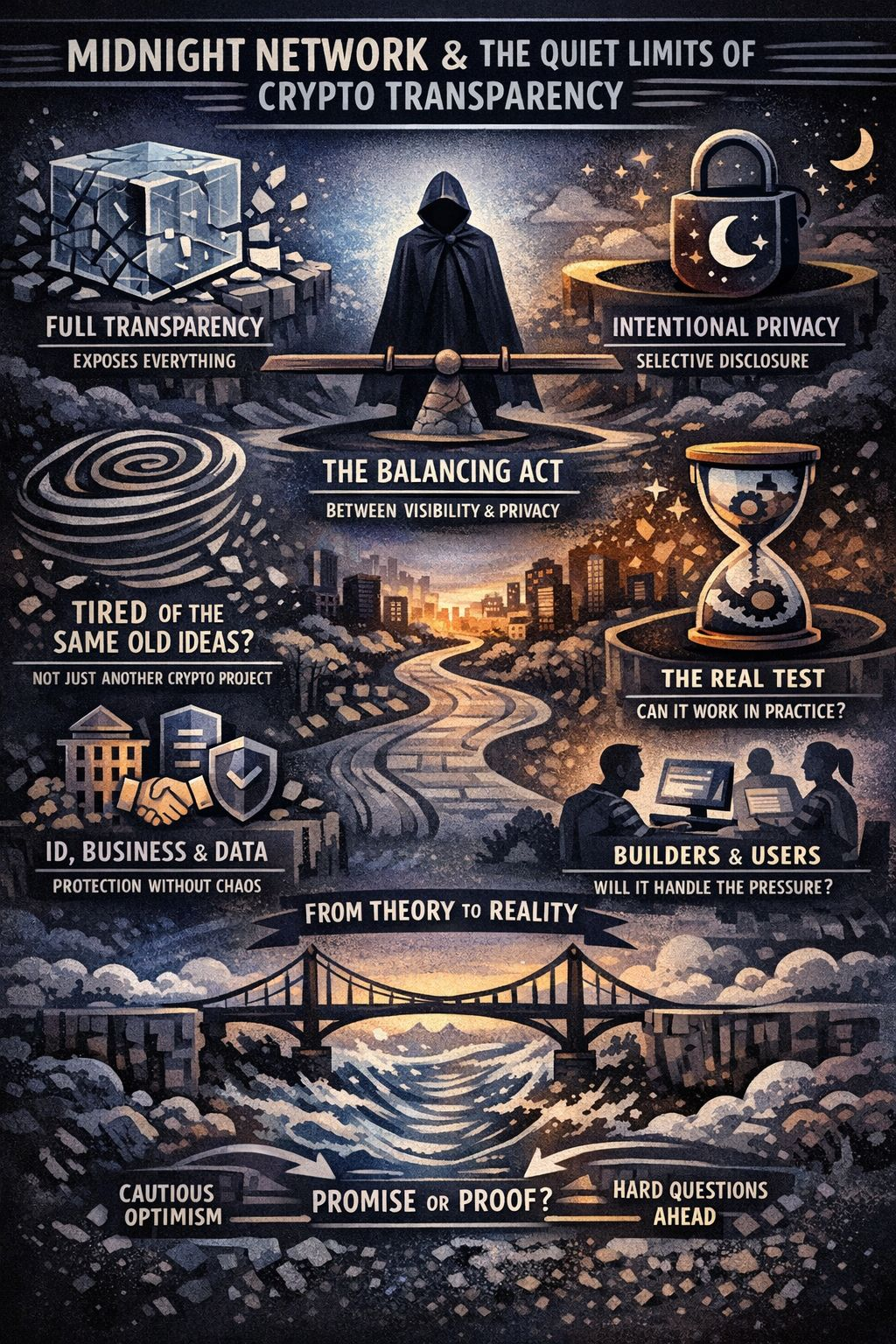
A lot of people look at it and immediately call it a privacy project, which is fair on the surface, but I think that misses the more interesting part. Midnight doesn’t feel like it’s simply trying to hide things. It feels like it’s built around a question crypto still hasn’t answered honestly: does proving something really have to mean exposing everything?
That might sound like a small distinction, but I don’t think it is.
Because full transparency sounds great until you start thinking about how real people, real businesses, and real systems actually work. Then it gets messy. Not because anyone is doing something wrong, but because not everything useful is supposed to happen in full public view all the time. Internal operations, sensitive financial behavior, private coordination, identity-linked actions, business relationships, treasury logic, selective permissions — a lot of this becomes awkward, inefficient, or even impossible when every detail is expected to sit permanently on display.
That’s the part Midnight seems to understand.
And I think that’s why I kept paying attention to it. It doesn’t come across like it’s trying to sell secrecy just to sound mysterious. It feels more like it’s trying to make disclosure intentional. Selective. Something that happens because it should, not just because the system defaults to it.
That feels like a more mature way of thinking about the problem.
Crypto has spent years treating transparency like a moral victory, then acting surprised when that model starts to feel invasive or clumsy the moment real use cases enter the picture. It turns out people do care about privacy. Not always in some dramatic ideological sense, but in a normal human sense. People don’t want every action, relationship, or decision permanently visible just because the technology allows it.
That doesn’t mean everything should be hidden. It just means exposure should be more deliberate than this space has been willing to admit.
Midnight feels like it starts from that idea.
What also makes it stand out to me is that it doesn’t feel especially loud about it. There’s less of the usual crypto theater. Less of the trying-too-hard energy. Less of that constant need to sound historic in every sentence. And I appreciate that, because when a team really understands the problem it’s tackling, you can usually feel it in the way the system is designed. You don’t need the slogans to do all the heavy lifting.
Still, I’ve been around this market long enough to know that a smart design is not the same thing as something that survives real life.
That’s where I get more careful.
A lot of projects sound convincing when they’re still sitting safely at the idea stage. The vision makes sense. The architecture makes sense. The pitch makes sense. Sometimes even the early technical design makes sense. But then the harder part begins. Developers run into friction. Users don’t care as much as expected. The ecosystem never really forms. The whole thing becomes admired in theory and ignored in practice.
That happens all the time in crypto.
And I think that’s the real question around Midnight. Not whether the core idea is interesting, because I think it is. The real question is whether it can become something people actually want to build with and use, without the complexity becoming the whole story.
Because that’s usually where privacy-focused infrastructure struggles. The idea is easy to respect. The experience is much harder to get right.
It’s one thing to say applications should reveal less. It’s another thing entirely to create an environment where developers can actually work that way without feeling like every decision now comes with extra technical weight. Strong ideas can absolutely get buried under their own complexity, especially in crypto, where even simple things already tend to feel harder than they should.
So I’m not looking at Midnight and thinking the ambition alone is enough. I’m looking at whether that ambition can survive contact with reality.
And to me, that’s what makes it worth watching.
Because the problem it’s pointing at feels real. Maybe more real than a lot of the market wants to admit. Blockchains became very good at making things visible. They did not become nearly as good at understanding that visibility is not always the same thing as usefulness. Once this space tries to move beyond speculation and into something that resembles actual coordination, that becomes harder to ignore. Identity, internal workflows, treasury controls, business logic, permissions, compliance, private data — a lot of this simply does not belong in a system where everything is treated like it should live under permanent public light.
That’s where Midnight starts to feel less like a niche privacy idea and more like a response to something structural.
What makes it even more interesting now is that it is no longer sitting entirely in theory. Midnight has moved closer to the stage where the market gets to stop imagining what it could be and start judging what it actually is. That changes the tone for me. It makes the project more serious, but it also makes it more exposed. Because once something approaches real deployment, the conversation changes. It stops being about whether the idea sounds intelligent and starts becoming about whether the system can carry its own weight.
That is where things get real.
And that’s also where a lot of projects start to lose their shine. Ideas always look cleaner before they have to carry users, developers, tooling, incentives, and all the friction that comes with real conditions. Midnight can talk about selective disclosure, privacy-preserving applications, and a more mature model of onchain coordination, but eventually all of that has to translate into something builders can actually use without feeling buried by the architecture.
That’s the test I care about most.
Because if Midnight matters later, it won’t be because it sounded smarter than the rest of the field. It won’t be because the language was cleaner, or because people were ready to believe in another infrastructure story. It will be because it solved something that has been quietly getting in the way for years — this constant mismatch between what blockchains can verify and what real participants are actually comfortable exposing.
And that mismatch is bigger than people think.
Crypto has spent so much time celebrating public verifiability that it rarely stops to ask whether every useful system should look like a glass box. In practice, a lot of them shouldn’t. Businesses don’t want every internal rule exposed. Institutions don’t want every operational pattern visible. Users don’t want every action tied forever to a fully open record. Even governance and compliance can require discretion, not because anyone is doing something shady, but because context matters.
That is the deeper tension Midnight seems to be built around.
And honestly, I respect that more than I respect most of the market’s recycled talking points. It feels like a project that noticed something the industry keeps trying to step around. Not because the problem is glamorous, but because it is inconvenient. It forces crypto to admit that there is a difference between transparency as a tool and transparency as an obsession.
That distinction matters.
Still, I’m careful not to romanticize it. I don’t trust projects just because they sound thoughtful anymore. I trust pressure. I trust the ugly stage where a system has to become usable instead of just coherent. I trust the moment when builders either stay because it works for them, or quietly leave because the friction turns out to be heavier than the promise.
That is where Midnight has to prove itself.
Because thoughtful design is a good starting point, but it is not proof. Good instincts are not proof either. Even a real problem is not proof. Plenty of projects have been built around valid problems and still ended up irrelevant because they could not make the leap from concept to habit.
That leap is everything.
So no, I’m not looking at Midnight with blind excitement. It’s not that. It’s something quieter than that. More cautious. More curious. Just that feeling that it may be aimed at something real while too much of the market is still busy repeating old answers and calling them new.
Maybe that becomes something meaningful. Maybe it doesn’t.
But I’m still paying attention, and these days, that already means more than people think.
#night @MidnightNetwork $NIGHT