
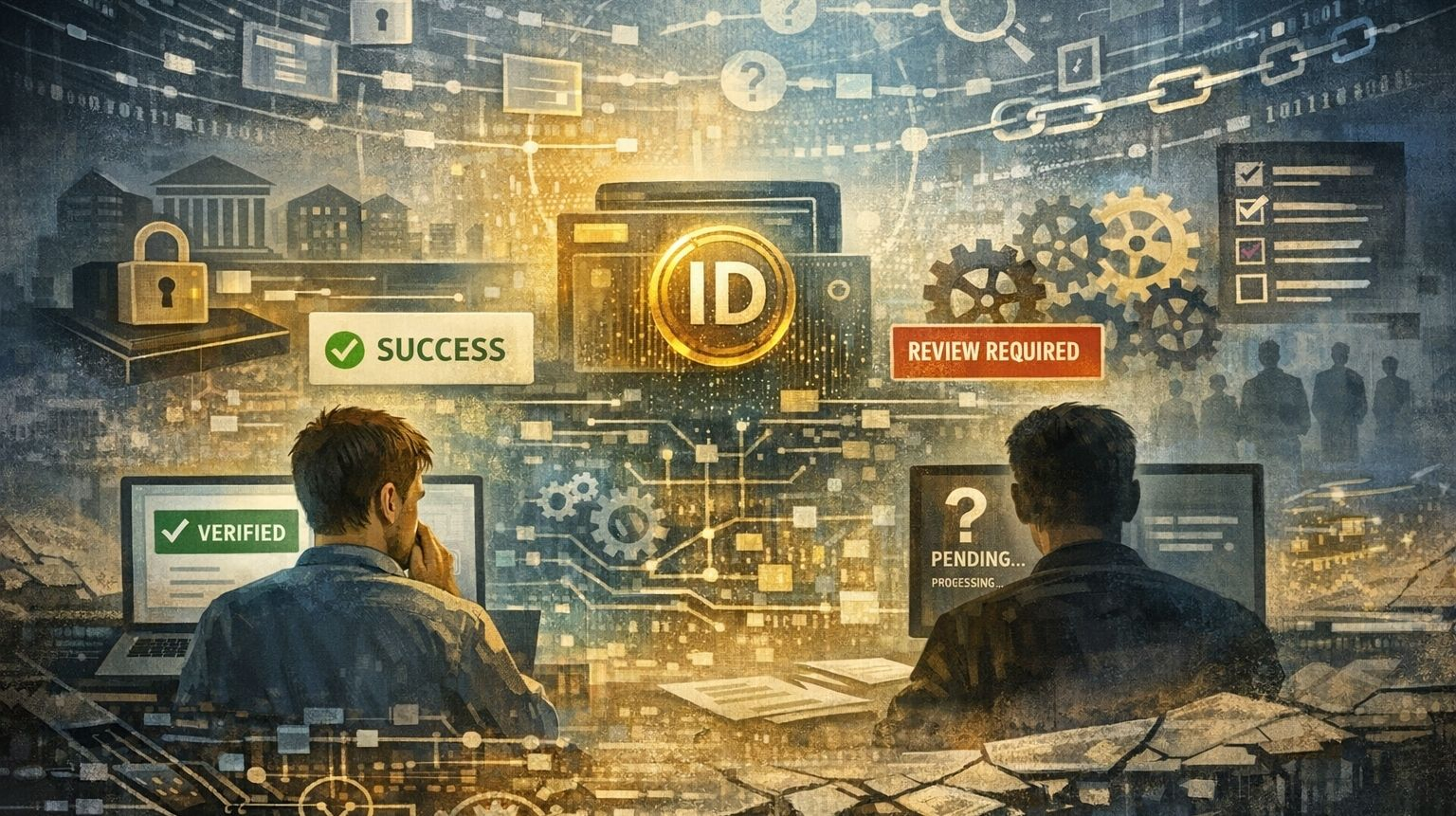
I was having tea with my brother one evening when he casually mentioned he d been trying to claim something online a small reward tied to some verification process. He wasn t frustrated in an obvious way, just slightly puzzled. He kept saying I’ve done everything they asked And I believed him. He had the screenshots the confirmations even that subtle confidence people carry when they know they followed the rules. Still something wasn’t clicking on the other side It didn t reject him It just didn’t fully accept him either
That moment has stayed with me more than I expected.
I think because it quietly exposes something these systems don t like to admit We talk about building global infrastructure for credential verification and token distribution as if the hard part is technical—how to prove something how to store it how to move it across systems. But the longer I watch the more it feels like the real friction begins after the proof is already there.
There s this assumption that once something is verified it becomes usable. That proof naturally leads to acceptance. But in practice that link feels fragile
A credential.at its core is supposed to settle a question. Did this person do this thing? Are they who they claim to be? It sounds simple. But the moment that credential enters a different context—another platform another institution it gets reinterpreted. Not necessarily rejected, just reconsidered. And that reconsideration isn’t always visible.
I’ve started noticing how much of this process lives in the background hidden behind clean interfaces. You see a verified label a successful transaction a token in your wallet. It feels final But behind that there are still quiet decisions being made. Systems checking other systems. Policies layering over protocols. Small conditions that weren’t obvious at the start suddenly becoming decisive at the end.
And when something doesn t work it s rarely clear why
What makes it more complicated is how differently people experience this. For someone comfortable navigating these systems the steps feel manageable even predictable But for others the process can feel like moving through a space where the rules keep shifting slightly Not enough to be called broken, but enough to create hesitation.
I’ve seen people follow instructions perfectly and still feel uncertain about whether they ve actually completed something That uncertainty lingers even after the system says done It s a strange kind of gapwhere technically everything is correct but psychologically it doesn t feel resolved
Then there s the distribution side which seems straightforward until you look a little closer Tokens rewards access they re positioned as outputs of a fair process. You meet the criteria you receive the outcome But what counts as meeting the criteria isn t always as clear as it seems
Sometimes it s based on measurable actionsclicks submissions completions. Things the system can easily track But not everything meaningful fits into those categories. Intent understanding effortthese are harder to capture So they often get left out
What emerges is a system that feels precise but can miss something important People learn to align with what s being measured not necessarily with what s being valued They collect credentials because they can not always because those credentials represent something real or useful to them
I don t think this is manipulation It feels more like a side effect of trying to standardize something inherently uneven
Because at its core this isn t just about verification or distribution It s about trust And trust doesn t behave like data
You can prove something mathematically cryptographically with high certainty But acceptance still depends on how that proof is perceived Institutions especially don t just ask if something is valid They ask what happens if it turns out not to be Even a small risk can outweigh a high level of certainty
So they hesitate They add layers They create exceptions
And those exceptions start to shape the system in ways that arent immediately obvious Two people with the same credential might have completely different experiences depending on where and how they try to use it The infrastructure is global but the acceptance is local conditional
That s where the idea begins to feel less stable
I also can t ignore how much of this depends on standards that are still evolving What counts as a valid credential today might not hold the same weight tomorrow Systems have to decide whether to update reinterpret or ignore older data. Each choice carries consequences even if they re subtle
There s no fixed ground here even though the system tries to present one
And then there s the question of who shapes these standards. Not in an obvious centralized way but through influence. The entities that issue widely recognized credentials the platforms that become default gateways the developers who define how verification is implemented they all leave a mark
Over time, certain patterns become dominant, not necessarily because they’re perfect, but because they’re adopted. And once adoption reaches a certain point, it becomes harder to question.
I keep coming back to how all of this feels from the outside, as someone watching rather than building. There’s a certain elegance to the idea. A global layer where identity and achievement can move freely, without friction. It solves a real problem, or at least it tries to.
But the more I pay attention, the more I see how much of the real work happens in the spaces between systems. In the moments where something technically valid still needs to be interpreted. Where proof exists, but acceptance hasn’t caught up yet.
It’s not a failure. It’s just not as complete as it looks.
When I think about my brother that evening, I don’t see someone who was blocked by technology. I see someone who had done everything right and still felt slightly out of sync with the system he was interacting with. Not excluded, just not fully recognized.
And maybe that’s the part we don’t talk about enough.
That these infrastructures don’t remove uncertainty. They reorganize it, make it more structured, more visible in some places and more hidden in others. They create a sense of order, but that order still depends on how people choose to interpret and accept it.
I’m not against the idea. If anything, I think something like this is probably inevitable. The world is too interconnected now to rely on fragmented systems forever.
But I also don’t feel convinced that verification alone can carry the weight we’re placing on it.
There’s a quieter layer beneath all of thishow people, platforms, and institutions decide what they’re willing to trust, and when. That layer doesn’t move as quickly as the technology. It resists clean solutions.
And I keep wondering if the real challenge isn t building better proof but understanding why proof on its own is never quite enough in something like Sign Protocol
@SignOfficial#SignDigitalSovereignInfra $SIGN