
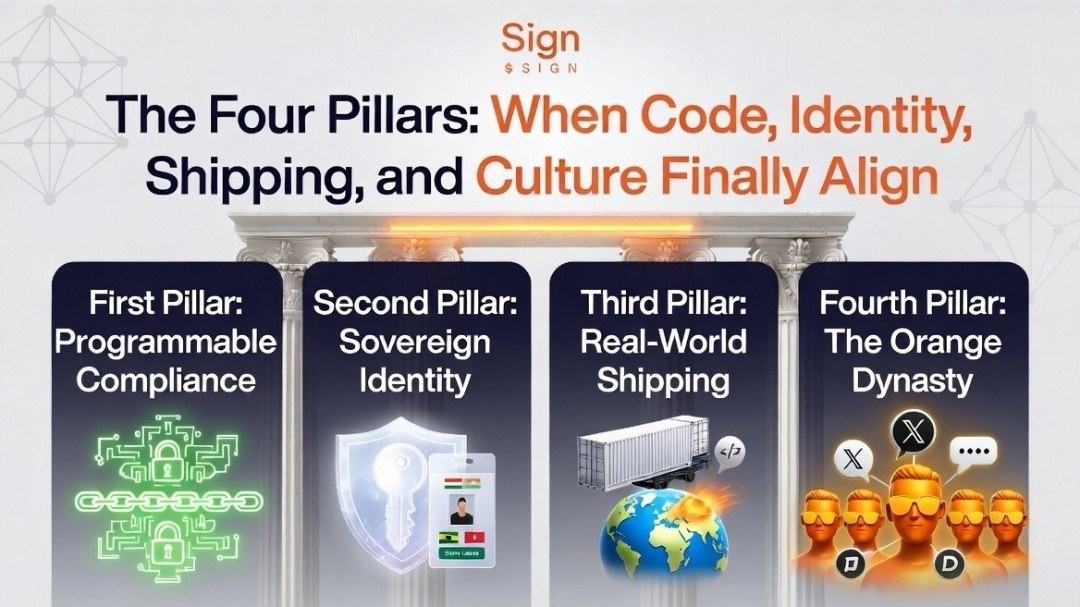
I have been sitting with everything I wrote about Sign Protocol for a while now. The built‑in rules essay covered the compliance side, how cooldowns and buyer checks get locked straight into the smart contract. The hackathon piece talked about shipping, the Bhutan example where thirteen apps landed on a live national identity system. Then I tried to pull it together into three pillars: programmable compliance, sovereign identity, real‑world shipping. That framework held up, but something kept nagging at me. There was a fourth piece I had not named yet, the one that makes the other three feel alive instead of just technically correct.
That missing piece is the Orange Dynasty.
First Pillar: Programmable Compliance
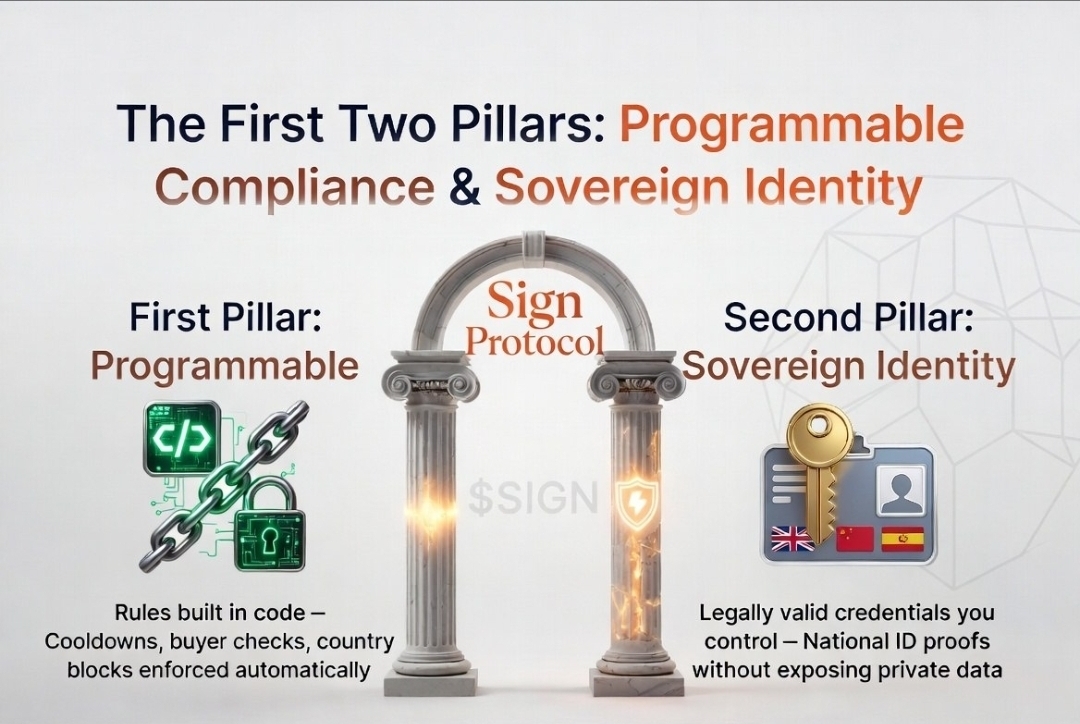
Let me run it back quick for anyone who missed the first thread. Sign built rules into the code. Cooldowns that match whatever the law says, so you cannot dump something you just grabbed. Buyer checks that pull from a proof system linked to actual ID verification, without spilling your private info everywhere. Country blocks that shut down transfers to banned spots automatically. No lawyer on retainer, no spreadsheet, no “trust us.” Just code that enforces the rules every single time. That is what turns a toy chain into something real‑world heavy hitters can actually use.
Second Pillar: Sovereign Identity
The identity piece is what made the Bhutan hackathon work. Sign does not treat identity like a wallet address. They treat it like a legally valid credential that you control. The proof system pulls from national ID, places like Sierra Leone, Kyrgyz Republic, Thailand, and Bhutan, without dumping your whole life on‑chain. You prove you are the right person from the right jurisdiction, and that is it. That unlocks cross‑border deals, government services, and real financial flows without the usual paperwork grind. The user holds the keys, but the state trusts the proof. That balance is rare.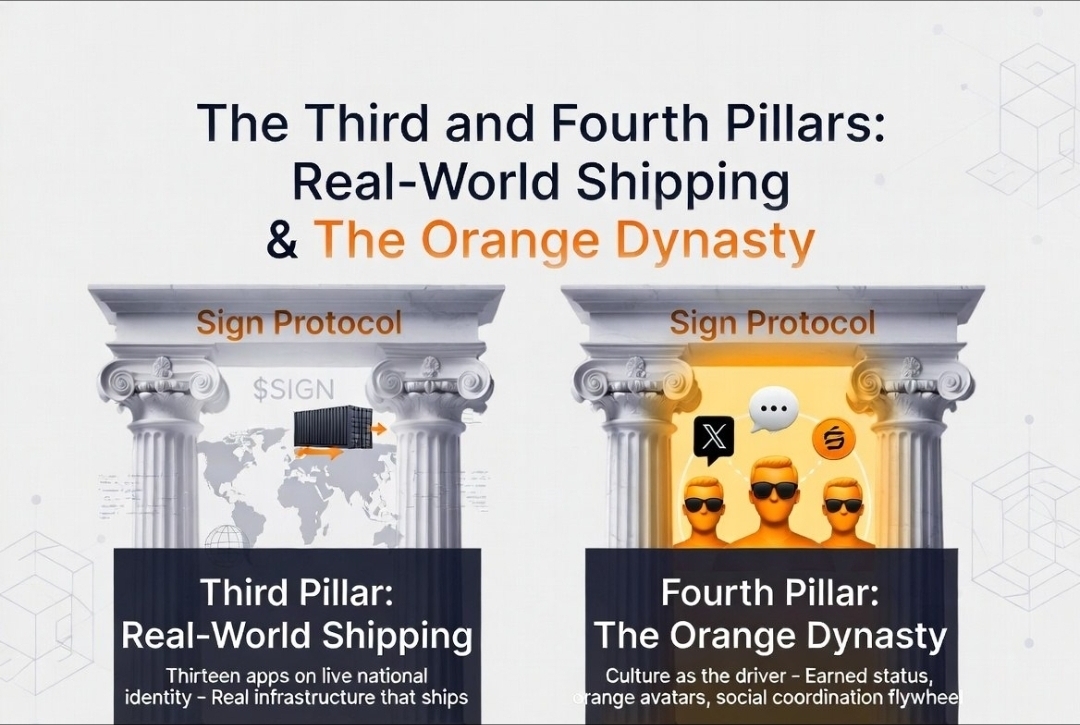
Third Pillar: Real‑World Shipping
I said before that I do not buy hackathon hype. Most events are chaos, half‑baked ideas that break at the last minute and disappear after the weekend. But Sign runs structured events with docs, mentorship, and clear prize tracks. The Bhutan NDI hackathon delivered thirteen apps built on a live national digital identity. That is not a demo weekend; that is infrastructure getting used. The protocol manages over four billion dollars in assets and generated fifteen million dollars in revenue last year. Numbers like that do not happen by accident. People are actually building on this stack, and the builds hold.
Fourth Pillar: The Orange Dynasty
Here is the part I almost missed. None of the above works at scale if there is no culture around it. Most protocols have code and maybe a Discord server. Sign somehow built a carnival that doubles as a coordination layer.
I watched the Orange Dynasty grow from the outside. Two weeks in, they had over four hundred thousand members with a hundred thousand verified users. That is not farmers. Farmers do not verify. Farmers do not coordinate. Farmers cash out and leave. What I saw instead was people tinting their avatars orange, wearing stylized sunglasses in their profile pictures, and actually showing up to X Spaces. Five hundred sixty hours of Spaces. Fourteen thousand five hundred posts. That is not a marketing campaign. That is people who want to be there.
The secret sauce is the soulbound token system. Most projects hand out badges that mean nothing. Sign splits their SBTs into categories based on real contribution. You want to be a Serious Builder? You build. You want Content Creator? You create. You want Support Warrior? You show up and help others. Because the badges are soulbound, you cannot buy your way into status. You earn it or you do not have it. That kills the usual farm behavior where whales scoop up everything and regular people hold nothing.
The Orange Dynasty App they just launched takes it further. It is social, payment, asset distribution, and identity all rolled into one. Users send ORANGEs to each other as recognition. The more you give, the more you get. Roles like “Orange in my Veins” for recruiting friends, “Orange Hands” for staking long term. These are not just names. They are status earned through action.
Why the Fourth Pillar Matters
I kept asking myself why the three pillars felt incomplete. Then it clicked. Programmable compliance, sovereign identity, and real‑world shipping are the engine. But an engine needs a driver. The Orange Dynasty is the driver. It is the group of people who test the rules, who build the apps, who show up to hackathons and actually ship. When the culture is strong, the infrastructure gets used. When the infrastructure gets used, it improves. When it improves, more people join. That flywheel is what separates dead protocols from living ones.
I still keep my feet on the ground. The governance is still largely centralized, and the core protocol code is not fully open source yet. Those are open questions that need watching. No community lasts forever if the product does not deliver, and the Orange Dynasty will face real tests when markets turn or hard decisions need making.
But what Sign built here is worth paying attention to. They automated compliance so governments can trust it. They made identity sovereign so users keep control. They shipped real products so builders have something solid to stand on. And they built a culture around it so all of that actually gets used.
My take remains the same: watch what people build, not what they say. The Orange Dynasty is people building. They are building identity, status, connections, and a shared language. That stuff does not come from a whitepaper. It comes from showing up every day, posting, talking, sending oranges to each other, and slowly turning a protocol into a place people want to be.
If you are curious, go check the orange avatars. Listen to a few Spaces. Run a test transfer with your own cooldown rules and see how it holds. The four pillars are there, code, identity, shipping, and culture, all lined up. That is rare. When they align, things get real.