

@SignOfficial #SignDigitalSovereignInfra $SIGN
i think i’ve been looking at Sign in the wrong order again. i keep starting from the attestation, the visible thing, and assuming that’s where everything important is anchored.
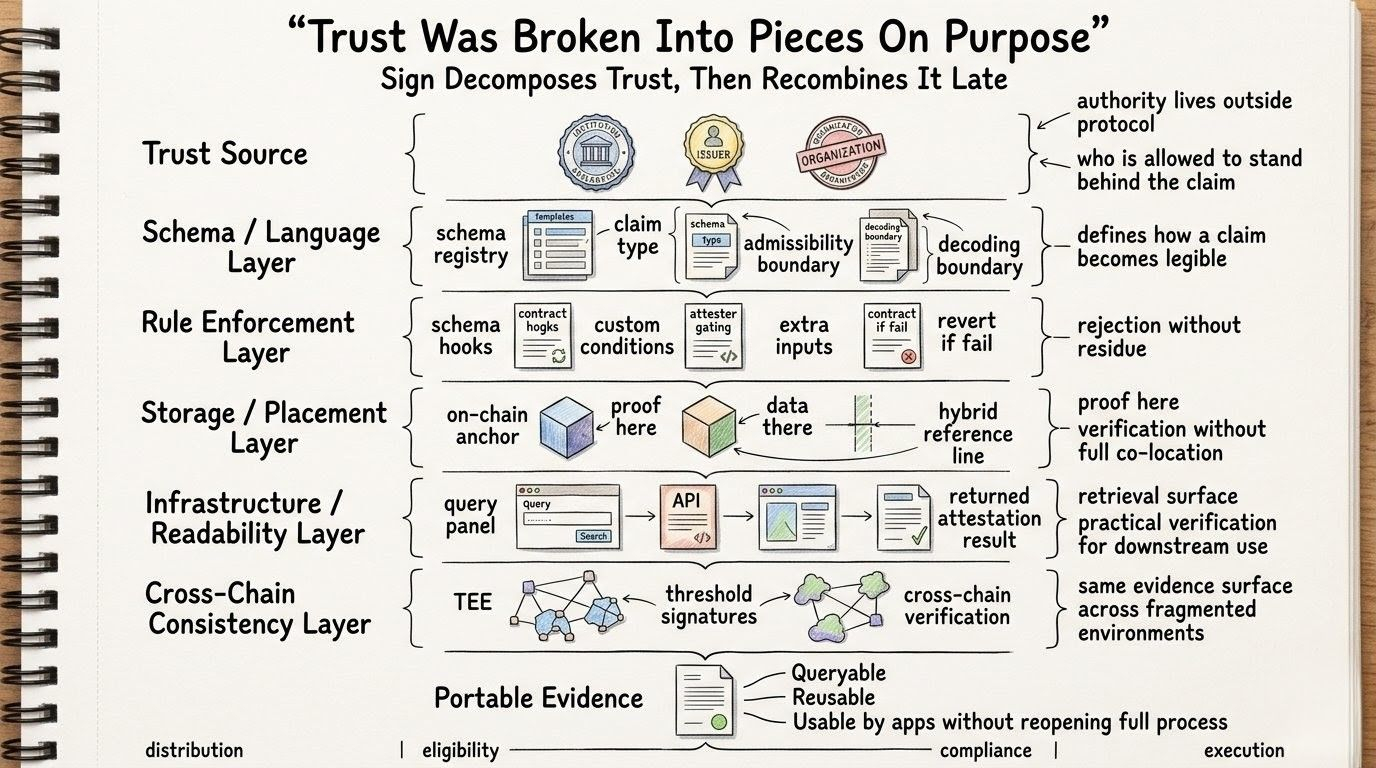
but it isn’t. whatever actually mattered was earlier, before the record looked clean, and also somewhere outside the place where the consequences later start firing. the more i follow it, the less it feels like one continuous sign system. it feels split. schema registry and schema hook logic decide emission there. TokenTable and other Sign-powered application layers execute consequence here. and that split is subtle enough that you can stare at it for a while without really seeing it.
before anything becomes visible inside Sign, the claim is still surrounded by all the unstable parts that made it real in the first place. issuer-side process, documents, approvals, hesitation, someone signing off, someone unsure but letting it pass anyway. that is where the decision actually lives. not clean, not final, still shifting depending on context and people and timing.
something can still be stopped there, reshaped there, or quietly pushed through there.
on sign, schema changes the question before the claim even gets a chance to look settled. it stops being about whether something is right or wrong in the broad sense and starts becoming about whether this thing can exist here at all.
what structure it has to take. what fields it must fit into. what version of itself is allowed to become legible as attestation state. that part keeps pulling at me because it doesn’t feel neutral at all. if the schema moved even a little,
would the same claim survive as the same thing? or would it become something else without anybody admitting it was ever the same decision?
“shape starts deciding before anything feels decided.”
the live tension stays inside sign a little longer. conditions, thresholds, whitelists, maybe zk logic, whatever is doing the actual gatekeeping in that moment. the claim is still close enough to its own origin to be turned away. it hasn’t hardened yet. it still carries enough of the old uncertainty to fail for real. schema hook logic is doing the real narrowing here, and it only gets one shot at it.
and that only gets one chance.
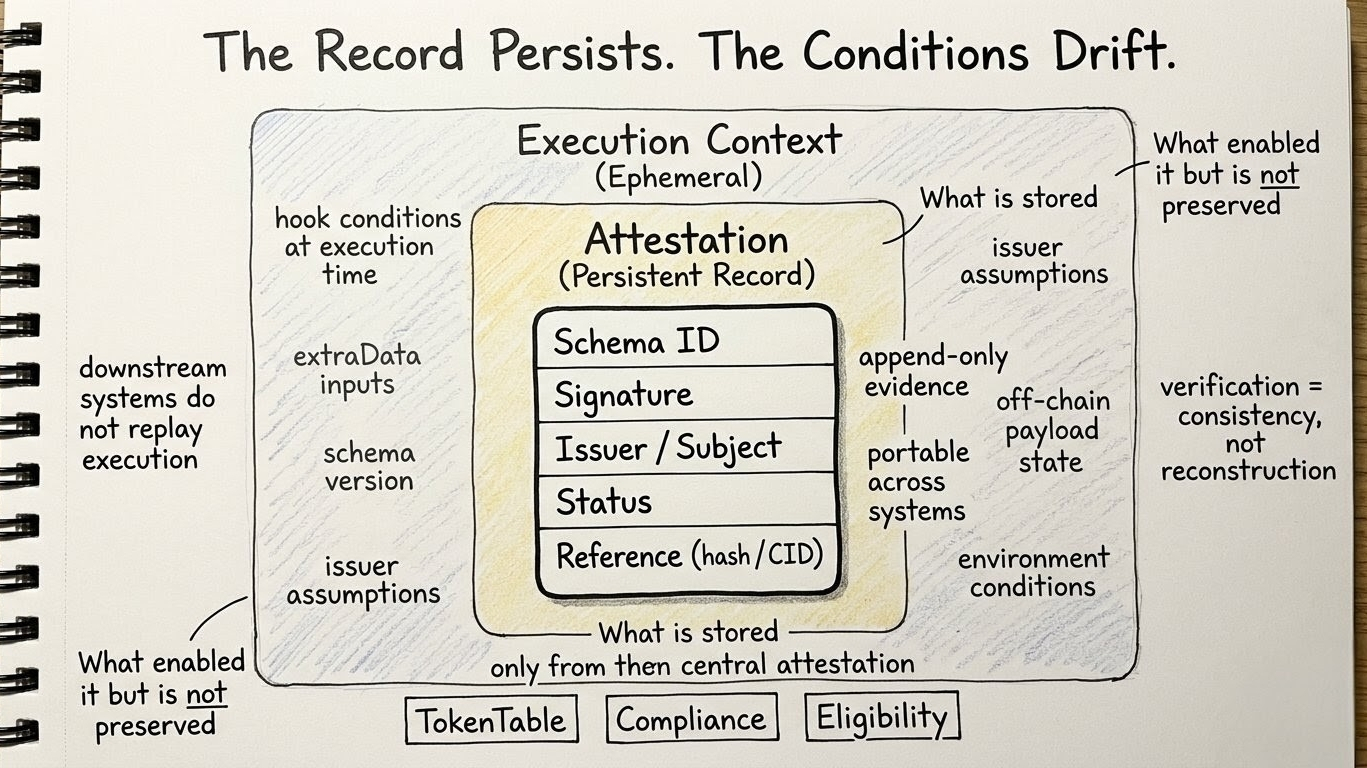
after that, the feeling changes completely. emitted attestation state exists. now it can be read, indexed, pulled into other systems. SignScan surfaces it. infrastructure keeps it reachable. TokenTable and other Sign-powered application layers pick it up and act on it. none of those places go back to where the uncertainty lived. they do not step into the earlier moment. they do not reopen the hook-time decision environment that made emission possible in the first place.
they don’t need to.
what they receive is already resolved enough to use.
so downstream behavior becomes almost embarrassingly simple. emitted attestation state exists. it matches the expected schema. good enough. continue.
and that “continue” is where the consequence starts.
that’s the split inside sign that keeps bothering me. the moment something was decided and the moments where something happens because of it are no longer the same place. they don’t even share the same conditions anymore. one belongs to context, people, timing, the awkward and unstable part. the other belongs to emitted attestation state becoming SignScan-visible, application-readable, and usable under schema.
“what gets used is not the decision, it’s the emitted remainder of it.”
maybe that’s the better way to say it.
because what if the conditions that made it valid shift later? not dramatic failure, just drift. authority changes a little. rules evolve. context moves in quiet ways that don’t announce themselves. something that passed once no longer sits exactly the same. not obviously wrong, just not as solid as it looked when it crossed that boundary.
does anything downstream notice that?
or is that already outside the frame?
because when i follow the flow, i can’t really find a place where anything goes back. the trust layer anchored authority once. schema registry fixed readable shape once. schema hook logic allowed emission once.
SignScan keeps serving the emitted state.
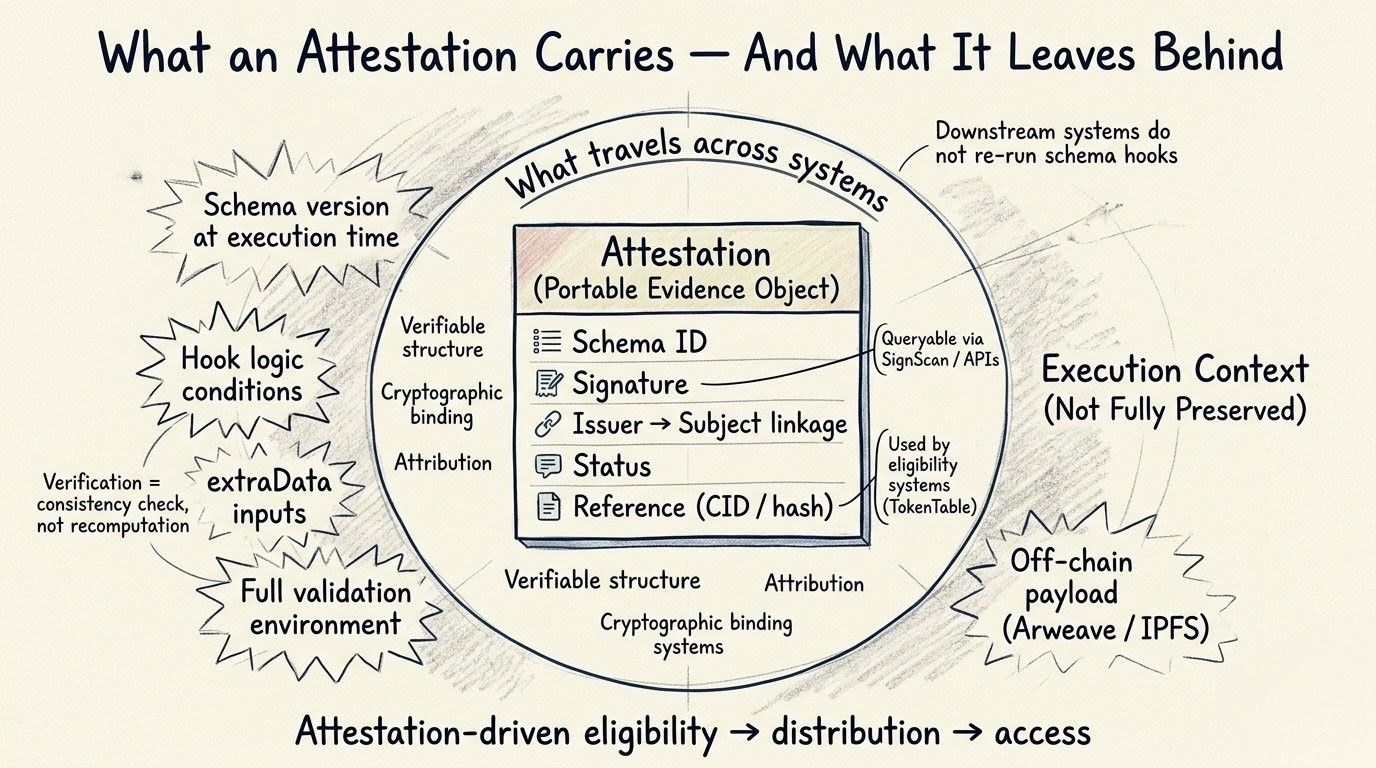
TokenTable and other Sign-powered application layers keep consuming that emitted attestation state under schema. what stays visible after that is emitted attestation state. what doesn’t stay equally visible is the issuer-side process, the schema shaping, and the hook-time reasoning that made emission possible.
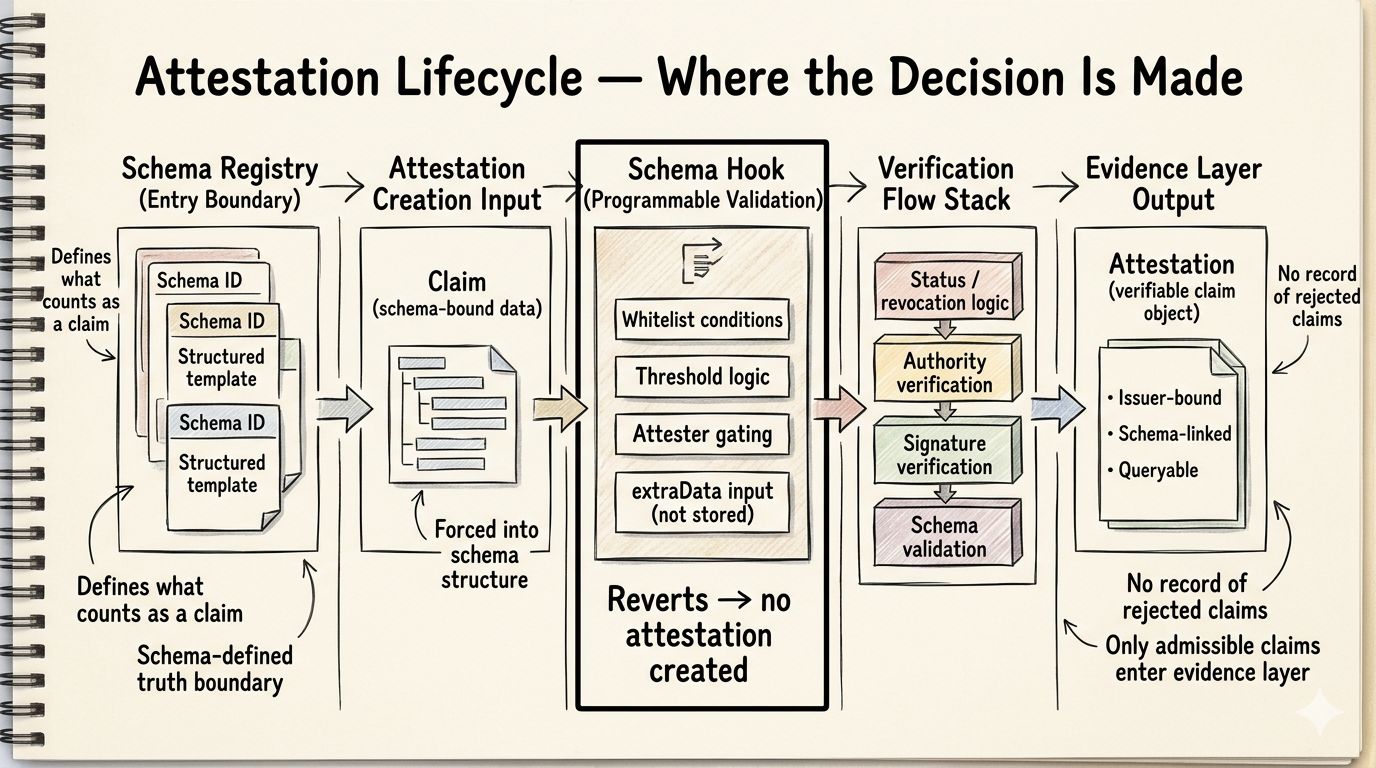
what keeps moving through Sign is not the original decision environment. it is emitted attestation state made legible by schema registry, passed by schema hook logic, surfaced by SignScan, and consumed by TokenTable and other application layers.
so consequence keeps happening based on something that isn’t being re-checked.
not now.
not continuously.
just… then.
that gap between “was valid” and “is still valid” doesn’t look like much at first. everything still works. things move. systems stay consistent. but the more i sit with it, the less trivial it feels. downstream systems are not interacting with a living decision. they are interacting with emitted attestation state that no longer changes unless something new is emitted.
TokenTable on sign unlocks because emitted attestation state exists under schema. access resolves because emitted attestation state exists under schema. eligibility flows because emitted attestation state exists under schema.
and all of that can keep happening while the original conditions drift further away from the moment that produced the state.
“action keeps going even when context is no longer present.”
maybe that is the only way something like this can scale. if every application had to reconstruct the original decision environment, re-run schema registry checks, re-execute schema hook logic, re-evaluate issuer context, nothing would move. everything would stall.
so Sign removes that weight. it lets the decision happen once and lets everything else operate from emitted attestation state.
that separation between schema-hook decision and application-layer consequence works.
but it also creates distance.
not just between layers. between times. between the moment something was judged and the later moments when it keeps being used.
and that’s the part i can’t smooth out.
if sign schema registry and schema hook logic decide emission, but TokenTable and other Sign-powered application layers execute consequence from emitted attestation state under schema,
what actually connects those two over time? trust in the original moment? continuity of state? habit?
something even thinner than that, like the quiet assumption that if emitted attestation state passed once under schema, nobody needs to question it again?
because nothing inside the flow seems interested in bringing that question back.
and if it never comes back, does that mean it isn’t needed?
or just that it stopped being visible?
i don’t know.
but the more i follow it, the harder it is to ignore that the sign hook-time decision stays where it happened, and everything else just keeps moving with emitted attestation state.