
SIGN Protocol was easy for me to misunderstand at first.
I looked at it and thought, alright, this is probably one of those projects that sounds useful on paper but does not really stay with you. Credential verification. Token distribution. Important words, sure, but not the kind that immediately feel alive. More like background infrastructure. Necessary maybe, but not something you expect to say anything deeper about the internet.
That was my first reading of it.
And honestly, I think that is exactly why it made me pause later.
Because the more I thought about SIGN Protocol, the less it felt like a project about credentials, and the more it felt like a project about a gap we still have not solved. We have built systems that can move value. We have built systems that can record activity. We have built systems that can prove a transaction happened. But we still struggle with something more basic than all of that.
We still struggle with knowing what deserves to be trusted.
That part is still messy.
A wallet can receive tokens, but that does not tell you who is behind it. An address can interact with a protocol, but that does not tell you whether the activity means anything. A person can show up onchain, and still leave behind almost no useful signal about whether they are real, eligible, credible, or even singular. The record exists, but the meaning is still missing.
That is where SIGN Protocol started becoming interesting to me.
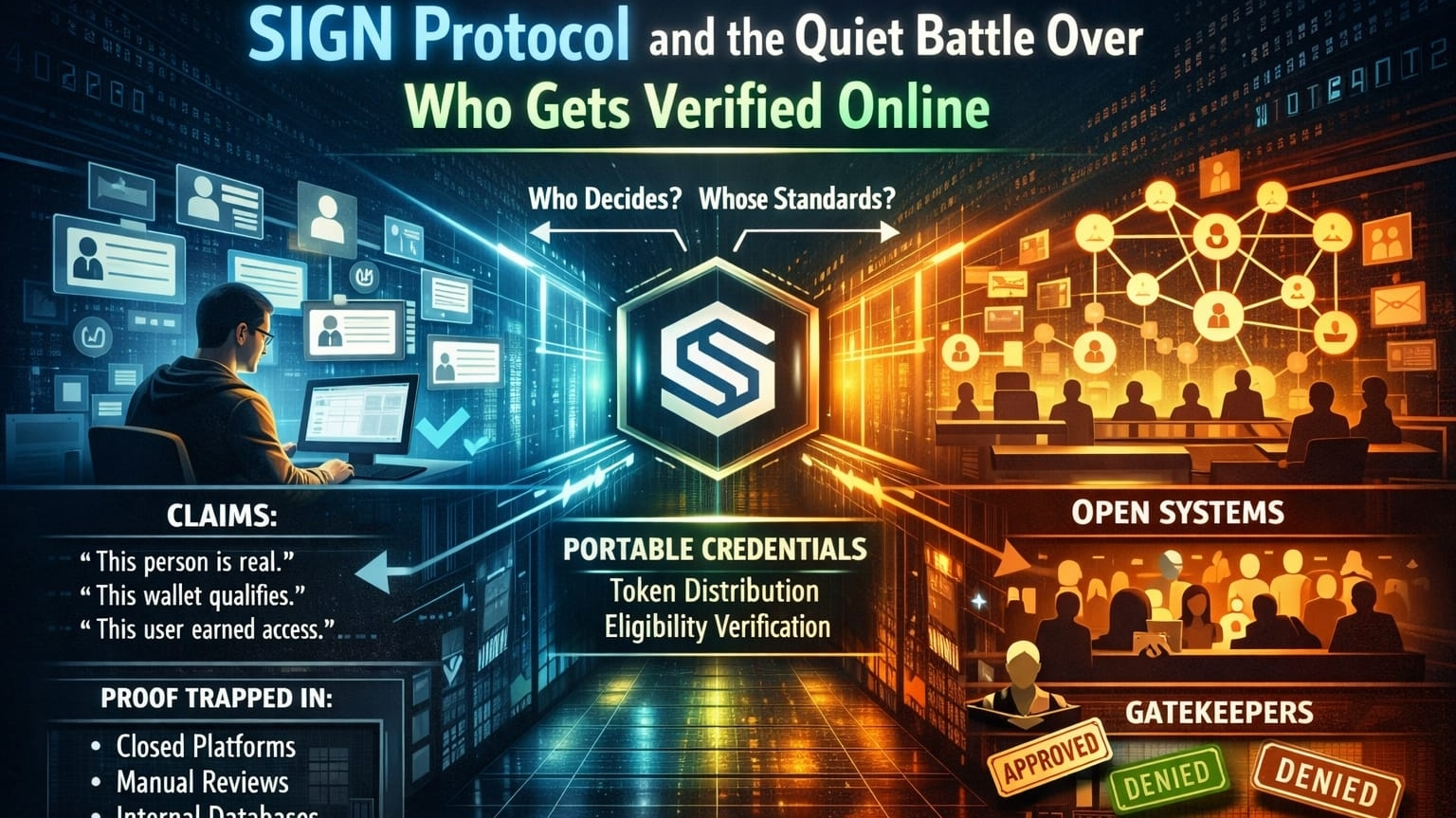
Because underneath the clean description, it is really dealing with claims. Very simple human claims, actually. This person is real. This contributor participated. This wallet qualifies. This user should receive something. This credential should count. And once you look at the internet through that lens, the problem becomes hard to ignore.
So much of digital life still runs on claims that are hard to carry from one place to another.
They sit inside forms, platforms, databases, spreadsheets, admin panels, private communities, and manual review systems. They get checked once, in one context, by one group, and then the proof more or less stays trapped there. Every new system has to ask again. Every new distribution has to verify again. Every new community has to rebuild trust from scratch or borrow it from somewhere else.
That is the real friction.
Not just proving something once. Making that proof usable in a way other systems can recognize.
And that is why the token distribution side of SIGN matters more than it first sounds. Because distribution is never just about sending tokens out. It is about deciding who should receive them and why. That sounds obvious, but it is where things get uncomfortable fast.
Who counts as a real participant? Who counts as a real user? What kind of activity matters? What kind of proof is enough? Who gets to decide?
That is where projects like this stop feeling administrative and start feeling political.
Because verification always sounds neutral until you get close enough to see the hands behind it. Someone chooses the rules. Someone defines the categories. Someone decides which credentials are valid and which issuers are trusted. Someone creates the standard, and after a while the standard starts to look natural just because enough people build around it.
That is the part people usually rush past.
Infrastructure does not remove trust. It reorganizes it.
It gives trust a structure. A format. A path it can travel through. That can be genuinely useful. In fact, a lot of the time it is useful. Reusable verification is better than repeating the same messy process again and again. Portable credentials are better than locking proof inside one platform. Cleaner systems do reduce friction.
But cleaner does not mean innocent.
The moment a system becomes widely used for verification, it also starts shaping what becomes legible. And once that happens, power moves quietly into the background. The system may look open. The rails may look neutral. The process may look objective. But if the wrong standards harden early, or the wrong issuers become central, then exclusion just gets upgraded into infrastructure.
That risk is real.
A perfectly formatted credential can still reflect bad judgment. A distribution system can look fair while carrying hidden assumptions about who counts. A proof can be portable and still come from a gatekeeper. None of that disappears just because the design is cleaner.
And I think that is what made SIGN Protocol feel more serious to me over time.
Not because it magically solves trust. It does not. Nothing does. Human judgment is still upstream. Social legitimacy is still upstream. Institutions, incentives, and recognition still sit underneath the technical layer. But what SIGN seems to recognize, and what a lot of people still underestimate, is that the internet keeps running into the same wall.
Transactions are not enough.
Sooner or later, systems need a way to carry meaning with movement. Not just that something happened, but what that thing meant. Not just that value moved, but why it moved to this person and not that one. Not just that a wallet exists, but whether its presence should actually count for something.
That is a much harder problem than most people admit.
And maybe that is why SIGN Protocol stayed in my head longer than I expected. Because at first it looked like one more utility project sitting somewhere in the background. But the deeper I looked, the more it felt like a reminder that the internet is still missing a reliable way to handle recognition without quietly rebuilding the same old gatekeepers in new technical language.
That tension is what makes it worth paying attention to.
Not because it gives a final answer.
Because it sits right inside one of the biggest unfinished questions in digital systems: not how to move value, but how to decide which claims deserve to move with it.