
I’ve seen this story before.
Everyone says cross-chain is “solved”… and I’m sitting there thinking—no, it’s really not. Not even close.
Moving tokens? Sure. That’s gotten smoother. Still clunky in places, but workable.
Moving truth?
That’s where everything starts to break… quietly at first, then all at once.
I remember the first time I tried to track a credential across chains—something simple, just a proof tied to activity. On one chain, it existed.
On another? Gone. Like it never happened. Same wallet. Same user. Completely different reality.
That’s when it clicked for me…
Liquidity isn’t the real problem.
Data is.
And this is where Sign Protocol keeps creeping back into my head.
Not loudly. Not with the usual ego trip narrative about “fixing interoperability.” It’s more subtle than that.
It’s basically asking a different question:
What if we stop moving data… and just prove it instead?
At first, I didn’t buy it.
Because I’ve heard variations of this before. New bridge, better relayer, cleaner messaging layer… same old promise, different packaging.
And let’s be honest—bridges have been a stomach-turning mess.
Hacks. Delays. “Trust us” infrastructure nobody actually understands.
So yeah… I’m skeptical by default now.
But the way Sign Protocol approaches this?
It’s different enough to make me pause.
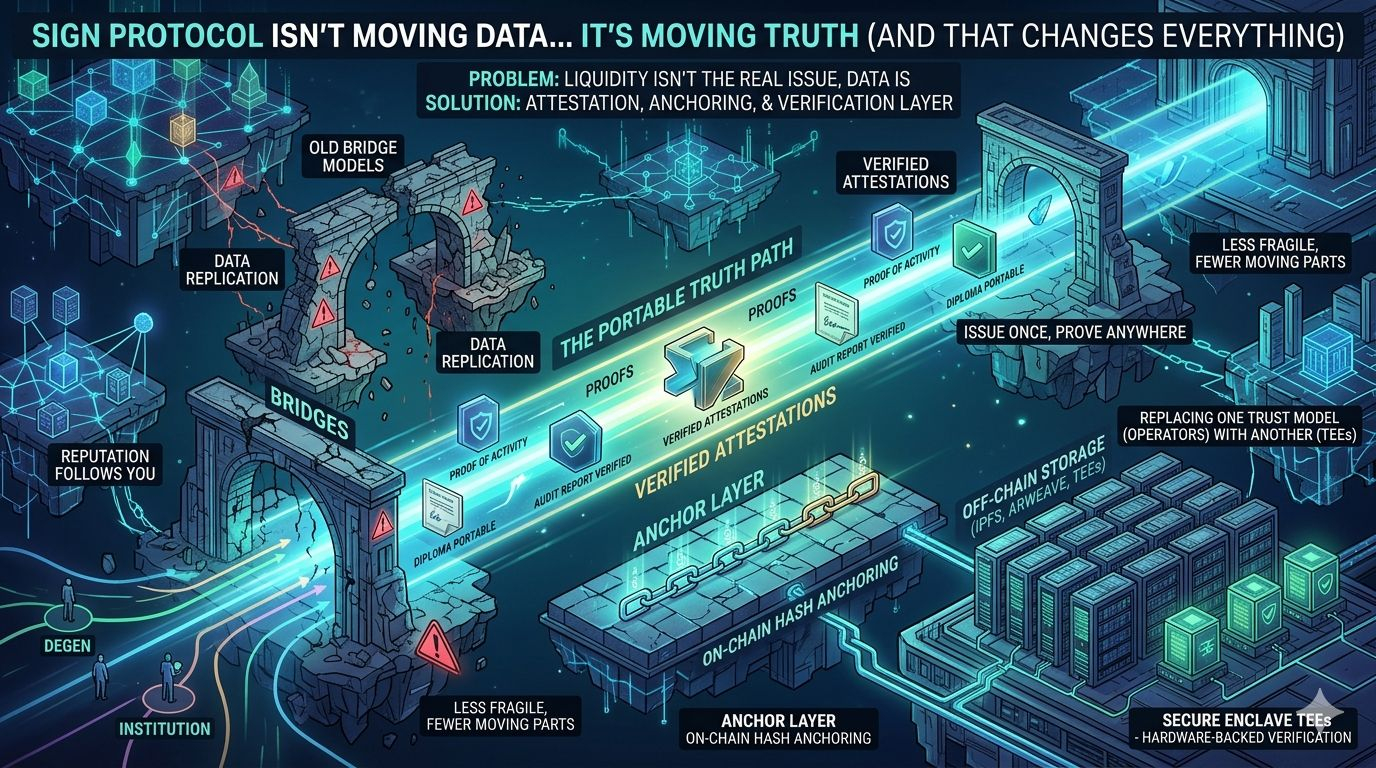
Instead of copying data from one chain to another and hoping nothing breaks in between, it leans into verification. Hard.
You create an attestation. That part’s familiar.
But instead of dragging that data across chains, you point to where it lives… and then verify it on demand.
That’s where things get interesting.
Sign plugs into systems like Lit Protocol and uses TEEs—trusted execution environments.
Sounds heavy. It kind of is.
But the idea is simple.
When a proof needs to be checked, these secure environments fetch the original data, validate it, and sign off on whether it holds up.
No copy. No bridge risk. No duplicated state floating around waiting to desync.
Just… confirmation.
Subtle shift.
Big implications.
Because now you’re not trusting a bridge operator you’ve never heard of.
You’re trusting a hardware-backed verification layer.
Is that perfect?
No.
Nothing in this space is.
But compared to what we’ve been dealing with? It feels cleaner. Less fragile. Fewer moving parts that can blow up at the worst possible moment.
And then there’s the hybrid model.
This is the part I actually like.
Because let’s be real—stuffing everything on-chain was never going to scale. We all kind of knew it… we just kept pretending it would.
Sign Protocol doesn’t force that.
It anchors proof on-chain… but pushes the heavy data off-chain. Think IPFS, Arweave—storage layers that actually make sense for large payloads.
You keep the hash. The reference. The integrity.
But you don’t clog the system.
That’s not just smarter.
It’s more usable.
Now zoom out a bit.
What does this actually mean in practice?
For regular users… yeah, the degens.
Your reputation stops getting reset every time you switch chains. Airdrop eligibility, activity history, all those little signals—they move with you.
You farm on one chain, verify on another… and you’re not starting from zero like some ghost user every time.
That’s been a quiet pain point for years.
For institutions?
This gets heavier.
Diplomas. Audit reports. Compliance records.
Stuff that can’t afford to be “kind of verified.”
With Sign Protocol, you issue once… and prove anywhere. No reissuing. No rebuilding integrations chain by chain.
That’s not hype.
That’s infrastructure.
Still… I’m not fully sold.
Because here’s the uncomfortable part.
We’re replacing one trust model with another.
Bridges had operators. Now we have TEEs.
Less messy? Probably.
Untouchable? Definitely not.
And I’ve been around long enough to know—every “clean” system eventually meets messy reality.
But I’ll give it this.
Sign Protocol doesn’t feel like a patch.
It feels like a rethink.
Less about forcing chains to talk… more about making truth portable regardless of where it lives.
And honestly… that might be the first time cross-chain has started to feel less like a workaround and more like an actual system.
So now I’m watching.
Not the announcements. Not the integrations.
I’m watching what happens when this gets pushed.
When people try to game it. Stress it. Break it.
Because that’s when you find out if you’re really moving truth…
Or just repackaging the same old fragmentation with better branding.