


What kept pulling me back on @SignOfficial was not the attestation itself.
Worse than that. Actually...
It was the way the team started behaving before the attestation existed at all.
I do not think people say this part out loud enough. Once they know the record is going to end up in Sign, queryable later, visible in SignScan, reusable by somebody else six systems away, they start cleaning the case too early. Not the case, actually. The language. The shape of it. Same bad instinct. You can watch it happen.
A review note that should have stayed ugly turns into a field.
A maybe gets shaved into a yes. Fine.
A “good for this route only” gets shortened into something cleaner because nobody wants that mess sitting there later under a schema with an issuer trail attached to it.
And suddenly the future dashboard is writing the present decision.
That part bothers me.
Because the soft version of Sign is easy. Attestations. schemas. portable trust. whatever. Nice enough. The actual thing, inside a workflow, is harsher. Once a team knows the output will be durable and searchable later, they stop writing for the case and start writing for the record. Same humans. Same pressure. Different behavior. Cleaner output. Worse decision surface.
Okay okay.
I kept picturing a boring internal queue because it is always the boring queues. Some ops or compliance team is trying to push approvals through. They know the attestation is not staying local. It is going to be pulled later. SignScan will show it. Another partner might query it. Some claims path might read it. Reporting will definitely read it. So nobody wants to leave a weird field hanging there. Nobody wants “conditionally cleared pending secondary review” if “eligible” is shorter and less embarrassing. Nobody wants to explain route-specific nuance when the schema can hold one neat label and keep the line moving.
So they compress.
Not later. Up front.
And this is very Sign-native. Not generic data-cleaning whining. Specific to a system where the claim is going to be durable, visible, queryable, reusable later. That future changes how they write it now.
Maybe “too legible” is not fair. No. Fair enough. Legibility is the point. That is why they are using it. But the point still has side effects. Once the record has a future, the present gets tidied for it. And tidy is where people start lying to themselves.
I have seen versions of this where the underlying case is still messy as hell. CRM notes still carrying caveats. Manual reviewer still treating the decision as narrow. Slack thread still saying "only for phase one" or "do not use for payout yet." Then the schema field gets populated with something clean because the team knows the later object needs to travel. Needs to look respectable. Needs to survive SignScan without making the whole process look like the process actually was.
Nice.
Now the Sign attestation is not just preserving judgment. It is preserving the cleaned-up version of judgment the team thought would age well in public.
Then the export goes out with the clean field value anyway, and that is the version the later team inherits.
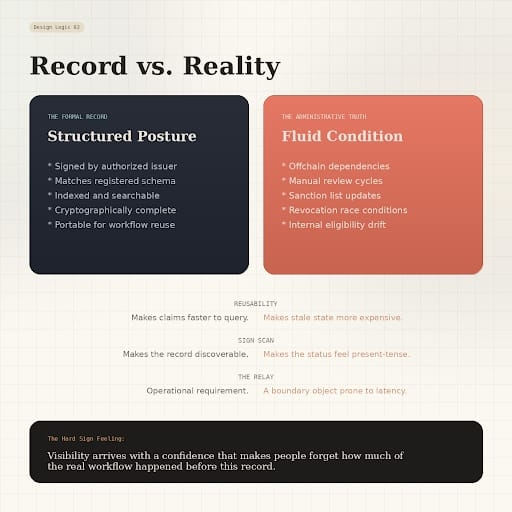
Worse version, honestly.
Because it means the later misuse did not really start later. It started when they cleaned the case up for the record.
A team wants the final object to read cleanly. Understandable. They do not want the schema cluttered with route-specific qualifiers, timing caveats, provisional flags, local-only language, all the weird little truths that would force the next team to slow down. So they trim. They standardize. They choose the field value that will look stable later instead of the one that is truest now.
And then the later systems inherit something that was born flatter than the case itself.
That is why I do not buy the lazy line that queryability only matters once someone queries. No. It is already in the room earlier, changing what gets said and what gets rounded off. SignScan does not have to be open yet for SignScan to be affecting behavior. People know the record is headed there. That is enough.
Enough is not enough... Actually.
I keep coming back to one ugly little example. Review team has a subject that is good to proceed under one narrow path, not final for anything broader. Everyone around the case knows that. It lives in notes, comments, someone’s head, all the healthy institutional places where precision goes to die. Then the schema field gets set to something neat because nobody wants the future record looking half-resolved. Later a claims filter sees the neat field. Later reporting sees it. Later some partner sees it. Great. By then the team can even tell themselves the later misuse was the real mistake.
Was it.
Or did the mistake start when they realized the attestation would be queryable later and started writing for that audience instead of the case in front of them.
That is the more annoying version. Because it means Sign did not just preserve the workflow. It pressured the workflow into a cleaner self-presentation before preservation even happened.
Good for the record. Maybe.
Not always good for the decision.
And that kind of distortion is almost impossible to audit afterward because the final attestation looks perfectly normal. Schema matched on Sign ( $SIGN ). issuer signed. SignScan shows a respectable object. Nobody can see the uglier wording that got sacrificed three steps earlier because it would have made the later record harder to operationalize. That earlier loss does not leave a tidy scar. It just quietly improves the final object and worsens the truth content.
Which is a rotten trade if the next system is going to act on it.
Then somebody downstream reads the attestation like it is a faithful capture of the original decision. Maybe it is. Maybe it is the cleaned version the team thought would survive being queried later without making everyone slow down and ask what the hell the field actually meant.
Still valid. Still signed. Still very usable.
And maybe already bent by the fact that the team wrote it for SignScan before they finished being honest about the case.