

Alright… here’s the thing that’s been sitting in my head lately — and I might not explain it perfectly but I’ll try.
The more I look at this whole @SignOfficial idea… the more I feel like we’ve been overcomplicating money for no reason.
Like seriously… what even is money on-chain?
It’s not coins. Not really.
It’s just… signed claims.
That’s it.

Someone signs “this belongs to me.”
Then signs again to send it.
Then someone else signs to accept it.
And we all just agree those signatures are valid.
That’s the system.
---
And when I started thinking like that… everything kinda simplified in my head.
No fancy narratives. No “next-gen financial revolution” talk.
Just signatures moving around.
Even stablecoins… same thing.
Balances? signed.
Transfers? signed.
Minting? yeah… signed again.
It’s honestly… kinda boring when you strip it down. But also very clean.
---
Now on public chains — this model just fits naturally.
Everything is visible. Anyone can check.
No need to trust some company tweet or announcement.
You just look at the data and go:
“okay… this is signed… this checks out… done.”
That’s real trust. Not marketing trust.
---
But where it got more interesting for me was the permissioned side…
Like imagine a private network. Not everyone inside. Limited access.
Something like enterprise setups.
At first I thought okay, this must be totally different.

But… it’s not.
Still signatures.
Same exact idea.
Only difference is… who’s allowed to sign and who’s allowed to see.
That’s it.
Not a new system. Just… a gated version of the same logic.
---
And that’s where I kinda paused and thought — wait…
If both public and private systems are running on signed data…
then Sign Protocol is basically acting like a common language between them.
That’s actually powerful.
Because now you’re not forcing two different worlds to connect awkwardly…
you’re just expressing the same truth in two places.
Public for transparency.
Private for control and speed.
Simple idea. But not talked about enough I think.
---
Now about that high TPS stuff (like 200k+ or whatever)
Honestly… I don’t get impressed by big numbers anymore.
Because it depends on what you’re doing.
If you're just verifying signatures and ordering them… yeah, it’s gonna be fast.
You’re not running heavy smart contracts every second.
So yeah… speed makes sense.
But speed is not the hard part.
---
The real problem?
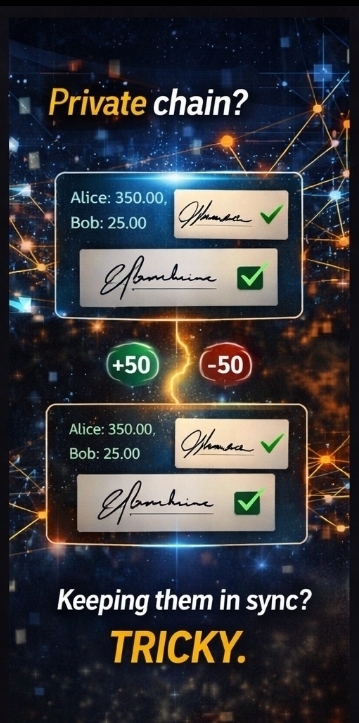
Keeping both sides… in sync.
That’s where things can break.
If public chain says one thing… and private system says something slightly different…
even small difference…
That’s where trust starts cracking.
And once that cracks… it’s really hard to fix.
---
What I kinda respect about this approach though…
It’s not trying to sound magical.
It’s not like “we invented a new universe of consensus” or whatever.
It’s more like:
“hey… just focus on signatures. Build around that. Keep it consistent.”
That feels… grounded.
---
Also makes debugging easier in theory.
If something goes wrong, you don’t dig through layers of abstraction.
You just ask:
who signed this?
when?
why?
Simple questions. Clear answers.
That’s accountability.
---
I’m not saying this solves everything… not even close.
Cross-system consistency is still a big challenge. Probably always will be.
But starting from signatures instead of hype…
feels like the right direction.
---
Anyway… I’m still learning this stuff.
Probably missing things. Definitely missing things lol.
But yeah… I’d rather understand what’s actually happening under the hood
than just follow whatever trend is loud this week.
Because in the end…
It all comes back to one thing:
who signed what…
and do we all agree on it?