
I don’t remember exactly when the excitement faded.
Maybe it was sometime after the second or third cycle. After DeFi summer turned into yield farms that looked suspiciously alike. After NFTs went from strange and interesting to strangely predictable. After AI tokens, RWAs, restaking, and whatever comes next all started to blur into the same pattern, just with different branding.
At some point, you stop chasing narratives and start recognizing them.
It’s not cynicism exactly. More like fatigue. A quiet awareness that most things in crypto aren’t as new as they sound. They’re recombinations of old ideas, wrapped in better storytelling.
And yet, every now and then, something makes you pause.
Not because it promises a revolution, but because it tries to solve a problem that never really went away.
Sign Protocol is one of those things.
The Problem That Never Left
If you strip crypto down to its bones, it’s always been about trust.
Or more precisely, about removing the need for it.
But in practice, we never really removed trust. We just moved it around.
We trust smart contracts. We trust multisigs. We trust auditors. We trust oracles. We trust bridges, even after they fail. We trust teams, even when we say we don’t.
And outside the chain, it gets even messier.
Who verified this wallet?
Is this user eligible?
Did this person actually sign this document?
Is this claim real, or just another Discord screenshot?
These questions keep coming back, across every cycle.
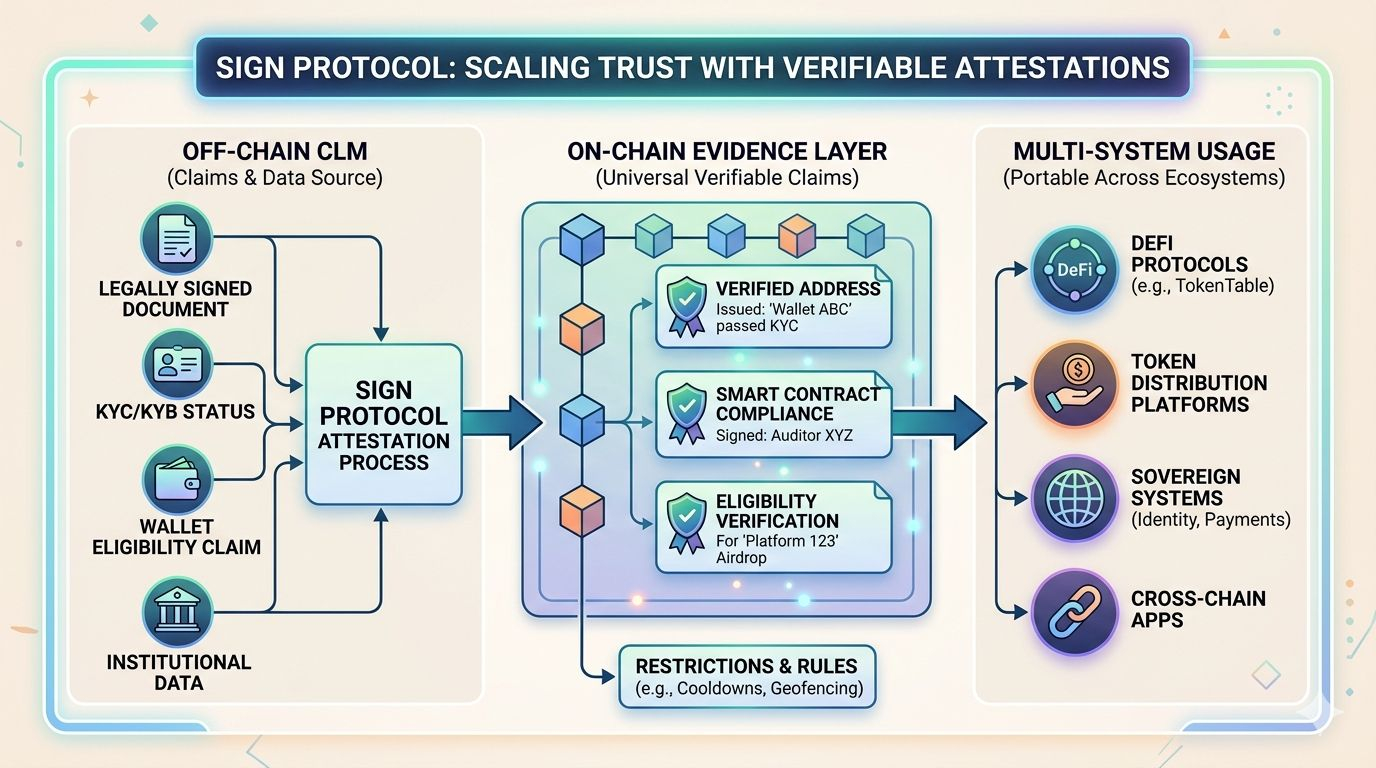
Sign Protocol sits in that uncomfortable space between on chain certainty and off chain reality. It tries to turn claims into something verifiable, portable, and persistent, using what it calls attestations, essentially structured, signed statements that can be checked later.
On paper, it sounds simple. Almost too simple.
But simplicity in crypto usually hides complexity somewhere else.
The Idea That Makes You Pause
The core idea is not new.
“Let’s make information verifiable.”
We’ve heard that before.
But Sign’s framing is slightly different. It’s not just about identity or credentials in isolation. It’s about building a shared “evidence layer” that different systems can rely on, whether that’s token distributions, contracts, or even government level infrastructure.
That’s where it gets interesting.
Because instead of building another app, it’s trying to be infrastructure, something underneath everything else. A system where a claim, like “this wallet passed KYC” or “this address is eligible,” can be issued once and reused across chains and contexts.
In theory, that reduces friction.
In reality, it raises new questions.
Cooldowns, Verification, and Restrictions
One of the more grounded aspects of Sign’s ecosystem shows up in its practical rules, things like cooldowns, buyer verification, and country restrictions.
They don’t sound exciting. They don’t trend on Twitter.
But they point to something important.
Crypto systems, especially token distribution platforms like TokenTable, have to deal with abuse.
Bots farming airdrops.
Users sybil attacking eligibility systems.
Regulatory constraints depending on where users are located.
So you end up with rules.
Cooldowns to prevent repeated claims.
Verification layers to filter who can participate.
Geographic restrictions to stay within legal boundaries.
These aren’t glamorous features. They’re compromises.
And they reveal what Sign is actually trying to do, not just build trustless systems, but build systems that can operate in the real world, where rules exist and enforcement matters.
It’s easy to dismiss this as just another compliance layer.
But it’s also where most crypto projects quietly struggle.
Why This Might Matter
There’s a certain maturity in focusing on verification.
Not in the marketing sense, but in the recognition that coordination is hard.
If different applications, chains, and institutions can’t agree on what’s true, everything becomes fragmented.
Sign tries to unify that.
A universal way to say:
This happened.
This is valid.
This can be checked.
And importantly, it tries to make those claims portable across chains, addressing the long standing problem where verification on one network doesn’t carry over to another.
If that works, it could reduce a lot of redundant processes.
Repeated KYC.
Repeated eligibility checks.
Repeated trust assumptions.
But “if that works” is doing a lot of heavy lifting.
Why It Might Not
Because verification is not just a technical problem.
It’s a social one.
Who issues the attestations?
Why should anyone trust them?
What happens when they’re wrong?
Or worse, when they’re compromised?
Sign Protocol can make claims verifiable, but it doesn’t make them inherently truthful. It still depends on the credibility of whoever creates those attestations.
And that brings us back to something crypto never fully escaped.
Trusted parties.
Just better organized.
There’s also the question of adoption.
For an “evidence layer” to matter, it has to be widely used.
Developers need to integrate it.
Projects need to rely on it.
Users need to accept it.
Otherwise, it becomes another isolated system solving a problem that only exists within its own ecosystem.
Crypto has seen this before. Many protocols try to become “the standard.” Few actually do.
Scaling Trust Across Systems
There’s also a deeper tension here.
Sign positions itself as infrastructure for large scale systems, even sovereign ones, including identity, money, and capital distribution.
That’s ambitious.
Maybe necessary.
But also complicated.
Because scaling verification to that level means dealing with:
Privacy concerns
Government oversight
Legal compliance
Cross border inconsistencies
It’s one thing to verify a wallet for an airdrop.
It’s another to build something that governments or institutions might rely on.
And crypto has a mixed track record when it comes to bridging that gap.
The Token Question
Then there’s the token.
$SIGN sits at the center of the ecosystem, powering operations and governance.
Which raises the usual question.
Does the system need it?
Or does it exist because every protocol is expected to have one?
In theory, the token aligns incentives.
It funds the network.
It gives users a stake.
It decentralizes governance.
In practice, tokens often introduce noise.
Speculation overshadows utility.
Short term price movements distract from long term design.
Users engage for rewards, not because the system is useful.
It’s not unique to Sign.
It’s just part of the pattern.
And it makes you wonder whether a protocol focused on verification, something that ideally should be neutral and infrastructure like, benefits from having a speculative layer attached to it.
Or whether it complicates things.
A Familiar Kind of Uncertainty
After a while, you start recognizing a different kind of signal.
Not hype. Not narratives.
But tension.
The tension between what a system is trying to be and what it might become.
Sign Protocol sits right in that space.
It’s grounded enough to address real problems, verification, trust fragmentation, cross chain identity.
But it’s also ambitious enough to risk overextension.
It wants to be infrastructure.
It wants adoption.
It wants to bridge worlds that don’t easily connect.
That’s not easy.
Thinking Out Loud
Maybe the most honest way to look at something like this is to sit with the uncertainty.
To acknowledge that it’s not obviously a success or a failure.
It’s just an attempt.
An attempt to formalize something crypto has always struggled with, proving things in a way that others can rely on.
And maybe that’s why it stands out, at least a little.
Not because it feels new.
But because it feels unresolved.
Like a question crypto hasn’t answered yet, and might not for a while.
And whether protocols like this move us closer to an answer, or just rearrange the same pieces again, is still unclear.
@SignOfficial #SignDigitalSovereignInfra
