
I keep circling back to the tricky part about Sign’s digital record-keeping.
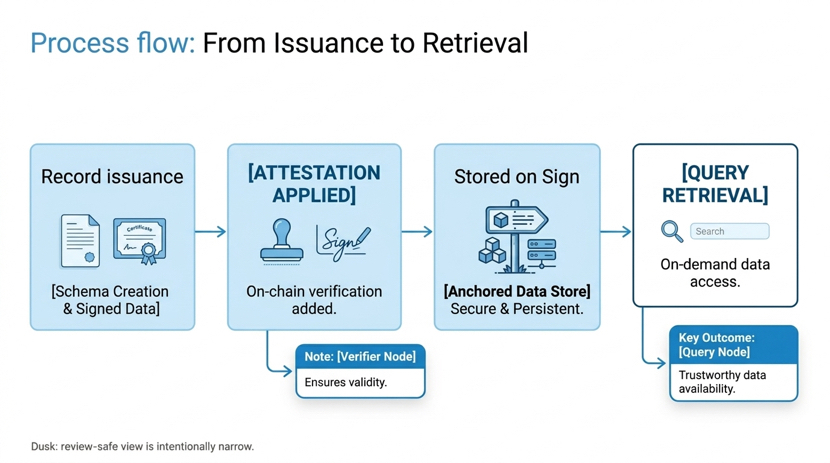
Creating the record is straightforward.
Fields filled. Attestation attached. Signature applied. Evidence linked. The record exists. Somebody approves it. Sign stores it. Everyone nods and moves on. That’s the simple part.
The real difficulty comes afterward.
Because once the record is there, the institution behind it doesn’t always behave predictably.
Imagine a department issues a credential for residency through Sign. The data fields are structured. Attestation is applied. Evidence is connected. Citizens can present the credential without sending stacks of paperwork every time. This step works exactly as intended. Sign enforces structure. Records are retrievable. Queries run smoothly. Much better than fragmented forms or scattered PDFs.
The challenge appears months later.
When a verifier — a bank, regulator, or another office — examines the same record, the key question isn’t “Does this exist?”
It’s “Who is still responsible for backing this decision?”
I’ve looked at enough accurate Sign records to see this clearly. The record is complete. The attestation is valid. Everything resolves in the system. Yet someone in compliance pauses, and suddenly the question is about trust, not existence. Did this approval follow a temporary procedure? Is the exception still valid? Who decides whether it’s acceptable today?
The conversation shifts.
Record on the screen. Policy document in hand. No one disputes that the attestation exists. Everyone debates whether it can be relied on safely.
This is the friction inherent in Sign’s model.
The system is excellent at capturing and displaying the record. It is not equipped to ensure that an institution continues to take responsibility for decisions when circumstances evolve.
This isn’t rare. It’s everyday practice. Rules change. Leadership changes. Policies evolve. The record remains, but the institution’s willingness to endorse it may diminish quickly.
On Sign, the record can appear flawless through all of this:
Fields resolve.
Issuer checks out.
Attestation remains.
Signatures verify.
Queries return results.
But the cleanliness of the record does not equal accountability. That is the nuance often missed: Sign makes evidence readable and portable, but responsibility remains human.
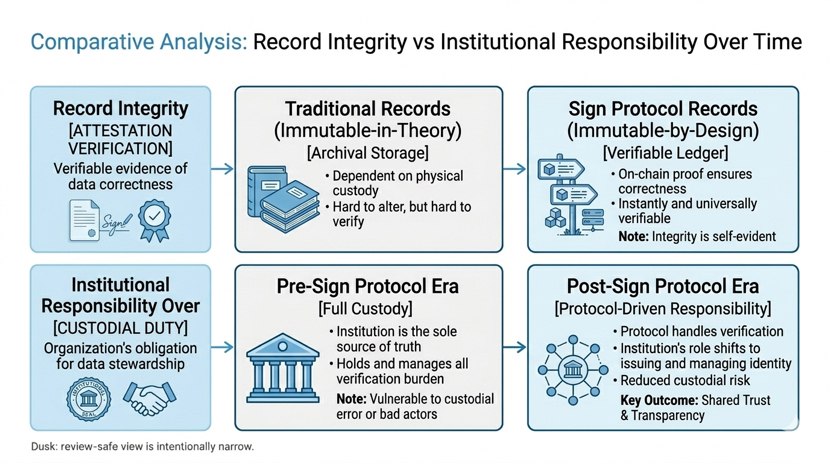
Consider a program approval for funding or a professional license. The record is clear. Downstream staff see it. Excellent. Then questions arise: which approval pathway was applied? Which version of the rules was in effect? Were all steps completed fully or partially? A perfect digital record does not answer these questions. It only provides the facts. Decisions still need human judgment.
Sign clarifies the data.
The record exists. Retrieval works perfectly. But it cannot determine who must defend it or explain it when scrutiny occurs. That is the real limitation: structured data is not equivalent to institutional commitment.
I understand why this record layer is valuable.
Organizations need something better than scattered spreadsheets, untracked email approvals, or fragmented databases. Sign provides that. Records are consistent, auditable, and machine-readable.
Yet clarity does not remove human discretion.
It simply shifts where the responsibility lives.
The real tension begins not in the record’s existence, but in who will answer for the consequences when questions arise — the issuer, the operator, the app owner, or the authority present in the room.
Sign can generate the record flawlessly.
It can track every change.
It can make the record accessible and transparent.
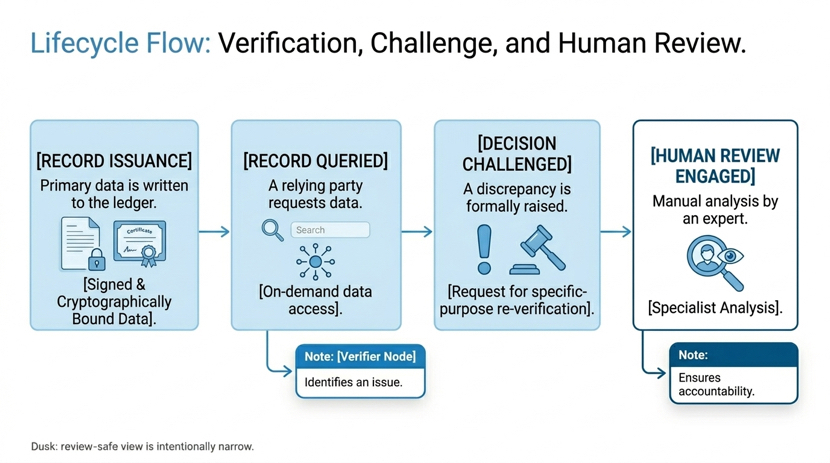
But the final decision — the judgment — remains with humans.
Sign preserves the record.
It does not preserve the willingness to defend it.
And that is the detail that keeps drawing my attention.