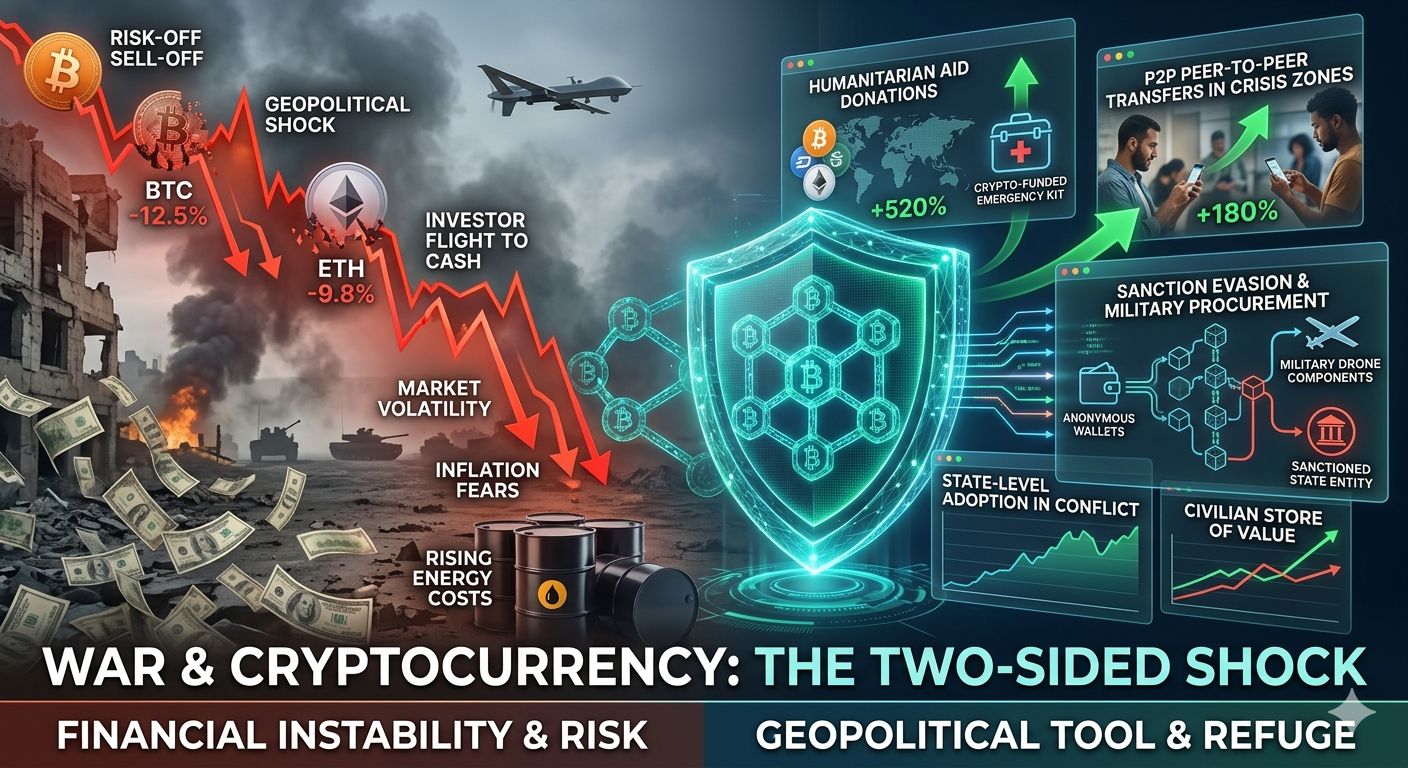
The interaction between war and cryptocurrency in 2026 is complex and two-sided. While it initially acts as a volatile risk asset prone to sell-offs during geopolitical shocks, it simultaneously serves as a crucial functional tool for both humanitarian and military logistics, and for evading international sanctions.
1. Market Impact: Volatility and "Risk-Off" Behavior
Geopolitical tension remains a primary driver of short-term volatility in the crypto market. When a conflict escalates, investors typically engage in "risk-off" behavior, meaning they sell volatile assets (like cryptocurrencies and stocks) and flee to safer havens (like cash, gold, or U.S. Treasuries).
Inconsistent Safe-Haven: Bitcoin, in particular, continues to demonstrate that it is not a consistent safe-haven like gold. During immediate shock periods, it has tended to behave like a "high-beta risk asset," briefly dropping alongside broader risk markets before finding support.
Energy Prices: Conflicts, especially in the Middle East, can drive up global oil and energy prices. This increase fuels inflation expectations, which complicates the global economic outlook and further dampens risk appetite, including for crypto.
2. Functional Tool: Aid, Evading Sanctions, and War Logistics
The most notable trend in 2026 is the documented use of cryptocurrency as a strategic, financial logistics tool by states, citizens, and paramilitary groups involved in or affected by war.
Military Procurement: A significant development is the use of crypto for military fundraising and purchasing low-cost equipment. Reports, including from blockchain analytics firm Chainalysis, have tracked millions of dollars in crypto donations to pro-Russia groups used specifically to buy military drones and components on global e-commerce platforms. Iran-linked groups have also been found using crypto to procure drone parts from international suppliers.
Evading Sanctions: For countries facing heavy international sanctions, such as Russia and Iran, cryptocurrency provides a path to bypass traditional financial systems. It allows state entities and sanctioned groups, like Iran's Islamic Revolutionary Guard Corps, to move funds across borders to maintain military or economic operations.
Civilian Life & Aid: Conversely, crypto remains a lifeline for civilians. It is used as a peer-to-peer means of payment, a store of value against hyperinflation, and a way for humanitarian aid to enter conflict zones when banking systems are down. In some conflict areas, civilian use for value storage has increased significantly.
Visualizing the Impact: The Two-Sided Shock
The generated image illustrates this complex duality.
The Left Side (Conflict & Risk): Represents the initial market shock. A war-torn city is overlaid with a red, crashing chart labeled "RISK-OFF SELL-OFF." Arrows point down toward falling traditional money and rising oil barrels, showing how the market initially reacts with panic.
The Right Side (The Functional Tool): Shows a digital blockchain nexus providing diverse functions. It explicitly visualizes the conflict's uses:One screen shows "HUMANITARIAN AID DONATIONS" (the positive).
Another shows "SANCTION EVASION & MILITARY PROCUREMENT" (the strategic).
A third tracks "STATE-LEVEL ADOPTION IN CONFLICT" as a contrasting, yet upward, trend.