
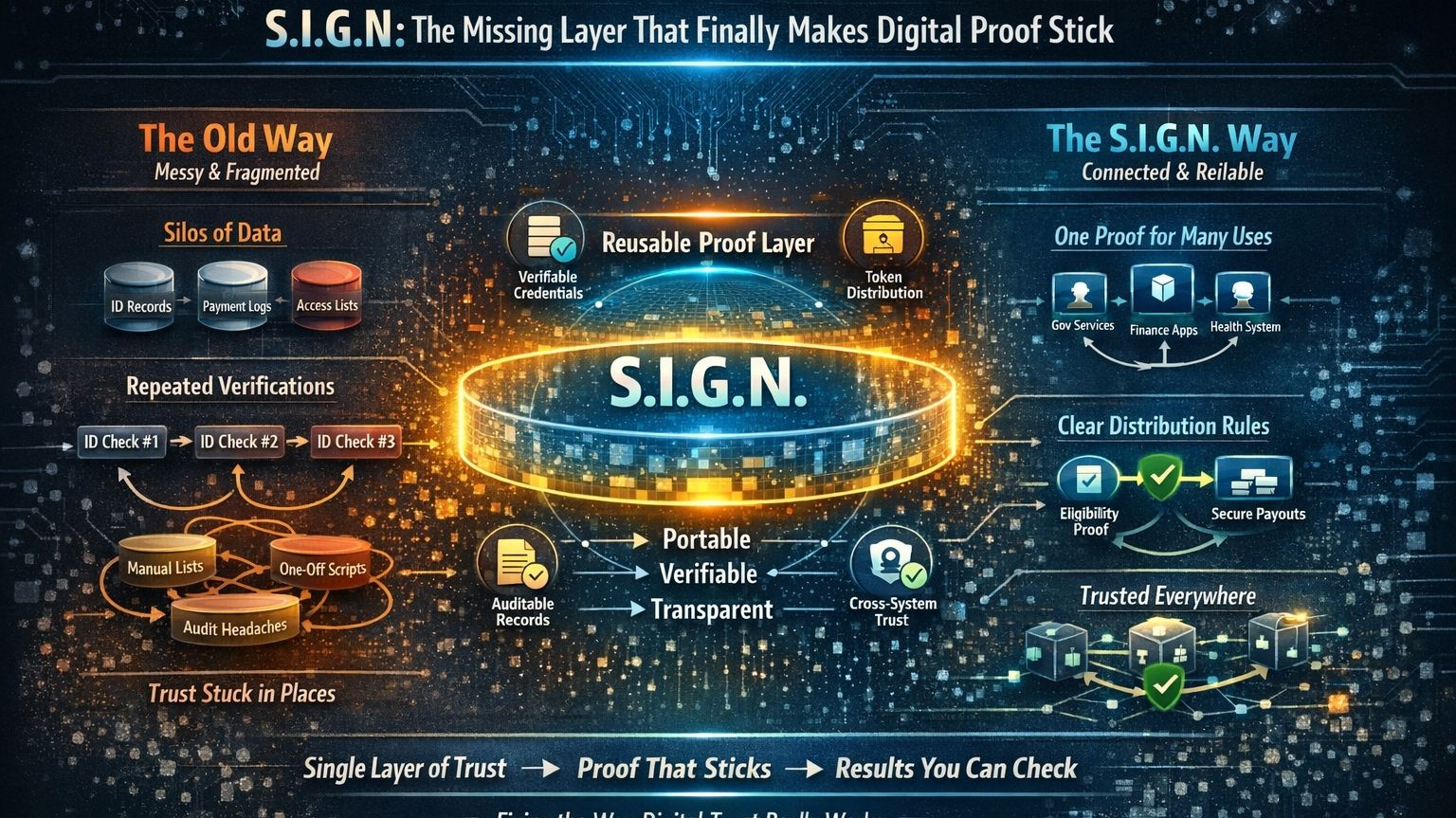
S.I.G.N. is one of those projects that doesn’t really scream for attention, which is honestly part of why it’s interesting. It’s not dressed up like a miracle. It’s more like boring but important plumbing that a lot of systems have needed for a long time and somehow kept avoiding.
What I actually like about it is that it starts from a pretty plain frustration: why is verification still such a mess? You prove something once, then you prove it again somewhere else, and then again after that, as if the first proof never happened. It’s exhausting. It wastes time. And it makes digital systems feel way less smart than they pretend to be.
S.I.G.N. is trying to fix that by treating proof like something that should carry weight beyond one locked room. A credential should not be trapped inside the system that issued it. That’s the whole point. It should be usable, checkable, and still mean the same thing when it moves somewhere else. Simple idea. Weirdly rare.
The thing is, once you start thinking about it that way, a lot of the mess around digital identity starts to look less mysterious. It is not really about fancy tech. It is about trust. Who said something was true, when they said it, and whether anybody else should care. That’s the real game. Everything else is just packaging.
And S.I.G.N. seems to get that. It treats credentials as attestations, which is a much better word for what they actually are. Not vague claims. Not decorative badges. Real evidence with context attached. That part matters more than people think. Because if the proof is clean, the rest of the process gets a lot less annoying.
Then there’s the distribution side, which is where things usually get sloppy fast. Moving value around sounds easy until you actually have to do it at scale. Lists go out of date. Rules get interpreted badly. Somebody exports the wrong spreadsheet. Somebody else notices three weeks too late. Classic stuff.
S.I.G.N. looks like it was built by people who are tired of that nonsense. It treats distribution like something that should be traceable from the beginning, not something you explain after the damage is done. Eligibility is tied to evidence. Allocation is tied to rules. The result can be checked against the original setup. That’s not flashy. It just works better.
And that’s kind of the theme here. S.I.G.N. is not trying to be impressive in the loud, overpromising sense. It feels more like an attempt to clean up the underlying system so everything built on top of it has a better chance of surviving. Less hand-waving. Less “trust us.” More receipts.
That matters because digital systems fail in very ordinary ways. Not always through dramatic hacks or big scandals. Sometimes they fail because the basics are sloppy. Bad records. Weak verification. Duplicate checks. Manual work everywhere. The stuff that actually matters gets buried under layers of process that nobody enjoys using.
S.I.G.N. is trying to pull some of that back into one place. A shared layer for proof. A cleaner way to handle verification. A less chaotic way to move value where it needs to go. That is the part worth paying attention to.
Not because it sounds revolutionary. Because it solves a problem people have been putting up with for too long.
And honestly, that’s usually how the useful projects show up. Quietly. A little unglamorous. Doing the plumbing while everyone else is busy making noise.