

I remember the first time I looked at Sign’s schema hook docs and felt that little trader annoyance that usually means I’m finally seeing the thing clearly. Not because the product was bad. Because it was smaller than the story people were trying to force onto it. A schema hook is basically custom logic that fires when someone creates or revokes an attestation, and if that hook rejects the action, the whole call fails. In plain English, that is a programmable checkpoint. A gatekeeper with rules. Useful, absolutely. But when I see people jump from that to “this is full infrastructure now,” I pull back a bit. That is where this title comes from for me. Sign let a local review shortcut keep traveling until everyone started calling it infrastructure. The question is whether the market is finally pricing the shortcut, or the infrastructure fantasy.
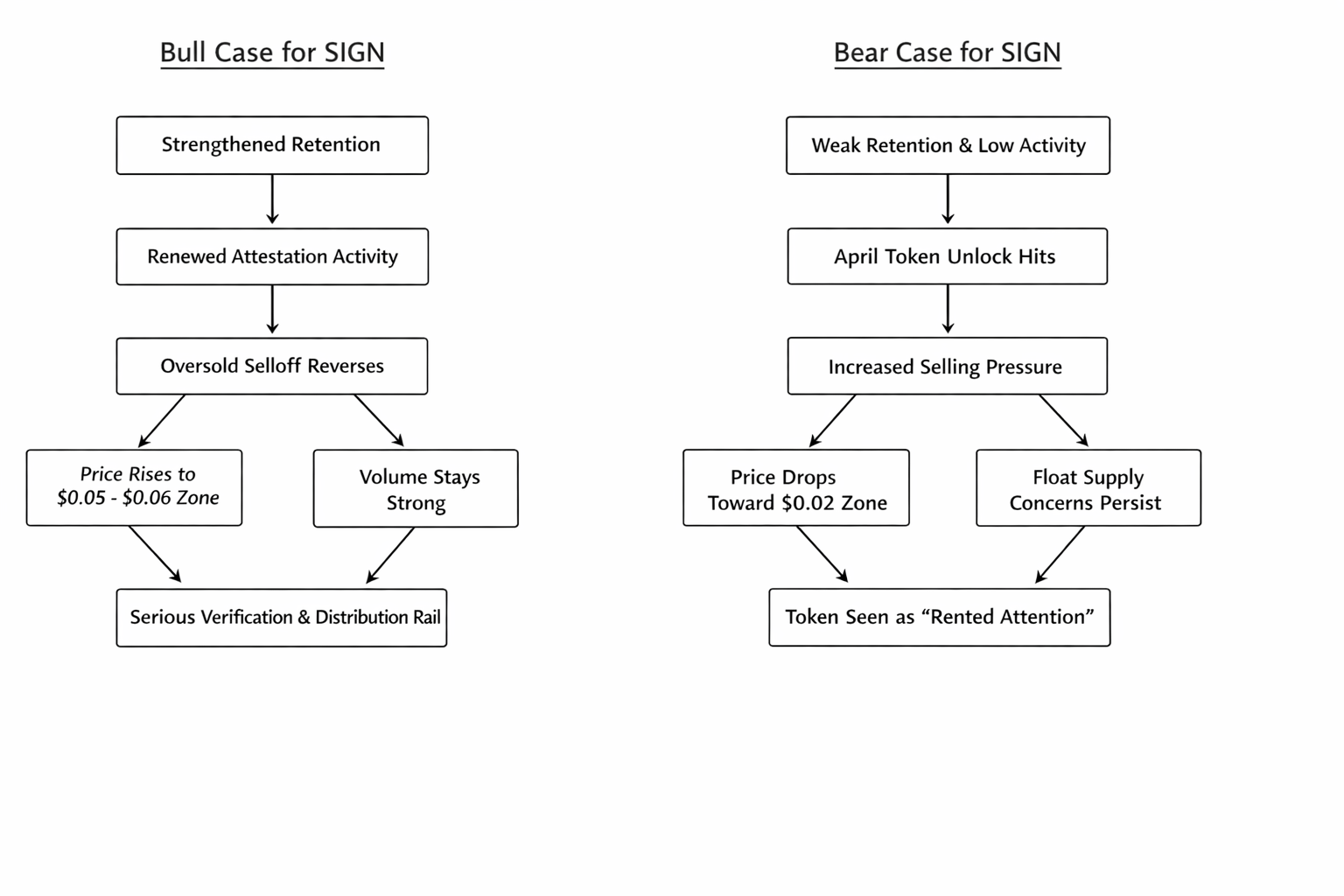
Today’s tape is not giving you an easy answer. Binance shows SIGN around $0.03204 with roughly $52.5 million market cap, about $31.6 million in 24 hour volume, and a circulating supply listed at 1.6 billion. CoinGecko is in the same zone at about $0.03206, roughly $52.6 million market cap, and about $26.6 million in 24 hour volume, while showing the token down 37.6% on the week. That is not dead money. But it is not trust either. It is active disagreement. When a token trades more than half its market cap in daily volume and still cannot stop bleeding on the weekly view, what that usually tells me is simple: people are willing to touch it, but they are not ready to marry it. Now here’s the thing. The product underneath is not nonsense. Sign’s current docs are very explicit that S.I.G.N. is a broader stack for money, identity, and capital, while Sign Protocol is the evidence layer inside that stack. The protocol’s actual job is to standardize structured claims so they can be signed, stored, queried, verified, and audited later. That matters. A lot, actually. If I were explaining it to a trader friend, I’d say think of Sign less like an app and more like a shared receipt format with enforcement options. Not a wallet. Not a consumer front end. More like a system that says, “Here is the claim, here is who made it, here is the authority behind it, and here is whether the rule still holds.” That is useful for credentials, approvals, program eligibility, and distribution logic. It is boring in the way real plumbing usually is. Where I stay cautious is the jump from useful plumbing to valuable token. Traders get burned there all the time. The docs say Sign Protocol is infrastructure, not an application. Fine. But infrastructure can still be narrow at first. A schema hook that can whitelist attesters, charge payments, or inject custom checks is powerful, but it still starts as local logic around one schema. One checkpoint. One controlled process. That can scale outward over time, yes. But it does not automatically become universal trust infrastructure just because the words got bigger. I actually like that tension because it keeps me from getting lazy. I do not want to buy the slogan when the monetization and token capture path still need proving. The strongest part of the Sign story, for me, is not the slogan anyway. It is the evidence of use. The project’s MiCA whitepaper says that in 2024 Sign processed over 6 million attestations and distributed more than $4 billion in tokens to upwards of 40 million wallets. That is real scale. It tells me the team has touched large distribution workflows, not just demo-day theory. But this is exactly where the Retention Problem shows up. Distribution is episodic by nature. Airdrops, allocations, credential checks, eligibility proofs. They spike attention, then cool off. So I keep asking the same ugly question: after the distribution event, after the one-time claim, after the campaign ends, what keeps users, builders, and institutions coming back? If the answer is “the next campaign,” that is not retention. That is serialized novelty. Good for bursts. Bad for durable multiple expansion. There is also a token-side tradeoff that annoys me, and I think traders should be honest about it. CoinGecko shows a 10 billion max supply and a fully diluted valuation of about $320.7 million at today’s price. It also shows an upcoming April 28 unlock of 401.11 million SIGN, worth about $12.86 million at current pricing. On top of that, the same CoinGecko page shows 1.93 billion unlocked and in circulation on the tokenomics panel, while the market section still frames about 1.6 billion as tradable. That mismatch does not kill the thesis, but it does matter. When I am trying to size a swing or think about medium-term positioning, I hate ambiguity around float. It makes conviction more expensive. So what is the realistic bull case from here? For me, it is not some fantasy moon target. It is much simpler. On March 22, CoinMarketCap’s historical snapshot showed SIGN around $0.05287 with a market cap near $86.7 million. A return to that zone from today’s roughly $0.032 price would be about 65% upside. That is a real move, not a fairy tale, and it does not require the market to believe Sign has already won sovereign infrastructure. It only requires traders to believe the recent selloff overshot while product credibility remains intact. If buyers can push SIGN back into the $0.05 to $0.06 area and daily volume stays meaningfully alive, then I think the market is saying, “Fine, we are willing to price this as a serious verification and distribution rail, even if the long game is still unresolved.” The bear case is the one that keeps me honest. If the upcoming unlock hits into weak retention, soft follow-through, and no fresh proof that attestations are becoming recurring operational behavior rather than campaign bursts, then the token can stay pinned in low-trust territory. CoinGecko already shows SIGN about 75.5% below its all-time high and only about 54.8% above its all-time low. That is not a chart with deep sponsorship. If this slips back toward the lows near $0.02073 while more supply keeps arriving, the market is basically saying the product may be real, but the token still behaves like rented attention. And rented attention is brutal inventory to hold. That is where I land tonight. I do not think Sign is fake. I think the market is forcing the right question. Is this a programmable review layer with a nice narrative attached, or does it actually become repeat-use infrastructure that people depend on after the campaign ends? Watch recurring attestations. Watch whether distribution scale turns into repeatable system usage. Watch float pressure into the April unlock. And do not let a big story make you forget the ugly trader rule: if users do not return, value usually does not either. If you are eyeing SIGN here, do not buy the slogan. Track the behavior. Because the difference between a clever shortcut and real infrastructure is not what the docs call it. It is whether the world keeps using it when nobody is being paid to look.