
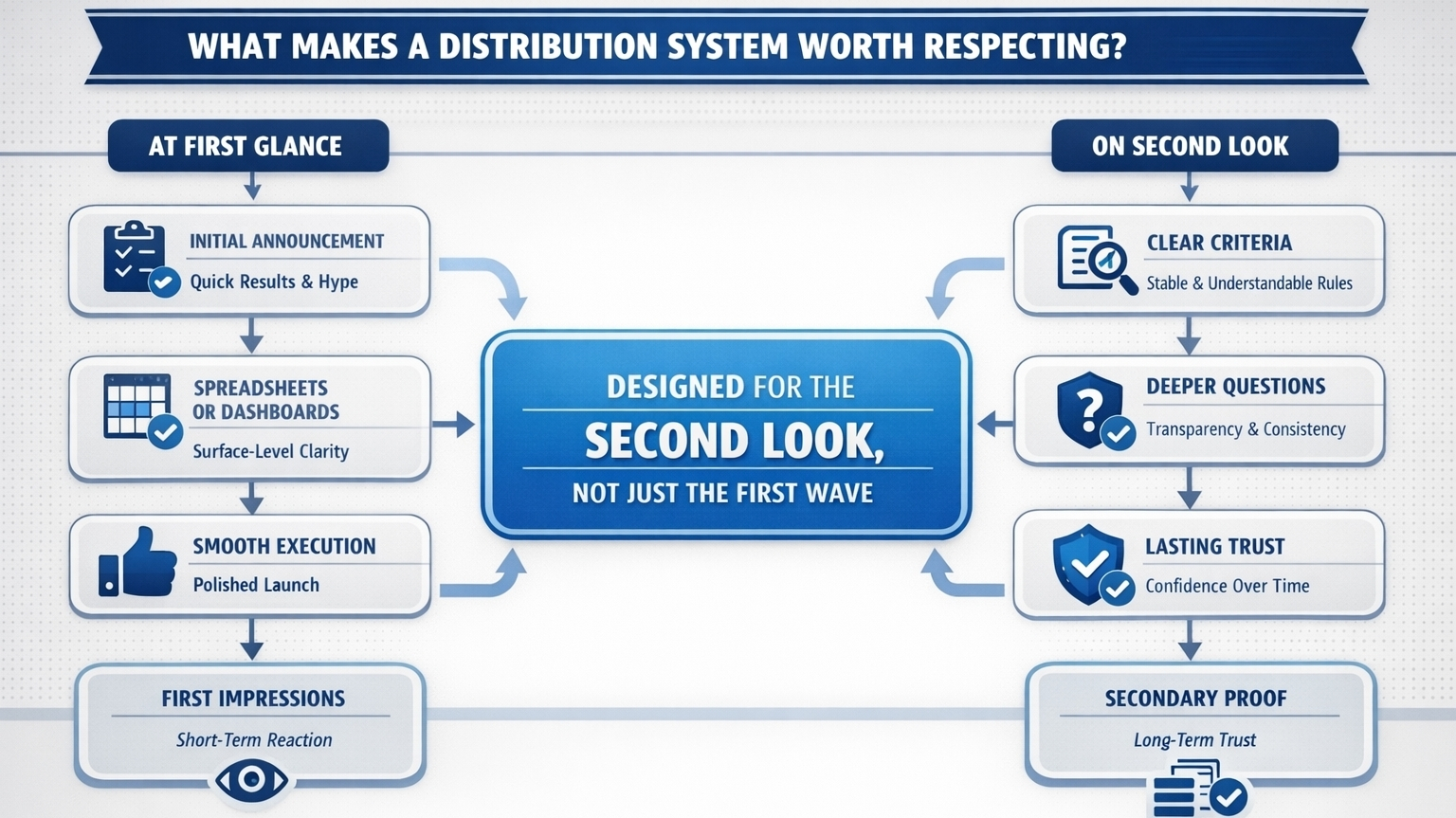

I was thinking today about how easily people treat a finished process like a trustworthy one. A distribution happens, the list goes public, wallets get checked, claims open, and for a little while everything feels settled just because it is already done. But I do not think that is where respect comes from. A system does not become worth respecting only because it completed the task. It becomes worth respecting when people can come back later, ask more difficult questions, and still find something solid behind the result.
That is the part that stays with me.
A lot of distribution systems look clear at first. There is an announcement, a spreadsheet, maybe a checker page, maybe some dashboard that makes the whole thing feel organized. And for a moment, that does look like transparency. But the more I sit with it, the more I feel that this kind of clarity is often very shallow. It shows people where they ended up, but it does not always help them understand why they ended up there. And once that understanding is missing, confidence starts feeling weaker than it first looked.
That is where respect really starts getting tested.
Because in the end, a distribution system is not only moving value from one place to another. It is making a decision. It is deciding who counted, what qualified, which rules mattered, and how those rules were applied. Once you look at it that way, the whole standard changes. A final list is no longer enough by itself. People start wanting to know whether the process can still make sense after the first wave of reaction is over. Why did this wallet qualify and not that one. Which rule decided the edge case. Did the criteria stay the same from beginning to end, or did they shift once the process became more difficult.
Those are not small questions.
And I think that is why this topic feels more serious to me than a normal token distribution conversation. The part that stands out is not only the act of distribution. It is the idea that a distribution should leave something behind that feels stronger than a finished outcome. Something people can come back to later. Something that helps the result still make sense after the easy moment has passed.
For me, that is what makes a system worth respecting.
Not speed on its own. Not polish on its own. Not even scale on its own. What earns respect is whether the system can still hold together once people stop reacting emotionally and start looking more carefully. A respectable system is one that does not depend too much on explanations after the fact, because the process itself already leaves enough behind to carry the weight more honestly.
That matters more than people sometimes admit.
A weak system can still look smooth in the beginning. In fact, many of them do. But the weakness usually shows up later. It shows up in confusion, in repeated clarification posts, in community members trying to explain the process to each other because the system itself no longer explains enough on its own. That kind of quiet erosion matters. Once people start feeling that a distribution is hard to revisit, every future distribution carries some of that doubt with it.
That is why respect is always about more than the event itself.
It is also about memory. It is about whether the process leaves behind something durable enough to carry trust into the next moment. Because a system that cannot be revisited easily usually ends up relying too much on reputation, messaging, or goodwill. And those things may help for a while, but they are not the same as structure.
That is the bigger thought I keep coming back to.
A distribution system worth respecting is one that feels designed for the second look, not just the first one. Not only for the first wave of reactions, but for the later moment when someone wants to go back and understand what actually happened. That is where a process either starts feeling stronger or starts feeling thinner than it first appeared. And honestly, I think that second moment matters more than the launch itself.
That is also why I do not think rules are a small detail.
Rules are rarely the exciting part. They are not what people notice first. But they are often the difference between a system that only looks fair and one that can still feel fair after people begin pushing on it. If the rules are stable, understandable, and clearly tied to the result, then even disagreement becomes easier to live with. People may still dislike the outcome, but at least they are not left guessing how it came into existence.
That is a healthier kind of trust.
And maybe that is the quiet line that matters most here. People can usually live with outcomes they do not like more easily than outcomes they do not understand. A system worth respecting does not remove every complaint. It removes some of the fog around the complaint. It helps people separate “I do not agree with this” from “I do not even know what happened.”
That difference is not small.
For me, that is what gives a distribution system real weight. Not the announcement. Not the spreadsheet. Not the first impression. The real weight comes from whether the process can still make sense after the easy moment is gone.
That is when respect starts feeling real.