


There is this one thing about @SignOfficial that has been seriously bugging me, and I think I finally figured out why.
So we have this project , Sign : Web3 infrastructure, DeFi adjacent.
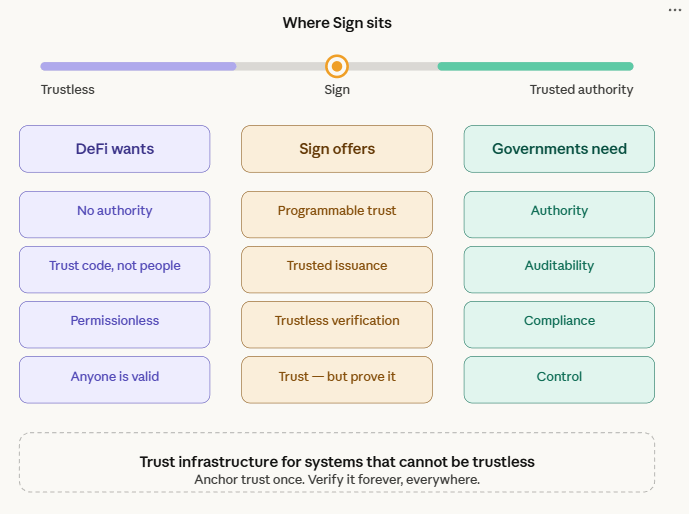
DeFi is almost always aiming for the trustless angle. Permissionless, trustless, those are the words we associate with it.
On the other side, you have DeFi projects that can't achieve trustless because of their very nature, so they go trust-based instead. What is interesting is that Sign is somehow both and neither. It's not trustless and it's not trust-based.
Honestly, most builds in DeFi can't sustain fully trustless or fully trust based, so they stay somewhere in the middle, gravitating toward one or the other. This is the place where Sign sitS. Right between the two opposites, and somehow juggling them just fine.
This is the reality for Sign because of the nature of their mission. They have taken on something that is honestly a little hard to carry. To be the intermediary between governments, countries, the whole insttutional slow circus — and the world of Web3 where things move at a completely different speed — is a goal that is very high set. Don't foool yourself even for a minute that this is easy.
We have institutions built oveR years, in some cases centuries, that still run on slow administration, layers of signatures, and physical presence. We have all tasted the long waits in grey office buildings where you stand patiently while someone adds another stamp to your fifteenth consecutive birth certificate, just so you can prove somewhere that you were born in that country, on that day, and that you are in fact you.
Now imagine doing that at the comfort of your home, over a PC, using Sign. Click verify. Your birth certificate is ready, sent to your email, valid in every country in the world.
That image is actually the whole point.
Because Sign is not targeting DeFi apps. They are targeting govrnments and national systems. Their architecture is described as sovereign grade digital infrastructure, a stack built for digital ID, CBDCs, and state-level systems. And countries cannot operate trustless. Govrnments need authority, auditability, control, compliance.
They don't want "no trust."
They want verifiable trust.
That is exactly where Sign positions itself. Instead of removing trust, it turns trust into something provable.
The distinction is clean once you see it:
DeFi tries to remove trust completely. You don't trust a person, a company, or a government. You trust code. Everything is permissionless. Nobody decides who is valid.
Countries don't work like that. Governments must decide things. They issue IDs. They define eligibility. They approve programs. You can't make a passport trustless , someone has to issue it.
So Sign doesn't try to eliminate that authority.
It separates authority from verification.
A government issues a credential. That part is trusted. But once issued, the verification becomes cryptographic and portable. Anyone can check it without trusting the issuer again. Trust is anchored once, then reused infinitely.
Not trustless issuance. But trustless verification.
That's the hybrid. That's what Sign actually is — not DeFi, not centralized, but something in between.

Cryptographic trust infrastructure for systems that cannot afford to be trustless.
And that also explains why adoption is slower. Countries test. Pilot. Regulate. Move carefully. But if one adopts, the scale is unlike anything DeFi has ever seen. You don't onboard users. You onboard populations.
DeFi is fast, trustless, chaotic. Sign is slower, structured, institutional. But potentially much bigger if it lands.
The contradiction is exactly the interesting part. Sign is not purely trustless. It is trust infrastructure for systems that cannot be trustless.
It's not saying "don't trust anyone." It's saying trust — but prove it.
Which, honestly, is more realistic for the world we actually live in.
