
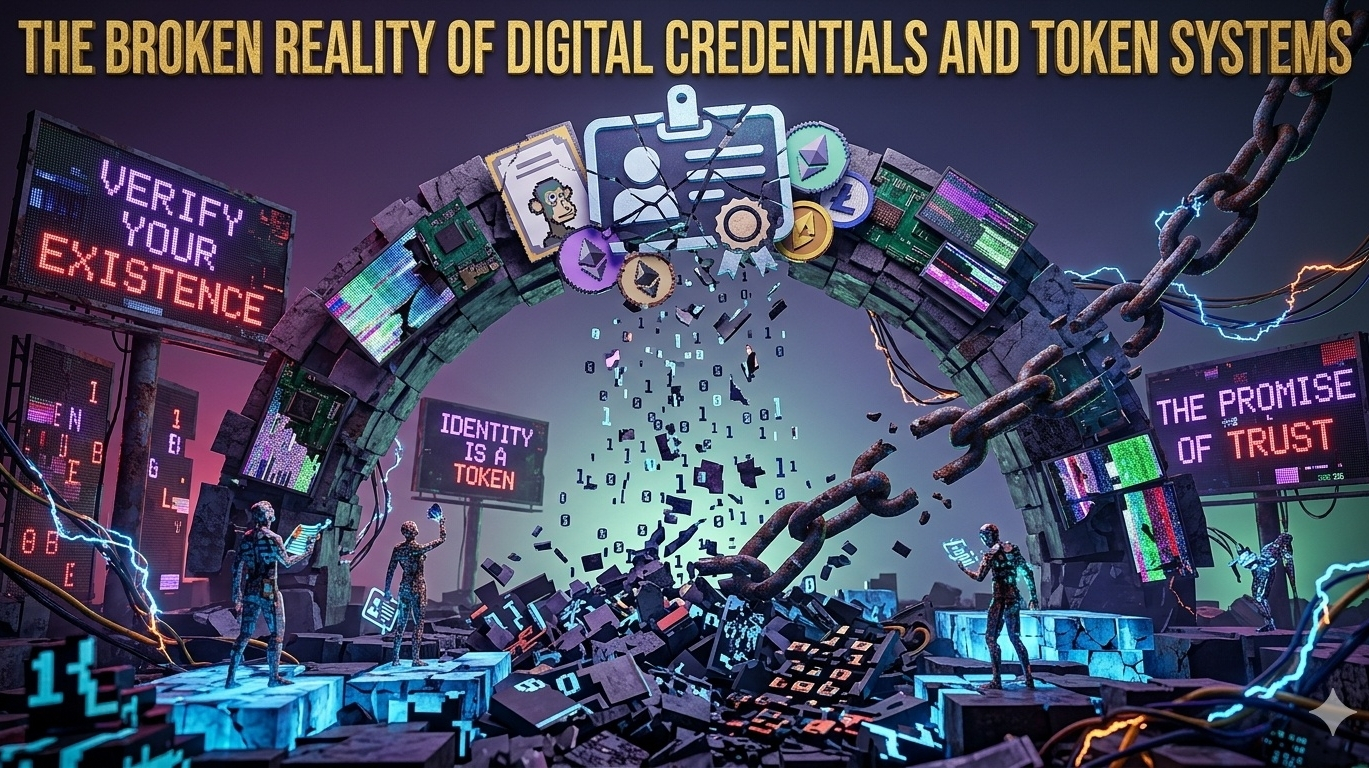

Nothing about this space feels settled. Not even close.
You try to do something basic—prove who you are, show a certificate, verify a skill—and it turns into a whole process. Upload this. Wait for that. Email someone. Try again because something didn’t match. It’s exhausting. And somehow the “solutions” coming out don’t really fix it. They just move the mess around.
Now everything is supposed to be tokens.
Your identity? Token. Your diploma? Token. Your job history? Also a token. Fine. But what does that actually change? You still need someone to issue it. You still need someone to accept it. The middle part just got more complicated.
And people act like decentralization solves everything. It doesn’t.
You still have trust, just hidden differently. Instead of trusting one institution, now you trust a bunch of systems, standards, and whoever wrote the code. You trust that the wallet works. That the network is stable. That the keys don’t get lost. That the format won’t be outdated in two years. It’s just more things to worry about.
And keys… yeah, that whole thing is a nightmare.
Lose your keys, lose your access. That’s it. No reset button. No support ticket. For regular users, that’s not acceptable. People forget passwords every day. That’s normal. Building a system that assumes perfect behavior is just asking for failure.
Then there’s the issue nobody really wants to deal with—revocation.
Say someone gets a credential. Later it turns out it shouldn’t have been issued. Or it expires. Or the institution changes its rules. What happens then? If everything is permanent, that’s a problem. If it’s not permanent, then what was the point of making it “tamper-proof”?
It’s always this trade-off, and no one has a clean answer.
And honestly, the token angle makes things worse sometimes.
The second you attach value to something, people start gaming it. They chase credentials not to learn, but to collect. They optimize for the system, not the skill. We’ve seen this before with traditional certificates. Now it’s just faster and easier to exploit.
Add incentives, and it gets messy real quick.
Also, not everything needs to be transferable. That’s another weird assumption. Some things should stay tied to a person. But then you have to enforce that. And enforcing anything in a decentralized setup gets complicated fast.
And let’s talk about the constant proving.
If verification becomes instant and easy, platforms will start asking for it all the time. “Prove this.” “Verify that.” It won’t stop at important things. It’ll creep into everything. And suddenly you’re signing requests all day just to exist online. That’s not convenience. That’s friction in a different form.
Interoperability is another headache.
Everyone says their system will connect with others. In reality, nothing lines up properly. Different formats. Different rules. Different assumptions. You end up needing bridges, adapters, workarounds. And those break. All the time.
So instead of one clean global system, you get fragments.
And the user experience? Still rough.
People don’t want to think about wallets or signatures or recovery phrases. They just want to log in, show what they need, and move on. If your system needs a tutorial, you’ve already lost most users.
But yeah, there is a real need here.
Right now, proving things across borders is slow and unreliable. Employers don’t trust foreign credentials. People fake documents. Verification takes forever. That part is broken, no argument there.
And yes, cryptographic proofs can help. Being able to verify something instantly without calling the issuer—that’s actually useful. That’s the part that makes sense.
But everything around it? Still messy.
People are building like the world is clean and predictable. It’s not. People mess up. Data changes. Organizations disappear. Systems need to handle that. Not ignore it.
Right now it feels like we’re overengineering the solution while the basics are still shaky.
And the hype just makes it worse.
Every project claims it’s fixing identity forever. Every pitch sounds the same. Meanwhile, regular users still struggle with simple stuff. That gap is hard to ignore.
What we’ll probably end up with is not some perfect global infrastructure. It’ll be a bunch of systems that kind of work together. Sometimes. On a good day.
Messy, patched, constantly updated.
Honestly, that’s fine. That’s realistic.
Just drop the hype. Stop pretending it’s solved. Focus on making small things actually work. Make it simple. Make it reliable.
Because right now, it’s neither.
THE BROKEN REALITY OF DIGITAL CREDENTIALS AND TOKEN SYSTEMS
Nothing about this space feels settled. Not even close.
You try to do something basic—prove who you are, show a certificate, verify a skill—and it turns into a whole process. Upload this. Wait for that. Email someone. Try again because something didn’t match. It’s exhausting. And somehow the “solutions” coming out don’t really fix it. They just move the mess around.
Now everything is supposed to be tokens.
Your identity? Token. Your diploma? Token. Your job history? Also a token. Fine. But what does that actually change? You still need someone to issue it. You still need someone to accept it. The middle part just got more complicated.
And people act like decentralization solves everything. It doesn’t.
You still have trust, just hidden differently. Instead of trusting one institution, now you trust a bunch of systems, standards, and whoever wrote the code. You trust that the wallet works. That the network is stable. That the keys don’t get lost. That the format won’t be outdated in two years. It’s just more things to worry about.
And keys… yeah, that whole thing is a nightmare.
Lose your keys, lose your access. That’s it. No reset button. No support ticket. For regular users, that’s not acceptable. People forget passwords every day. That’s normal. Building a system that assumes perfect behavior is just asking for failure.
Then there’s the issue nobody really wants to deal with—revocation.
Say someone gets a credential. Later it turns out it shouldn’t have been issued. Or it expires. Or the institution changes its rules. What happens then? If everything is permanent, that’s a problem. If it’s not permanent, then what was the point of making it “tamper-proof”?
It’s always this trade-off, and no one has a clean answer.
And honestly, the token angle makes things worse sometimes.
The second you attach value to something, people start gaming it. They chase credentials not to learn, but to collect. They optimize for the system, not the skill. We’ve seen this before with traditional certificates. Now it’s just faster and easier to exploit.
Add incentives, and it gets messy real quick.
Also, not everything needs to be transferable. That’s another weird assumption. Some things should stay tied to a person. But then you have to enforce that. And enforcing anything in a decentralized setup gets complicated fast.
And let’s talk about the constant proving.
If verification becomes instant and easy, platforms will start asking for it all the time. “Prove this.” “Verify that.” It won’t stop at important things. It’ll creep into everything. And suddenly you’re signing requests all day just to exist online. That’s not convenience. That’s friction in a different form.
Interoperability is another headache.
Everyone says their system will connect with others. In reality, nothing lines up properly. Different formats. Different rules. Different assumptions. You end up needing bridges, adapters, workarounds. And those break. All the time.
So instead of one clean global system, you get fragments.
And the user experience? Still rough.
People don’t want to think about wallets or signatures or recovery phrases. They just want to log in, show what they need, and move on. If your system needs a tutorial, you’ve already lost most users.
But yeah, there is a real need here.
Right now, proving things across borders is slow and unreliable. Employers don’t trust foreign credentials. People fake documents. Verification takes forever. That part is broken, no argument there.
And yes, cryptographic proofs can help. Being able to verify something instantly without calling the issuer—that’s actually useful. That’s the part that makes sense.
But everything around it? Still messy.
People are building like the world is clean and predictable. It’s not. People mess up. Data changes. Organizations disappear. Systems need to handle that. Not ignore it.
Right now it feels like we’re overengineering the solution while the basics are still shaky.
And the hype just makes it worse.
Every project claims it’s fixing identity forever. Every pitch sounds the same. Meanwhile, regular users still struggle with simple stuff. That gap is hard to ignore.
What we’ll probably end up with is not some perfect global infrastructure. It’ll be a bunch of systems that kind of work together. Sometimes. On a good day.
Messy, patched, constantly updated.
Honestly, that’s fine. That’s realistic.
Just drop the hype. Stop pretending it’s solved. Focus on making small things actually work. Make it simple. Make it reliable