

Once, I wanted to send $100 in ETH to a friend. The transaction was seamless—fast, trustless, and immutable. We’ve already perfected moving value across the globe without needing a bank to say "it's okay."
But as we were talking, my friend asked me a question that stopped me cold: "Value is easy, but how do we move Truth?" That’s when he told me about SIGN Protocol.
In our current Web3 world, we still have a massive trust gap.
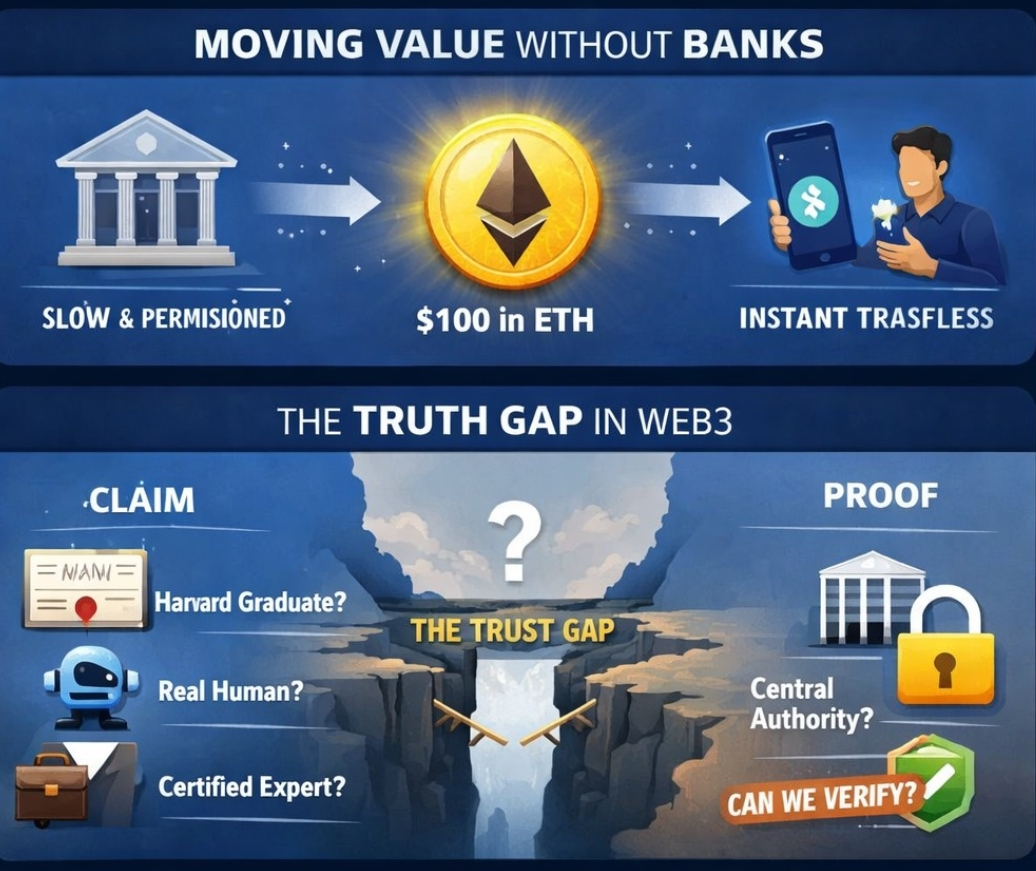
If a founder claims they have a Harvard degree, or a DAO voter claims they are a real human and not a bot, how do we prove it? Until now, we’ve had to run straight back to centralized gatekeepers, which completely defeats the point of decentralization.
This is where the "Don't Trust, Verify" mantra usually hits a wall—and it’s exactly why SIGN Protocol was built. It is the "Truth Layer" that finally allows us to move verified facts as easily as we move money.
Bridging the Truth Gap
To build a global, decentralized society, we need a tamper-proof way to verify data that lives outside a specific smart contract. SIGN Protocol solves this by turning raw data into a standardized, cryptographic attestation.
An attestation is more than a digital stamp; it’s a verifiable certificate anchored to the blockchain. It makes any claim—from a credit score to a professional certification—immutable and audit-ready, without requiring a central authority to vouch for it every single time.
How the Magic Happens: The Four Pillars
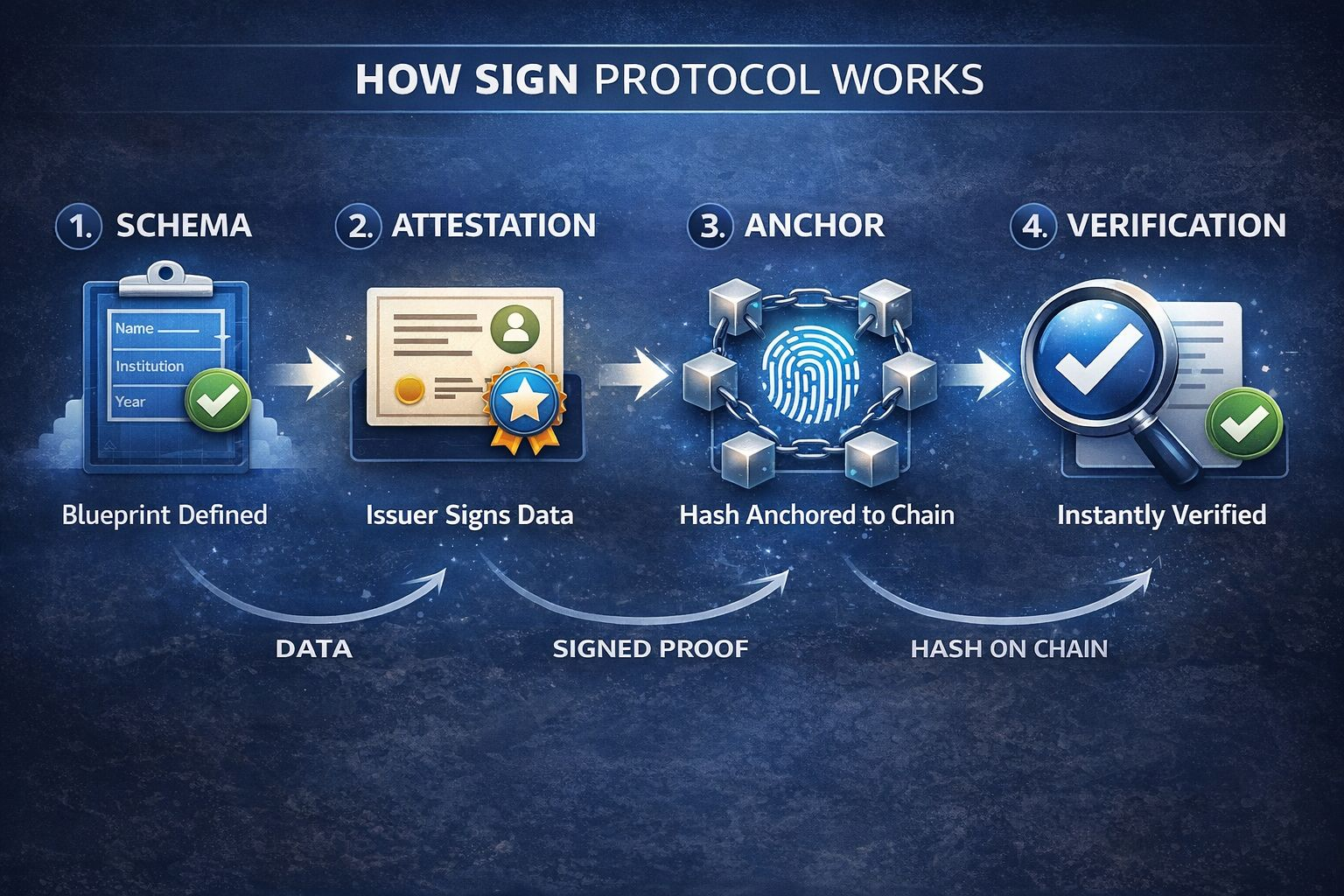
When we look at how SIGN works under the hood, it boils down to a seamless four-step lifecycle:
The Schema: First, we define the "blueprint." Before you can attest to a degree, the protocol needs a format: Name, Institution, Year. The SIGN Schema Registry creates this universal standard so different apps can "speak" the same language of truth.
The Attestation: An issuer (like a university or a government body) uses that schema to make a claim. They sign this data with their private key, essentially saying, "I vouch for this fact."
The Anchor: To stay efficient, SIGN doesn’t store the entire file on-chain. Instead, it creates a cryptographic "hash"—a digital fingerprint. This fingerprint is anchored to the blockchain, creating a permanent, tamper-proof pointer.
The Verification: This is the "aha" moment. When a third party needs to check that data, they query the protocol. SIGN matches the fingerprint against the anchored version and verifies the signature in milliseconds. You don't have to "trust" the person; you trust the math.
Why "Omni-Chain" is the Game Changer
The real genius of SIGN lies in its Omni-Chain capability. A verification on Ethereum is useless if you need to prove your identity to an app on Solana or TON.
Most protocols are silos. SIGN, however, uses decentralized relayers to synchronize these proofs across multiple blockchains. This means you can create your "Verified Human" attestation once, and it travels with you across the entire Web3 ecosystem. Your identity becomes sovereign—owned by you, but recognized everywhere.
The Future of Verification
Web3 has conquered money. Now, it is time to conquer infrastructure. We are building the systems for global finance, decentralized governance, and AI-human collaboration. To succeed, we must move away from "Don't be evil" and toward "Can't be evil."
SIGN Protocol provides the architecture for this shift. By transforming raw data into unified, cross-chain truths, it provides the missing piece of the puzzle: a universal layer of trust for a decentralized world.