

#SignDigitalSovereignInfra @SignOfficial $SIGN
i think i was placing the decision in the wrong place again. like i kept assuming it lives somewhere stable, somewhere you can point at later and say there, that’s where it was decided. but the more i follow a flow inside Sign, the more that idea just falls apart, because the system doesn’t keep a decision alive. it burns it. fast. almost too fast to notice.
you start before Sign, obviously. some institution, some issuer, some authority deciding this counts. but that part is messy, always messy. people delay things, conditions change halfway, someone overrides something quietly, something passes that shouldn’t, something fails that probably should’ve gone through. that whole layer feels alive, uncertain, negotiable.
then it reaches the point where it can even become attestation input, and that’s where the narrowing starts.
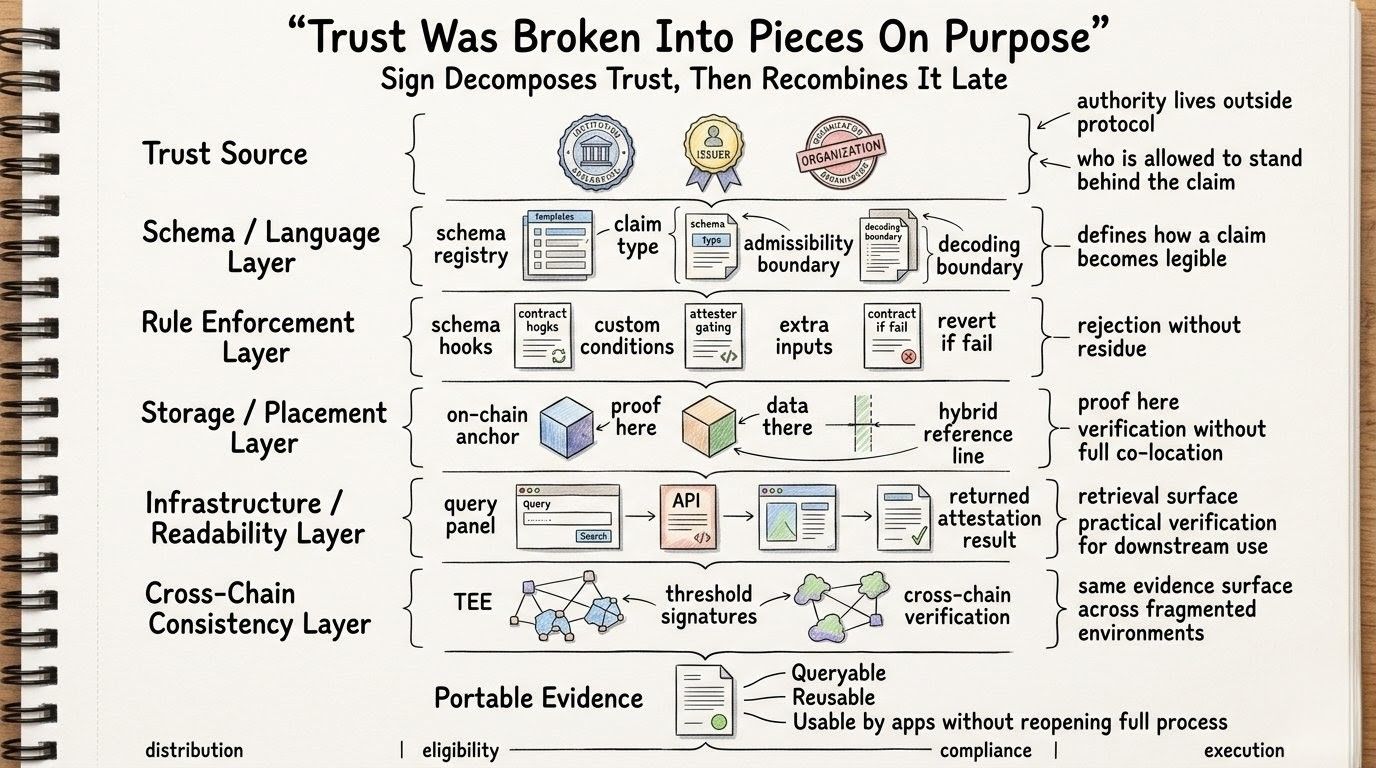
on sign, i used to think schema is just structure, formatting, harmless. but it’s not. it decides what is even allowed to exist here. not valid or invalid. exist or not exist. and already something gets cut away. things that don’t fit just never appear. not rejected exactly. just invisible.
that matters more than it looks like, because hook never gets to judge the whole world. it only gets to judge what schema already allowed into attestation form.
and this is where i think everything actually happens. not later. not in the app. not in SignScan. here. right here.
but it doesn’t feel big when you look at it. it’s just logic. checks. permissions. thresholds. maybe a zk proof, maybe a whitelist, maybe a payment condition. whatever the schema allows to run.
and it runs once.
just once.
no retries. no reconsideration. no “wait, let’s check again in a different context.” one execution under one exact hook-time state, one execution context, and that’s it.
and i keep coming back to this question: is this the only moment the system can still say no?
because after this, what happens?
attestation gets emitted and everything changes. quietly, but completely.
before hook-time inside sign, the stack is active. schema can exclude. hook can reject. the sign system can still block attestation emission. after hook-time, it can’t do anything like that anymore. it just holds emitted state, returns it, surfaces it, moves things forward. but it doesn’t evaluate anymore.
“after hook-time, the stack stops evaluating and starts returning.”
that line feels too simple but i can’t shake it, because nothing downstream challenges that execution context. SignScan doesn’t. it just shows what already exists. the query layer doesn’t. it just returns emitted attestation state. TokenTable doesn’t. it just reads and executes. EthSign doesn’t. it just anchors flow based on what’s already there.
no one goes back. no one asks should this still pass, would this still hold now, did something change.
nothing like that.
everything after is just acceptance infrastructure.
and that’s where it starts to feel strange, because the most important moment in the entire flow is the one nobody later participates in. nobody downstream was there. not the app, not the user, not even the systems that depend on it.
they all arrive after.
late.
always late.
so what exactly are they trusting? the attestation, or the fact that at some earlier moment, under some specific hook-time conditions, the hook didn’t say no?
“everything depends on a moment nobody can revisit.”
that’s the part that sits weird, because if something feels wrong later there’s nowhere to go. you can’t re-run the hook. you can’t reconstruct the exact execution context. you can’t re-create the exact conditions.
that moment is gone.
completely gone.
and maybe that’s necessary, because if every sign system had to re-evaluate everything, nothing would move. everything would stall, infinite loops of checking, no finality, no progress. so the sign system chooses something else. it compresses decision into one point, one execution, one pass or fail, and then freezes it into emitted attestation state.
but that creates this sharp edge between before and after.
before, uncertainty.
after, fixed reference.
no bridge between them.
and i keep asking myself, what if the hook ran under slightly different conditions? what if timing changed? what if authority changed? what if inputs shifted just a bit? would the result be the same?
we don’t know.
we can’t know.
because the stack no longer re-evaluates after emission.
it only cares that it did pass, not whether it would pass again.
past tense.
everything is past tense.
“validity is locked to a moment, not a condition.”
and that changes how i see everything downstream, because apps aren’t interacting with something alive. they’re interacting with something that already ended, already finalized, already decided somewhere else. they’re not part of the decision. they’re inheriting emitted attestation state from prior hook-time execution.
and that inheritance feels clean on the surface, but underneath it’s carrying something frozen, something tied to a state that no longer exists.
so what are we actually building here? a system of verification, or a system of remembered hook-time decisions?
and maybe that’s the real shift. Sign doesn’t keep verification alive. it finishes it quickly, isolates it inside hook-time, emits an attestation, and then everything else just builds on that without ever going back. SignScan can surface it. the query layer can return it. TokenTable and EthSign can execute on it. none of them can reopen the execution context that made it pass.
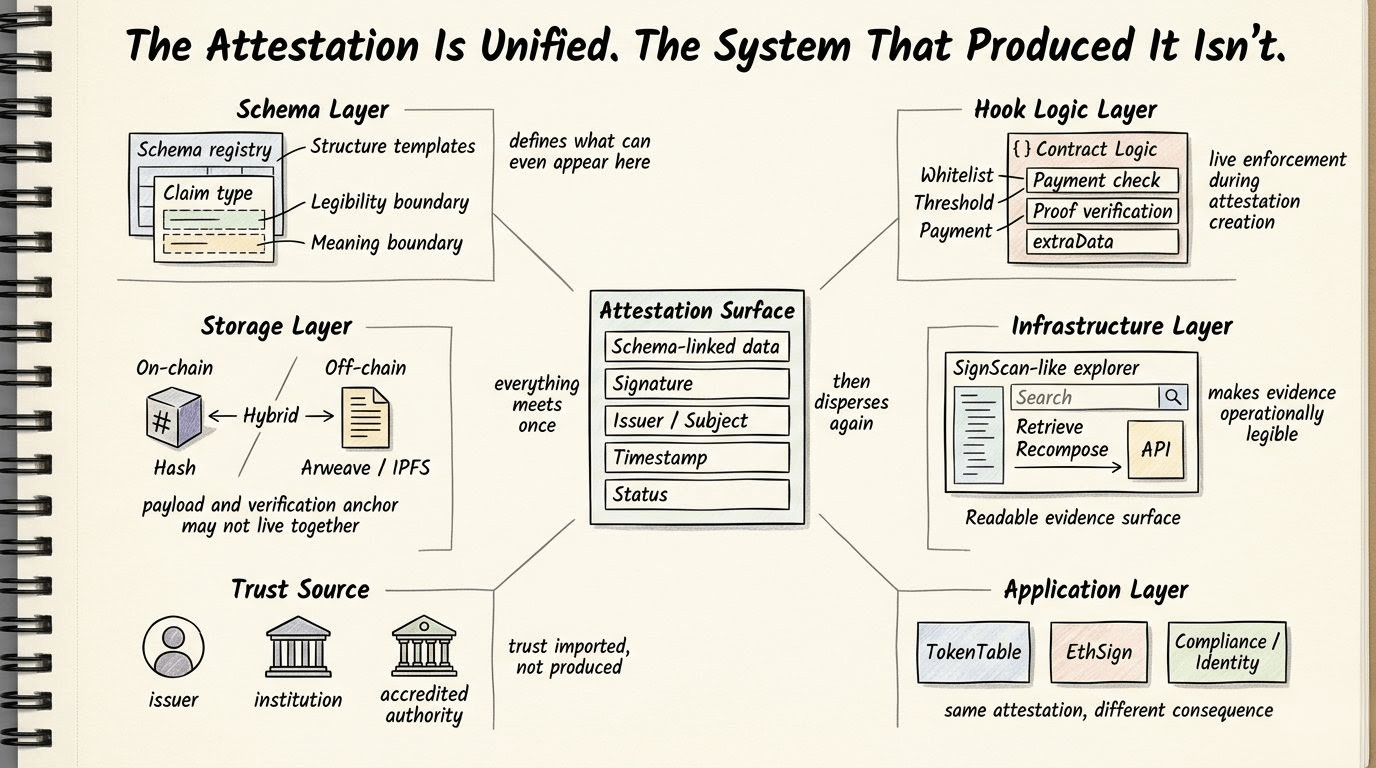
“the sign system only has one chance to say no.”
and if that’s true, then that moment is doing way more work than it looks like. more than the attestation. more than the app. more than the interface.
everything depends on that single execution.
and nobody sees it clearly, nobody interacts with it directly, nobody can revisit it later. it just happens and then disappears, leaving behind something that feels stable but came from a moment that was anything but.
and maybe that’s the part i can’t stop thinking about. not that the system works like this, but that the only real decision point is also the one that vanishes immediately after it happens.
like the stack makes up its mind and then discards the active decision context, leaving only emitted state behind.
SignScan can surface that state.
the query layer can return that state.
TokenTable and EthSign can consume that state.
but none of them can ask the original moment to speak again.
and everything else just lives with that, without ever being allowed to ask again:
would you still say yes now?