Last week, I had a conversation with my friend Ali.
He runs a small import business in Karachi. Nothing huge, just steady work. But the way he described moving money across borders… it stayed with me.
Sometimes transfers take days.
Sometimes they get delayed for no clear reason.
Sometimes the fees don’t even make sense.
And on top of that, there’s constant pressure to provide more documentation.
Proof. Statements. Explanations.
At the same time, he doesn’t want his entire financial life exposed.
That’s the contradiction.
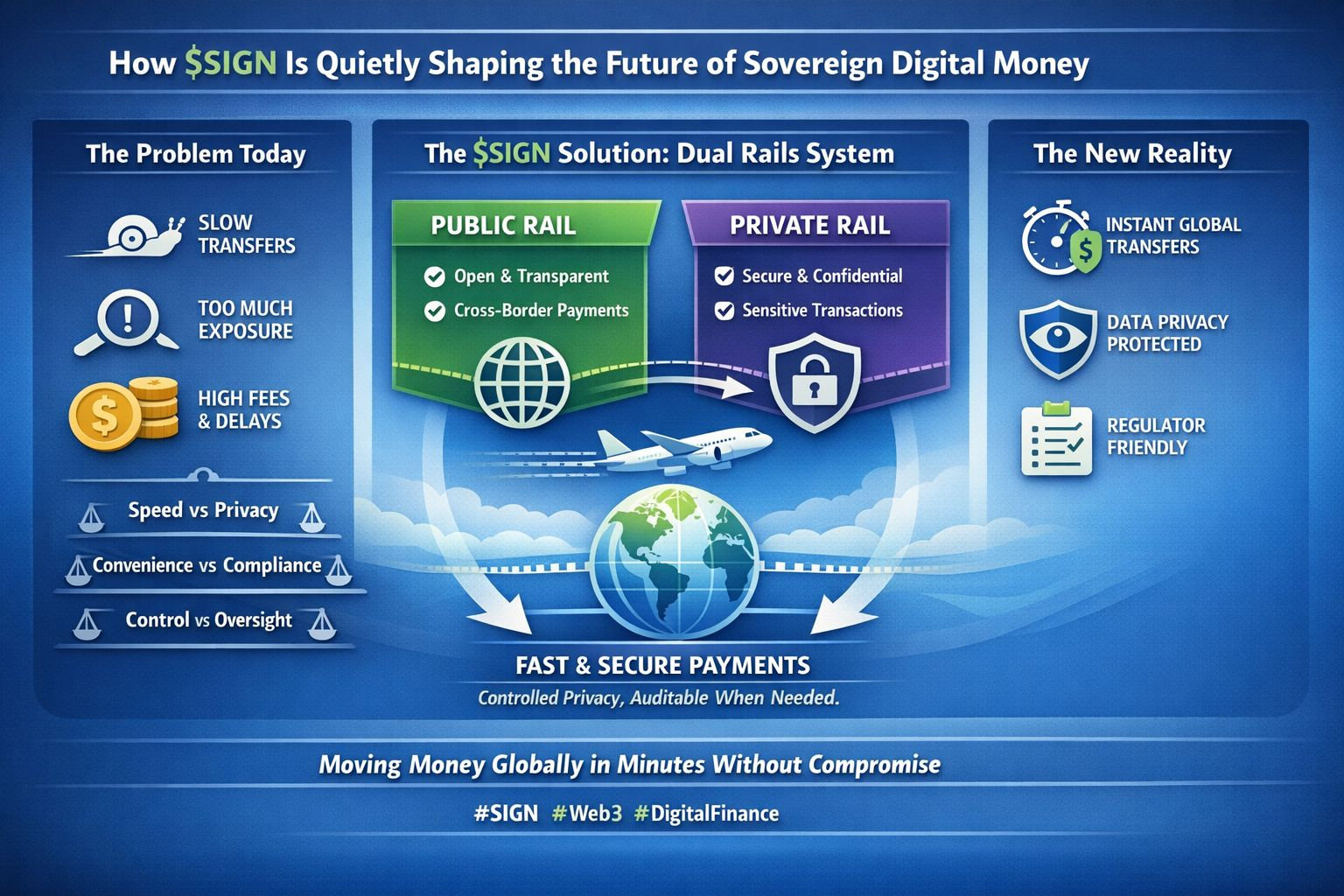
The Problem Nobody Has Solved Properly
Ali’s situation isn’t unique.
It’s the reality for millions of people:
Small business owners
Freelancers
Online sellers
Cross-border workers
They all live in the same tension:
Speed vs control
Privacy vs compliance
Convenience vs oversight
You either get fast systems that expose too much…
Or private systems that don’t scale and don’t satisfy regulators.
There’s no real balance.
Another Story, Same Friction
A few days later, I spoke to Sara.
She runs an online store.
She told me how she tried to pay an international supplier recently.
What should have been simple turned into:
Multiple verification steps
Delays
Back-and-forth communication
Hours lost… just to move money.
Not because the system can’t do it.
But because the system doesn’t trust itself.
Where $SIGN Starts to Feel Different
This is where $SIGN caught my attention.
Not as “just another crypto project.”
But as something trying to fix this exact tension.
Instead of forcing one side to win (privacy or regulation), it tries to balance both.
Two Rails, One System
The idea is surprisingly simple.
There are two layers:
A public rail
Transparent
Suitable for cross-border payments
Ideal for open financial activity
A private rail
Permissioned
Designed for sensitive transactions
Suitable for systems like central bank digital currencies
On this private layer:
Transactions remain confidential
But can still be audited when required
That’s the key.
Not hiding everything.
Not exposing everything.
But controlling who sees what, and when.
How It Works in Real Life
Imagine Ali sending money overseas.
Instead of dealing with delays and friction:
The transaction starts on a private system
It converts into a public asset for cross-border settlement
It reaches the recipient quickly
All without exposing unnecessary personal data.
From his perspective?
It just works.
No complexity.
No stress.
The Invisible Infrastructure
What makes this interesting is that most of this happens behind the scenes.
Users don’t need to understand:
Blockchains
Protocols
Infrastructure layers
They just experience:
Faster payments
Lower friction
More control
That’s how real systems succeed.
Not by being visible…
But by being reliable.
Privacy Without Breaking the System
One of the biggest challenges in digital finance is this:
Privacy often conflicts with regulation.
$SIGN approaches it differently.
Using permissioned systems, it allows:
High-volume private transactions
Configurable data access
Auditability when required
So regulators don’t lose visibility.
And users don’t lose control.
That balance is rare.
Why This Feels Practical
A lot of crypto ideas feel theoretical.
This doesn’t.
Because it answers a very simple question:
How does money actually work for people?
For Ali: Less waiting. Less friction.
For Sara: Less complexity. More clarity.
For regulators: More visibility. Better control.
Everyone gets something.
The Bigger Picture
If systems like this scale, the impact goes beyond convenience.
It changes how countries think about money:
Faster economic activity
Better financial inclusion
Stronger trust in digital systems
And most importantly…
It makes digital finance feel human again.
Final Thought
Right now, moving money still feels harder than it should.
Too slow.
Too complicated.
Too dependent on trust that doesn’t always hold.
But that’s starting to change.
SIGN is building a system where:
Payments are fast
Privacy is respected
Regulation is possible
All at the same time.
And if that works…
People like Ali and Sara won’t have to think about infrastructure anymore.
They’ll just see one thing:
Money that finally works the way it should.